

How to Compare Dress Manufacturers Before Placing an Order
A quotation can look clear at the beginning of a dress project. The problems often show up later, when the factory starts working on the sample.
The fabric may behave differently from what was expected. A measurement may need to be adjusted. A construction detail from the reference photo may not work exactly as shown. MOQ, packaging, or production timing can also change the actual cost of the order.
If you are comparing dress manufacturers, it helps to look at how each factory handles these details—not just the first price they send you.
Start With the Product, Not the Factory Price
Before you compare the prices, make sure the factories are quoting the same product.
A supplier may quote for a dress based on a reference photo, while another is pricing the same style from a complete tech pack. The two prices may look comparable on paper even though the information behind them is different.
For a dress project, look at:
- Fabric composition and weight
- Lining
- Garment measurements
- Size range
- Construction details
- Closures and trims
- Printing, embroidery, or embellishment
- Quantity by color and size
- Packaging requirements
A fitted satin dress, for example, cannot always be evaluated in the same way as a loose cotton dress. Fabric behavior affects pattern allowance, sewing, pressing, and sometimes even the order of construction.
When a design comes into our sample room, the first useful question is not simply “How much will this cost?” We need to understand how the garment is supposed to be constructed and which details may affect sampling or bulk production.
Otherwise, you may end up comparing two prices for two slightly different products.
Look for Experience With the Type of Dress You Are Developing
“Dress manufacturer” is a broad description.
A factory may produce large volumes of dresses but have limited experience with the particular construction you need. This matters more when the design includes fitted sections, unusual panels, delicate fabrics, sequins, draping, or detailed finishing.
Instead of asking only whether they make dresses, ask what kinds of dresses they are producing.
- Have they produced the same or a similar silhouette?
- Have they worked with the proposed fabric?
- Can they handle the required size range?
- Have they made similar lining or closure constructions?
- Can they manage embellishment or special finishing?
- Can they provide examples of comparable production?
You do not need a manufacturer that has made your exact dress before. That would be unrealistic for many new designs.
The key question is whether the factory can see the production problems your design may create.
For example, a manufacturer familiar with stretch fitted dresses will normally approach pattern allowance differently from one mainly producing loose woven styles. Experience with similar construction can make sampling easier. The factory already knows where some of the production issues are likely to appear.
Pay Close Attention to the First Sample
The first sample is one of the most useful points of comparison because you are no longer judging a factory from a presentation or quotation.
The first sample tells you how the factory understood your drawings, measurements, fabric and construction details.
Look at the finished sample, but also look at the development process behind it.
Was the measurement sheet followed?
Were the fabric and trims consistent with the specification?
Did the neckline, waist, hip, sleeve, and length measurements match the approved requirements?
If something was wrong, did the manufacturer understand the correction?
A first sample may require changes. That alone is not a problem.
Dress development often involves:
Pattern → First Sample → Fitting → Comments → Pattern Revision → Revised Sample → PP Sample
A revision is normal. What matters is whether the next sample fixes the points you marked.
This is particularly important for fitted dresses. A small change in bust, waist, hip, or shoulder measurement can affect the balance of the whole garment.
Keep the sample comments from each supplier. You will quickly see which factory is simply following instructions and which one is actually helping identify production issues.
Check How the Factory Handles Changes
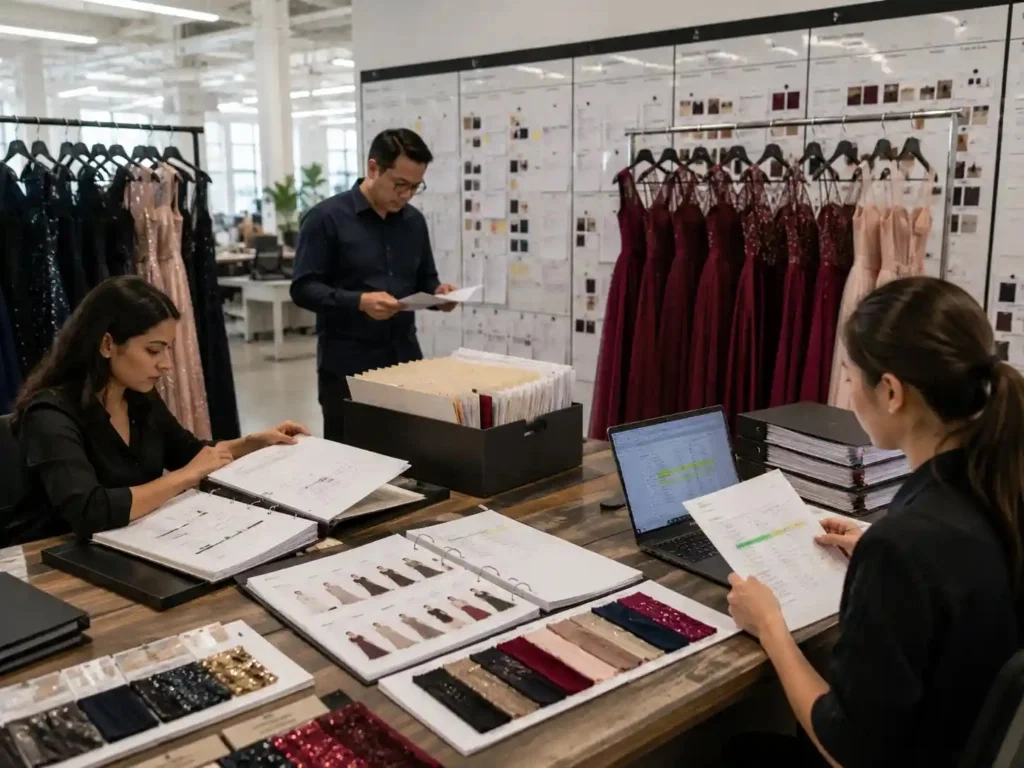
A dress rarely stays exactly the same from the first sketch to the bulk order.
You may change:
- Fabric
- Color
- Length
- Measurements
- Lining
- Sleeve shape
- Closure
- Trim
- Label
- Packaging
The problem usually starts when that change is not carried through to every production document.
The production team needs to know which specification is the latest approved version.
This matters even more when the designer, buyer, and production team are handling different parts of the order. A designer may send a construction change, while a buyer later confirms a different quantity or packaging requirement.
Before bulk production starts, everyone should be working from the same approved information.
Small documentation errors can become expensive once production has started. If the pattern room is working from one measurement sheet and the sewing floor receives another version, the mistake may not become visible until garments are already in production.
You can reduce this risk by asking:
Which documents will be used as the final production reference?
A factory may say it has a good QC system. What you really need to know is which version of the specification the production team is working from.
Compare MOQ With Your Actual Buying Plan
MOQ looks simple until you start placing a real order.
A manufacturer may quote:
MOQ: 100 pieces
But you still need to know:
- Is that 100 pieces per style?
- Per color?
- Per fabric?
- Can sizes be mixed?
- Does custom fabric have a separate MOQ?
- Is the MOQ different for sampling and bulk production?
For a small first order, that difference can change how much stock you need to buy.
Suppose your first collection contains five dress styles and you want relatively small quantities in several colors. A factory that accepts 100 pieces per style may be workable, while another supplier requiring 100 pieces per color could increase your initial inventory considerably.
Fabric can create another MOQ problem.
A factory may accept a small garment order while the fabric mill requires a larger minimum for a custom color. In that situation, the garment MOQ is not the only number you need to consider.
Ask about these requirements before confirming the quotation rather than discovering them after the sample has been approved.
Do Not Compare Unit Prices Until the Specifications Match
This is one of the most common problems when buyers compare several dress manufacturers.
You receive:
- Supplier A: $18.20
- Supplier B: $19.40
- Supplier C: $17.80
At first glance, Supplier C looks cheaper.
But the numbers are not useful until you know what each price includes.
Check the:
- Fabric
- Lining
- Trims
- Labels
- Packaging
- Special finishing
- Embroidery or printing
- Sampling
- Inspection
- Quantity assumptions
Fabric is a good example.
“Polyester satin” can describe fabrics with very different weights, finishes, widths, and hand feel. If one supplier prices a lighter fabric and another uses the specification from your tech pack, the difference is not really a manufacturing price difference.
Packaging is another example.
If one quotation includes individual polybags, branded labels, hangtags, and cartons while another does not, the lower garment price does not tell you which order will actually cost less to complete.
Put “what is included” next to the unit price on your comparison sheet.
Ask How Fabric Is Checked Before Cutting
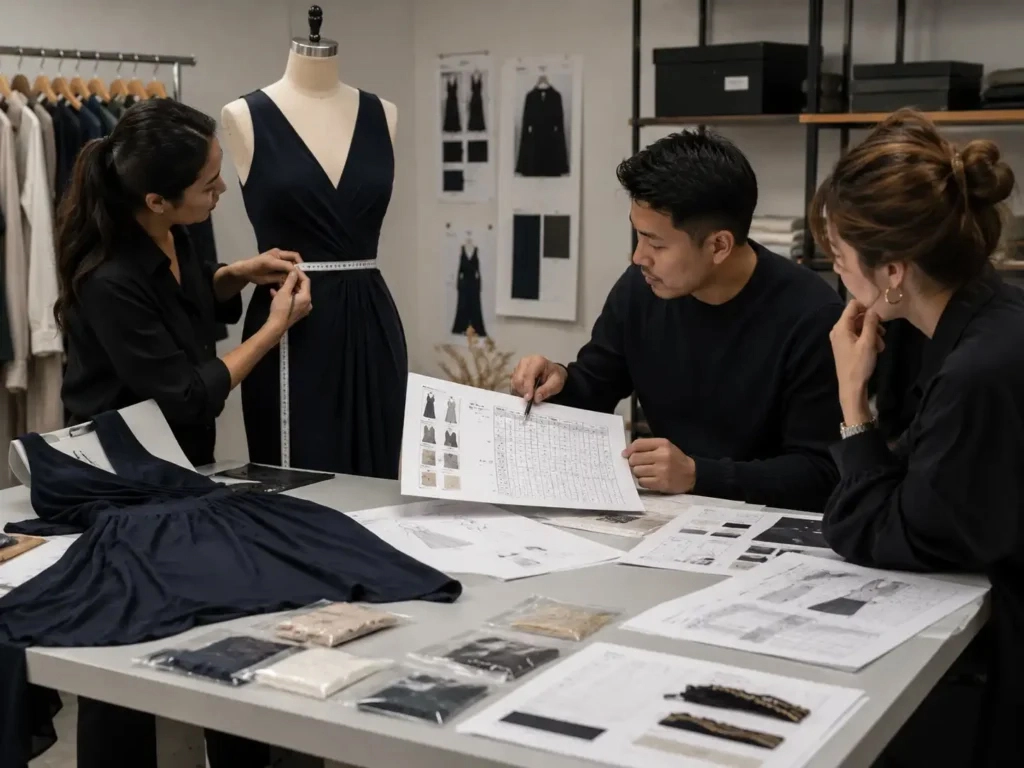
Fabric inspection is easy to overlook because buyers usually see the finished garment rather than the fabric roll.
From the production side, however, fabric can create problems before the first garment is sewn.
Depending on the fabric, the factory may need to check:
- Width
- Shade
- Surface defects
- Shrinkage
- Stretch and recovery
- Weight
- Direction
- Lot consistency
For some fabrics, pre-shrinking or other preparation may also be required before cutting.
A fabric problem found after bulk cutting is much harder to fix.
If the usable fabric width is different from the expected width, the marker may need to be adjusted. If shrinkage is higher than expected, finished measurements can be affected. If different dye lots vary noticeably, the garments may not look consistent across the same order.
Ask what happens to the fabric between arrival at the factory and bulk cutting.
“We have strict QC” does not tell you much by itself. Ask what the factory actually checks before the fabric reaches the cutting table.
Understand What Happens Between the Approved Sample and Bulk Production
The approved sample becomes the production reference. The next challenge is reproducing the same details across the bulk order.
You should ask how the manufacturer transfers the approved details into production.
A typical process may involve:
Approved Sample → Pattern Confirmation → Fabric Preparation → Bulk Cutting → Sewing → Inline Inspection → Pressing → Final Inspection → Packing
Each stage has its own failure points.
Cutting affects panel accuracy. Sewing affects measurements and seam construction. Pressing and packing can change how the finished garment looks when it reaches the customer.
Ask where inspections happen rather than simply asking whether the factory performs QC.
Inline checks are useful because problems can be identified while production is still running. If a recurring sewing issue is discovered only during final inspection, correcting it may require rework across a much larger quantity.
The exact inspection process will vary by product, but you should know where the important checks take place.
Compare Lead Time From the Same Starting Point
“Production takes 25 days” sounds clear until you ask when those 25 days begin.
One manufacturer may count from fabric arrival.
Another may count from PP sample approval.
Another may start after the purchase order and all materials are confirmed.
So “25 days” does not mean the same thing from one factory to another.
Ask:
What needs to be completed before bulk production starts?
Then confirm:
- Fabric approval
- Trim availability
- Final pattern
- PP sample
- Quantity confirmation
- Packaging details
- Purchase order
For a seasonal collection, the timeline includes much more than the sewing days.
A practical schedule may look like:
Sample Development → Fit Revision → PP Approval → Fabric Preparation → Bulk Production → Final Inspection → Shipment
If you only allow 25 days from the date you send the purchase order, but the factory cannot start bulk production until fabric and PP approval are completed, your launch date may be later than expected.
Check Whether the Factory Can Support Your Expected Volume
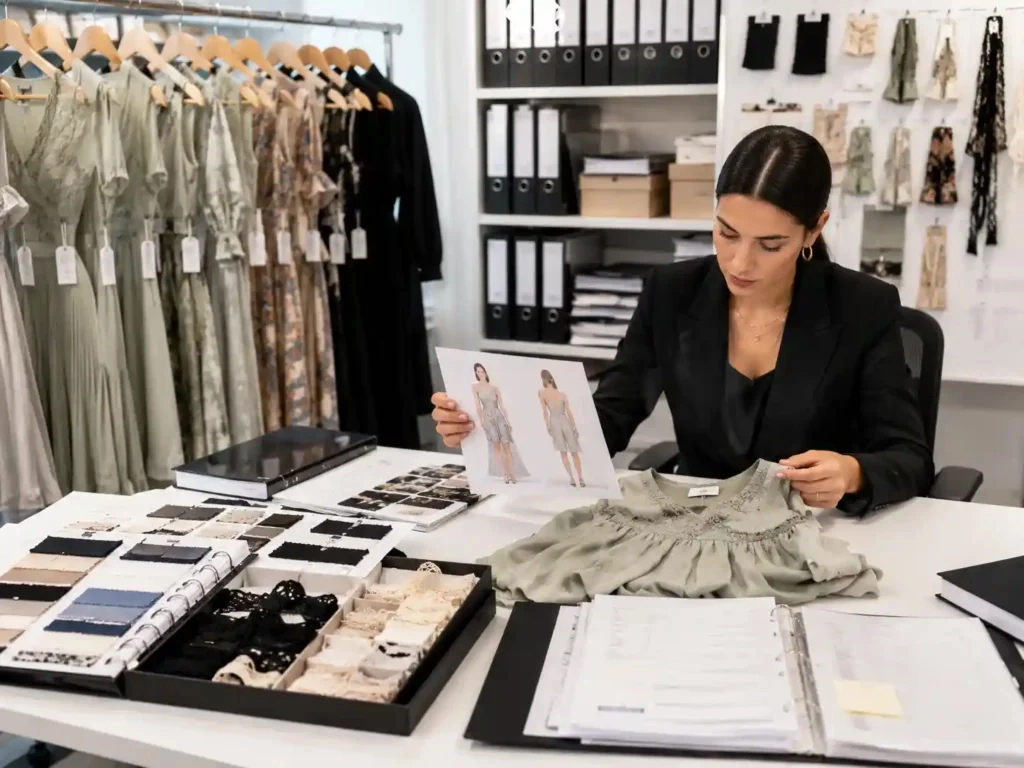
A factory’s monthly capacity does not tell you much unless you know what it means for your order.
A very large factory may be suitable for a high-volume program, but a growing fashion brand may need a manufacturer that can also manage smaller runs, several styles, and repeat orders.
Ask about:
- Approximate monthly capacity
- Similar styles currently produced
- Sewing line availability
- Peak-season scheduling
- Capacity for repeat orders
- Ability to increase quantities later
If you expect one style to become a core product, ask what happens when you need another production run.
The first order shows whether the factory can make the garment. A repeat order is a different test: can the same style be reproduced consistently?
Check Private Label Details Before Production Starts
For private label brands, the dress is only part of the finished product.
Your order may also include:
- Brand labels
- Size labels
- Care labels
- Hangtags
- Barcodes
- Custom polybags
- Cartons
- Other packaging materials
Confirm these items before bulk sewing and packing. Changing them at the end is much harder.
For example, a label position may seem minor during sampling but become difficult to change once bulk sewing has started.
The same applies to packaging. If your retailer requires a specific barcode format or folding method, the production team needs that information before packing begins.
Do not stop at “Do you offer private label?” Ask how labels, tags and packaging are documented and controlled during production.
Pay Attention to the Questions the Manufacturer Asks You
When you contact factories, pay attention to the questions they ask you—not only the answers they give.
If you send a complicated dress and the factory immediately asks about fabric composition, lining, measurements, construction, quantity, or finishing, that can be useful.
Those questions show that the factory is looking at the design from a production point of view.
On the other hand, if a quotation is issued without clarifying important details, you may need to confirm what assumptions were made.
In our production work, unclear information is usually easier to solve before sampling than after fabric has been cut. A short clarification at the beginning can prevent several rounds of correction later.
Build a Comparison Sheet Before You Choose
Once you have contacted several manufacturers, put their information into the same table.
| Comparison Point | Manufacturer A | Manufacturer B | Manufacturer C |
|---|---|---|---|
| Similar product experience | |||
| Fabric capability | |||
| MOQ per style/color | |||
| Sample development | |||
| Revision process | |||
| Quotation scope | |||
| Fabric inspection | |||
| Bulk QC | |||
| Bulk lead time | |||
| Private label | |||
| Packaging | |||
| Repeat-order capability |
Do not turn the table into a simple scoring exercise too early.
First record the actual differences.
For example, one manufacturer may have a slightly higher quotation but include more packaging or use the exact fabric specification you requested. Another may offer a lower price but require a larger fabric minimum.
Once the differences are written down, your team can discuss the actual trade-offs instead of debating three different prices.
What Information Should You Send Before Requesting a Quote?
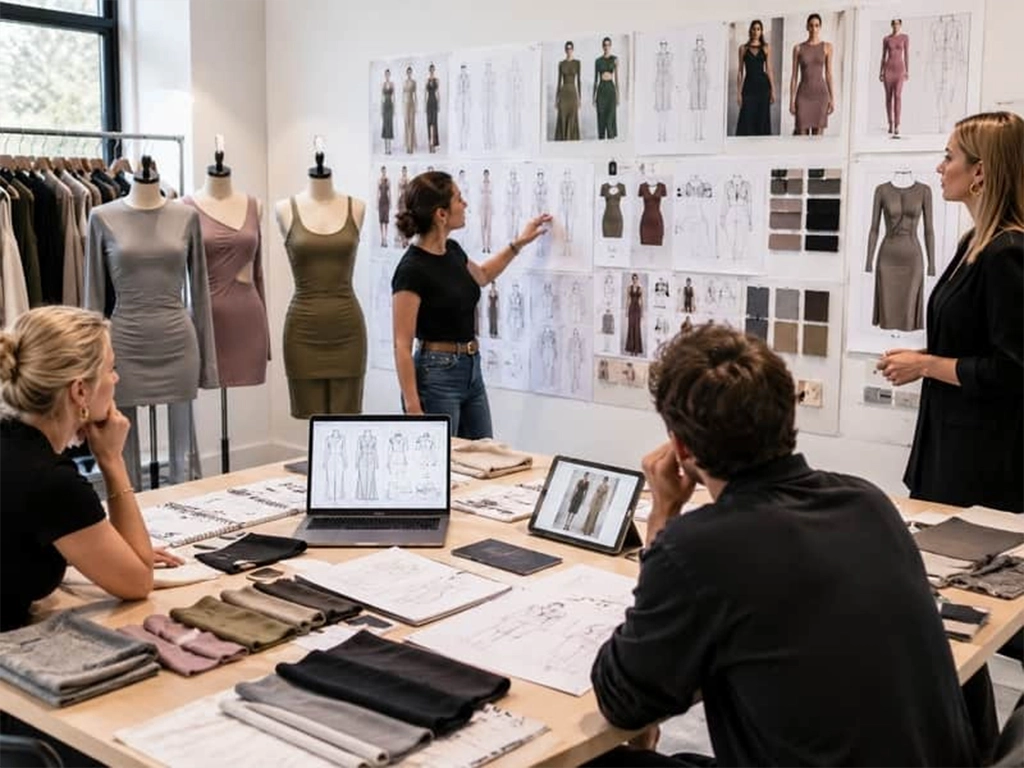
A manufacturer can give you a much more useful response when the basic product information is clear.
For an initial quotation, try to provide:
- Reference images or sketches
- Tech pack, if available
- Measurements
- Fabric requirements
- Color
- Size range
- Estimated quantity
- Labels
- Packaging requirements
- Target delivery date
If the fabric is undecided, say so.
If the quantity is an estimate, give a range.
If the construction is still being developed, explain which parts are fixed and which can change.
This is more useful than sending a reference image with only the message:
“Please quote.”
The manufacturer can then tell you which missing details are likely to affect the price or sampling process.
A Better Way to Make the Final Comparison
By this stage, the comparison should cover more than price:
- Design interpretation
- Fabric capability
- Sample development
- Revision handling
- MOQ
- Quotation scope
- Bulk production
- QC
- Private label
- Repeat orders
Then compare those points against what your order actually requires.
The priorities will depend on the order. A startup may need smaller quantities and more sampling support, while a retailer may focus more on delivery and packaging. For a larger brand, repeat-order capacity may matter more.
Focus on the production factors that could affect your order, and confirm them before committing to bulk production.
FAQ
Is it better to start with a manufacturer or a sourcing agent?
If you already have a tech pack and can communicate directly with the factory, you may not need an agent for the manufacturing side. If your specifications are still unclear or you need help coordinating different suppliers, an agent may have a different role.
What if a manufacturer cannot give an exact price from my reference image?
That is normal for many early-stage designs. A reference image may show the appearance without specifying fabric weight, lining, measurements, trims, or construction. Ask the factory which missing details affect the quotation most. Confirm those details before using the quotations to compare suppliers.
Should the same fabric be used for sampling and bulk production?
Ideally, the approved sample should represent the material that will be used for bulk production, especially when fabric behavior affects fit or appearance. If the sample uses a substitute fabric, ask how the bulk fabric differs and whether another approval is needed before cutting the order.
What happens if the final quantity changes after the quotation?
Ask the manufacturer how price breaks work before confirming the order. A change from 100 to 500 pieces can affect fabric purchasing, labor allocation, packaging, and sometimes the unit price. Confirm the new price before production starts. Do not assume the original unit price will stay the same.
How can you tell whether a manufacturer understands a complicated design?
Look at the questions they ask before sampling. If the factory asks about construction, fabric behavior, measurements, lining or finishing before sampling, that is useful information. It shows they are looking at how the garment will actually be made.
Conclusion
A dress manufacturer should be compared on more than the first quotation.
Look at the sample, the fabric, the MOQ, the production timeline, the QC process, and the private label details. More importantly, check what happens when something changes during development.
Keep the same specifications when you compare quotations, and write down what each price includes. That makes it much easier to see where the actual differences are before you place a bulk order.
For a new fashion brand, the cheapest quotation may not be the most useful one if the MOQ, sampling process, fabric requirements, or production schedule do not fit the project.
Related Dress Manufacturing Services
If you are developing a specific dress style, the same manufacturing process applies to fabric selection, pattern development, sampling, fit approval and bulk production. You can also explore our product-specific manufacturing pages below.
At Xiuyu Apparel, we work with fashion brands, startups, designers, and private label companies from sample development through bulk production.
- Silk Dress Manufacturer
- Party Dress Manufacturer
- Off Shoulder Dress Manufacturer
- Chiffon Dress Manufacturer
- Mesh Dress Manufacturer
Get a Clothing Manufacturing Quote Based on Your Design
If you already have a garment design, send us the product photo, tech pack, or reference sample together with your target quantity.
As a dress manufacturer, we can review the fabric, lining, construction, trims, and finishing requirements before preparing the quotation.

