

When you develop a dress with a clothing manufacturer, some of the product information you need later is created during the first few stages of production. Fabric composition, material references, supplier documents, approved samples, and production details can easily end up in different emails or files. If you wait until the finished order to organize them, it becomes much harder to confirm what was actually used. Keep those records with the same style from sampling through bulk production. When the style is reordered months later, the factory and your product team should be able to identify the approved fabric and sample version without searching through old emails.
Why Does Your Clothing Manufacturer Have a Role in DPP Data?
A clothing brand normally owns the product concept, style number, specifications, and selling information. The manufacturer works with another part of the picture: the materials and production process used to turn that specification into a finished garment.
For a dress order, you may know the fabric as:
“black stretch satin”
The factory needs more than that to produce the garment. There may be a specific fabric supplier, composition, weight, width, finish, color reference, and material lot behind the description.
- Main fabric
- Lining
- Zipper
- Buttons
- Elastic
- Labels
- Interfacing
- Packaging materials
Not all of these records will come from the same company. The fabric supplier may hold the material documents, the clothing manufacturer may keep the production records, and your team may control the final product specifications.
So instead of asking only, “Does my factory support DPP?”, ask whether the manufacturer can provide product and production records that can be traced back to the materials and approved specifications used for the order.
A better question is:
“Can my manufacturer give me clear product and production information that can be traced back to the materials and approved specifications used for my order?”
The European Commission has identified textiles and apparel as a priority product group for future Digital Product Passport requirements under the Ecodesign for Sustainable Products Regulation. The detailed textile-specific requirements are still being developed, so brands should distinguish current requirements from information that may become required later.
What Information Should You Collect From Your Clothing Manufacturer?
The exact data will depend on the garment and the market where it is sold. From the factory side, the practical approach is to start recording the main materials and specifications during development, then update the file when something changes.
1. Product Identification
The product file should clearly identify the garment and its production version. This normally includes:
For example:
- Style number
- Product name
- Color
- Size range
- Version or revision
- Purchase order
- Approved sample reference
A clear style number becomes more important once the design goes through several revisions.
Take a satin dress that went through a lining change and a neckline adjustment before bulk production.
If the factory file only says “Satin Dress 2026,” you may have to work backward through emails to find the correct version.
A clear style number and approved specification make that much easier.
2. Fiber Composition
For apparel, fiber composition is one of the first details to confirm.
Instead of keeping only a general description such as:
Polyester satin
your product file should identify the actual composition supplied for the approved fabric.
For example:
- 100% polyester
- 95% polyester / 5% elastane
- 70% cotton / 30% linen
The recorded composition should match the fabric that actually went into bulk production.
Problems often appear when the fabric changes after sampling. A substitute may look almost identical but have a different composition or performance.
The European Commission has identified fibre composition as one category of information relevant to textile DPP work, although the final requirements and implementation details remain subject to the applicable legislation.
3. Fabric Specifications
Composition is only one part of identifying a fabric.
During development, your manufacturer may also be working with:
- Fabric weight
- Usable width
- Stretch
- Finish
- Color reference
- Fabric construction
- Lining specification
- Material reference
These details become important when the style is reordered.
The first sample may use a lightweight stretch satin, while the bulk supplier later offers another satin with the same fiber composition and a heavier weight.
On paper, both may be “polyester satin.”
On the production floor, they are not necessarily interchangeable.
The difference can affect:
- Drape
- Fit
- Skirt volume
- Seam behavior
- Stretch recovery
- Cutting
- Finished measurements
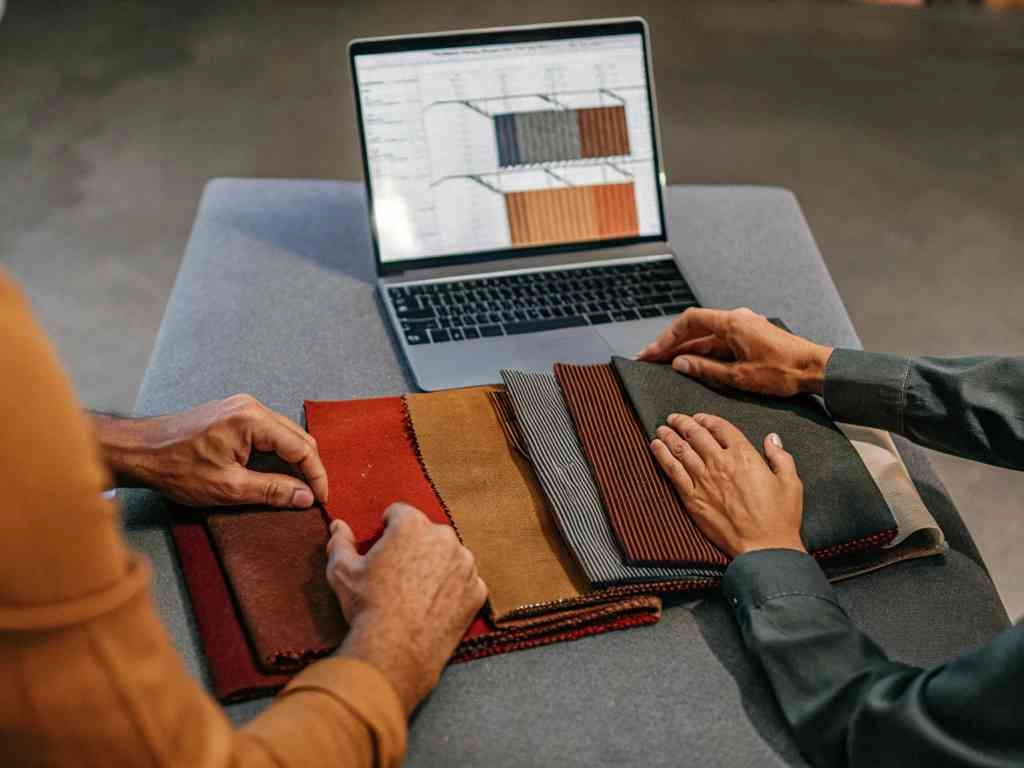
For a reorder, keep the material reference with the approved sample. “Polyester satin” on its own is not enough to identify the fabric used in production.
4. Material Supplier and Supporting Documents
If your clothing manufacturer sources fabric or trims for you, ask what supplier information and supporting documents can be retained for the materials used in your order.
Depending on the project, the file may include:
- Material supplier
- Supplier material reference
- Fabric composition documentation
- Relevant certificates
- Test reports
- Material lot or batch reference, where available
You do not need to collect a separate set of documents for every small component.
Focus first on the materials that support the product specifications, claims, or applicable requirements.
This becomes more important when the garment is sold with a recycled, organic, or other material claim.
The document needs to relate to the material that actually went into the garment.
5. Approved Sample and PP Sample Information
Your approved sample is one of the most useful references in a clothing manufacturing project.
During development, the dress may change several times. Fabric, length, measurements, lining, trims, construction, labels, and packaging can all be revised before the PP sample is approved.
- Fabric
- Length
- Bust measurement
- Waist measurement
- Lining
- Zipper
- Buttons
- Construction
- Label
- Packaging
By the time the PP sample is approved, the production team should have one clearly identified version to follow.
Keep that version identifiable.
If the factory has three different samples on the table and the production team is relying on an old measurement sheet, the problem is not only fit. Your product records can also become disconnected from the garment that was actually approved.
At our factory, the approved sample and its specifications are used as the reference for bulk production. The physical sample alone is not enough if the production team cannot identify which version it represents.
6. Production Order Information
Once the garment moves into bulk production, the product specification needs to be tied to the actual production order.
Useful information may include:
- Style number
- Color
- Size breakdown
- Ordered quantity
- Production quantity
- Production date
- Production reference
- Manufacturing location
- Approved sample reference
A small brand may keep this information in a production sheet or spreadsheet. Larger companies may connect the same records through PLM, ERP, PIM, or another product-data system.
The production order should show which product version and materials it relates to.
7. Material Changes Before Bulk Production
Material changes are not unusual during development. A fabric may become unavailable, a supplier may change its specification, the original color may fail approval, or the price may no longer work for the order.
If the fabric changes, the production record should change with it.
Before bulk cutting, review the replacement against the approved material, including:
- Fiber composition
- Fabric weight
- Width
- Stretch
- Shrinkage
- Drape
- Color
- Lining
- Finished measurements
Record the replacement as a change to the production specification rather than keeping the original fabric information simply because the appearance is similar.
8. Labels and Packaging
Labels also need to be checked before bulk production.
Depending on your product and target market, your order may include:
- Brand label
- Size label
- Care label
- Fiber composition label
- Country-of-origin information where applicable
- Hangtag
- Barcode
- SKU
- Polybag
- Carton marking
For private label projects, these details often come from the brand.
The factory then works from the approved files.
If the composition, size range, or style information changes during development, make sure the label artwork changes with it.
A label mistake discovered during final inspection can mean opening finished garments and replacing labels one by one.
That is much easier to avoid before bulk production.

When Should You Start Collecting This Information?
The product record will not be complete when the first sketch is sent, and that is normal. Add the information as the style moves through sampling and production.
Before Sampling
At the start of development, the working file normally contains the style reference, main fabric, fiber composition, lining, major trims, and any required certification or testing.
During Sample Development
During sampling, compare the actual materials with the original specification. Any approved change should be added to the working file.
At PP Sample Approval
By PP sample approval, the version moving into bulk should be fixed for fabric, color, measurements, construction, lining, trims, labels, and packaging.
Before Bulk Cutting
The production team should be working from the approved material and specification rather than an earlier sample version.
During Bulk Production
Keep the production reference connected to the style, color, quantity, and relevant material information.
Before Shipment
Review the final product information against the approved specification and production records.
By shipment, these records should be together in one product file that can be used later for DPP or other traceability requirements.
What Should You Ask Your Clothing Manufacturer?
Instead of asking a factory a broad question such as:
“Can you support EU DPP?”
ask questions that relate to actual production.
For example:
Can you provide the fiber composition of the fabric used in bulk production?
You want the answer to relate to the material actually purchased and used, not simply the fabric description from the first quotation.
Can you identify the fabric supplier or material reference?
This can help when you need to trace where a particular material came from.
What happens if the approved fabric changes before bulk production?
Ask how the change is communicated, approved, and recorded.
Can the production order be linked to the approved sample and specifications?
This shows whether the factory can distinguish the production version from earlier development samples.
Can relevant certificates or test documents be retained?
This is particularly useful when your product uses specific material or sustainability claims.
How are labels and packaging confirmed before production?
For private label orders, this can prevent incorrect product information from reaching finished garments.
A factory’s answers to these questions tell you more about its actual production records than a simple “Do you support DPP?” answer.

Which Information Comes From the Manufacturer and Which Comes From You?
Your clothing manufacturer does not automatically own all product information.
For example:
| Information | Likely Source |
|---|---|
| Style number | Brand |
| Product description | Brand |
| Fiber composition | Fabric supplier / manufacturer |
| Fabric specification | Fabric supplier / manufacturer |
| Material supplier | Manufacturer / fabric supplier |
| Certification document | Supplier / certification body |
| Approved measurements | Brand + manufacturer |
| Production quantity | Manufacturer |
| Production reference | Manufacturer |
| Manufacturing location | Manufacturer |
| Care information | Brand + manufacturer |
| Product SKU | Brand |
| Packaging specification | Brand + packaging supplier |
Your role is not to make the factory responsible for every field.
It is to make sure that each important piece of information has a known source and that the information matches the finished product.
The same issue becomes harder to manage when several suppliers are involved.
What If You Use Several Suppliers?
A fashion brand may not have one company handling the entire supply chain.
Your factory may know the main fabric composition but not have the final packaging specification.
Your packaging supplier may have the carton information but not know the final garment quantity.
Your brand may hold the SKU and product description.
Each supplier should be responsible for the information it actually controls.
For a small collection, a simple product information sheet can be enough to start.
What matters on the production side is that the brand, sample room, and production team are all working from the same approved version.
How Should You Handle Reorders?
A style might have 800 dresses produced six months ago and return as a 1,500-piece reorder.
If nothing has changed, you should be able to identify the previous:
- Fabric
- Lining
- Trim
- Measurements
- Construction
- Label
- Packaging
- Approved sample
If the brand wants a new fabric or color, record that as a new change.
Do not simply copy the previous product file and change the order quantity.
From a factory perspective, this is one of the easiest ways for old information to remain attached to a new production run.
A useful product trail looks something like:
Style → Approved Sample → Material → Production Order → Bulk Production → QC → Packing
You can manage this with a spreadsheet, production sheet, PLM, or ERP system. What matters is that each production run can be traced back to the correct product version and materials.
How Does This Relate to the EU Digital Product Passport?
The EU’s ESPR establishes the framework for Digital Product Passports, and textiles and apparel are among the priority product groups identified for future requirements. The European Commission’s current textile and apparel work includes product information and traceability, but the detailed requirements for this product group are still being developed.
Proposed DPP checklists should not be treated as confirmed legal requirements unless the applicable rules have actually been adopted.
Ask a few basic questions:
Which fabric was approved?
Which material and production version went into bulk?
What changed after sampling?
Which production order and supporting documents relate to it?
If these questions can be answered without searching through dozens of emails, the product records are already much easier to use for future traceability work.
A Practical Checklist Before You Place a Bulk Order
Before production starts, the following should be identifiable in the product file:
- The correct style and product version
- The approved main fabric
- Fiber composition
- Relevant material specifications
- Fabric supplier or material reference
- Important trims and lining
- Supporting certificates or test documents where applicable
- Approved sample or PP sample
- Final measurements
- Production quantity
- Production reference
- Manufacturing location
- Label specifications
- Packaging specifications
- Any material or construction changes
You do not need to collect every possible piece of information before making a first sample.
Start with the information that can change the product itself.
Then keep the approved version connected to the bulk order.
Frequently Asked Questions
1. Should you ask a clothing manufacturer for DPP data before placing an order?
Yes. Before bulk production, ask how the factory records materials, approved samples, production orders, and changes. A manufacturer may provide important production and material information without being responsible for creating the complete DPP for your brand.
2. What if your manufacturer cannot provide every piece of supplier information?
Check which records the factory can provide and which ones need to come from the material supplier. For example, the fabric mill may hold composition or certification documents while the garment factory keeps the production records.
3. What happens if your approved fabric is unavailable for bulk production?
Do not simply replace it and continue using the original product information. Ask for the replacement fabric details, compare the specification with the approved material, and confirm the change before bulk cutting. If the composition or other relevant characteristics differ, update the product records accordingly.
4. How can a small fashion brand keep track of all this information?
A small brand can start with a simple product sheet. There is no need to introduce PLM or ERP software just to organize the basic production records. Keep the style number, approved fabric, supplier information, sample version, production reference, labels, and supporting documents together. The system can become more sophisticated as your collection and supplier network grow.
5. Does your clothing manufacturer need to create the final DPP?
Not necessarily. Responsibility for the final product information depends on the applicable rules and the role of the economic operator involved. Your manufacturer is one source of supply-chain and production information. Your brand may still need to combine that information with product, commercial, and other supplier data.
Conclusion
DPP preparation can start with the records already created during a normal clothing order.
Keep the approved fabric, sample version, material references, production order, labels, and supporting documents tied to the same style. If a material changes before bulk production, update the record instead of carrying the old information forward.
This makes the product history easier to check during a reorder, when a buyer requests supporting documents, or when DPP requirements apply to the product.
Related Dress Manufacturing Services
If you are developing a new dress style, these records are created through the same fabric selection, pattern development, sampling, fit approval, and bulk production process. You can also explore our product-specific manufacturing pages below.
At Xiuyu Apparel, we work with fashion brands, startups, designers, and private label companies from sample development through bulk production.
- Cocktail Dress Manufacturer
- Mini Dress Manufacturer
- Lace Dress Manufacturer
- Slip Dress Manufacturer
- Formal Dress Manufacturer
Get a Clothing Manufacturing Quote Based on Your Design
If you are developing a new dress, send us your product photo, tech pack, or reference sample together with the target quantity.
As a dress manufacturer, we can review the fabric, lining, construction, trims, and finishing requirements before preparing the quotation and sample plan.

