

A custom dress can look finished on a sketch and still be far from production-ready.
Once the design reaches a clothing manufacturer, questions about fabric, measurements, construction, lining and fit start to come up. Some changes are simple when the pattern is still on paper. Once fabric has been cut, the same correction can mean recutting panels, changing sewing instructions or making another sample.
A practical development process moves through several stages, from the first design review and pattern development to sample fitting and PP sample approval.
What Do You Need Before Starting Dress Development?
A complete tech pack is helpful, but it is not required for every custom dress project.
Some brands send a finished sample. Others send a sketch, reference photos or a few product images with notes about what they want to change.
The useful information is usually:
- Design sketch or reference
- Physical sample, if available
- Size or measurement requirements
- Fabric preference or fabric swatch
- Construction details
- Color references
- Size range
- Expected order quantity
- Target delivery date
You do not need to have every measurement figured out before speaking with a manufacturer.
You may care most about the waist position, the amount of skirt volume, the neckline depth or the way the fabric falls on the body. Flag those points when the style is first reviewed by the pattern team. Otherwise, a pattern maker may make a technically workable decision that does not match what you had in mind.
For a new brand, this first discussion can also expose problems in the design before any fabric is cut.
What Happens When a Factory Reviews Your Dress Design?
The first review is usually more practical than visual.
At this stage, the pattern team is less concerned with making the sketch look right and more concerned with how the garment will actually be built.
A sketch may show a fitted bodice, for example, but not explain whether the garment needs darts, princess seams, internal support, lining or a particular closure. A backless dress may look simple but require careful control of the strap position and body coverage.
The pattern team will look at points such as:
- Bust, waist and hip proportions
- Neckline and armhole
- Shoulder or strap position
- Garment length
- Seam placement
- Skirt fullness
- Closure
- Lining
- Gathering or pleating
- Slits and openings
- Decorative construction
You should also separate design requirements from production preferences.
If the neckline must remain exactly as drawn, that is a design requirement. If the inside construction can be adjusted as long as the outside appearance stays the same, tell the factory that too.
This gives the pattern maker some room to solve construction problems without changing the part of the design that matters to you.
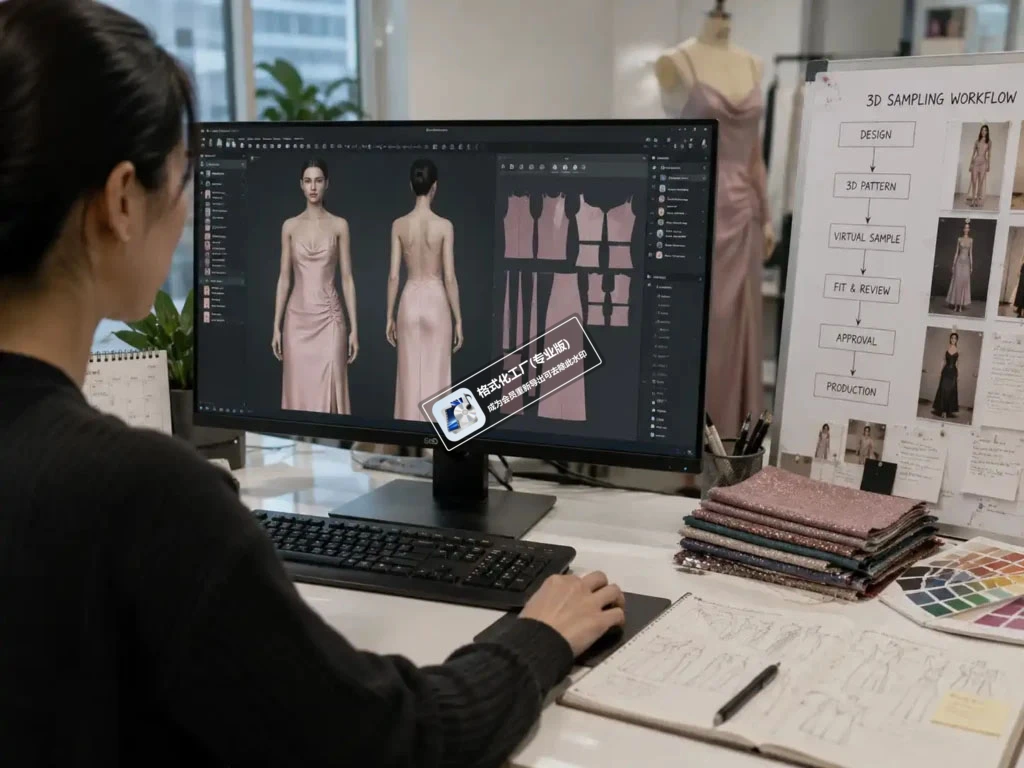
How Does Fabric Selection Affect Custom Dress Development?
Fabric selection can change the finished dress more than many first-time buyers expect.
You may have a particular fabric in mind because of its appearance, but the factory also needs to consider how it behaves after cutting and sewing.
For a dress, that can include:
- Weight
- Drape
- Stretch and recovery
- Transparency
- Shrinkage
- Fabric width
- Surface finish
- Sewing behavior
- Pressing requirements
Take a gathered chiffon skirt as an example. The amount of fullness that works with one chiffon may not give the same result with another. A heavier satin can hold a different shape, while a lightweight rayon may fall closer to the body.
A pattern that works on paper can still behave differently once it is cut in a softer or heavier fabric.
If you change the fabric after the first sample, the fit or silhouette may change with it. It is better to confirm the intended fabric before the production pattern is finalized.
For new brands, fabric availability should also be checked early. A fabric can work perfectly for one sample and still create problems when you need several hundred meters for bulk production.
When Does Pattern Development Start?
Once the main design points and fabric are confirmed, the pattern team can start the first pattern.
The first pattern sets the basic shape and shows how the bodice, skirt, seams and other sections will be joined.
For a fitted dress, the pattern needs to balance the bust, waist and hip. For a loose dress, the amount and location of ease become more important. For a slip dress, small changes around the neckline, straps or bust can noticeably change the way the garment sits.
If you send an existing garment, the pattern team can measure it and use it as a reference. But a sample garment does not tell the whole story.
Two dresses can look almost identical from the outside while using different seam allowances, lining construction or internal finishing.
Tell the factory whether the physical sample is meant to be copied closely or simply used as a reference for the new design.
What Is Checked on the First Dress Sample?
Once the first sample is made, you can judge the design as a real garment rather than a drawing and fabric swatch.
This is where you can see whether the proportions work together.
Instead of checking only the overall appearance, look at the dress while it is being worn.
Pay attention to:
- Bust fit
- Waist position
- Hip ease
- Neckline
- Armhole
- Strap placement
- Garment length
- Skirt volume
- Lining length
- Closure operation
- Seam balance
Fit should also be checked while the garment is moving.
Ask the fit model to sit, walk, raise the arms or move naturally. A dress can look fine standing still but pull at the armhole, ride up at the waist or open too much at the back during movement.
These details are much easier to correct at the sample stage than after bulk production.
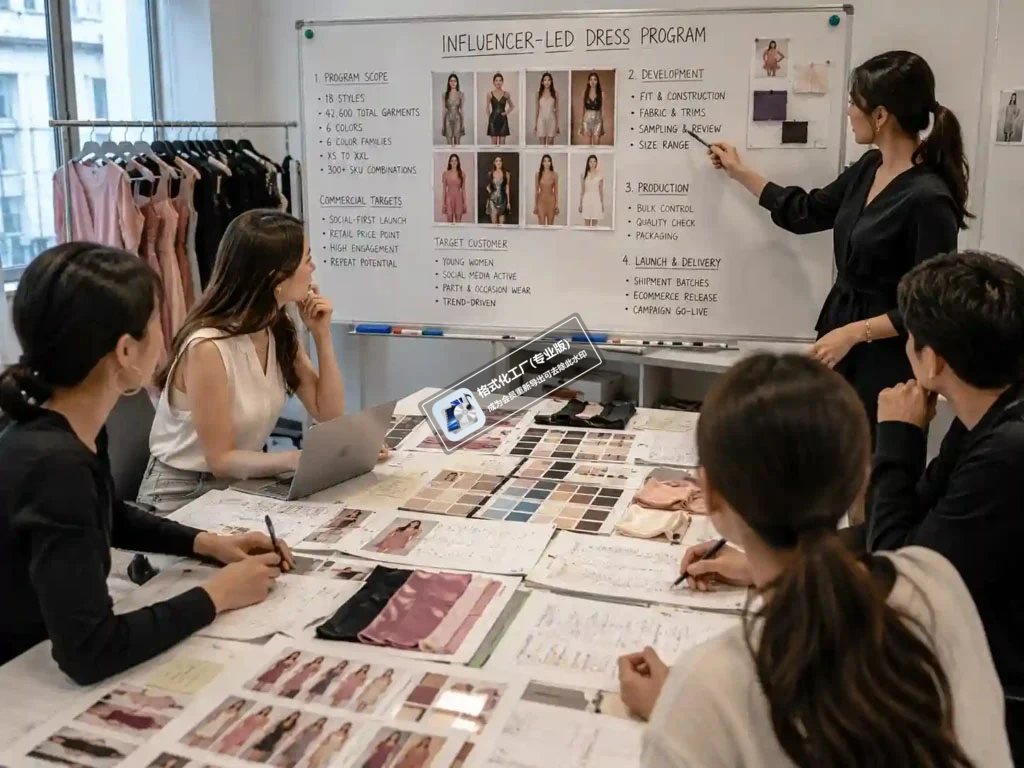
How Should You Give Sample Comments to the Manufacturer?
Clear sample comments can save a lot of back-and-forth.
Comments such as:
“Make the waist smaller.”
or:
“The top is too loose.”
are difficult to act on without more information.
If possible, give a measurement or identify the exact area.
For example:
- Reduce waist by 2 cm
- Raise neckline by 1 cm
- Shorten front length by 2 cm
- Move strap toward the shoulder
- Reduce ease at the hip
- Add more skirt fullness below the waist
Photos with marked areas are also useful.
If you are reviewing several dresses at once, keep comments separated by style number. Mixing comments between similar designs is an easy way to create unnecessary sample corrections.
From the factory side, a short comment with a clear measurement is often more useful than a long explanation. “Reduce waist 2 cm” is easier to work with than “the waist feels a little loose.”
What Happens After the First Sample?
After the first sample, the next job is to identify what actually needs changing.
Sometimes the problem is simply a measurement. Other times, the fit issue comes from the fabric, pattern or construction.
If the skirt does not fall correctly, reducing the waist measurement may not fix it. The problem could be the fabric weight, gathering distribution or the way the bodice joins the skirt.
If the problem is actually coming from the fabric or construction, changing the pattern first can create another problem instead of fixing the original one.
A simple sample record can show:
Original requirement → Sample result → Specific correction → Revised result
Keeping this record becomes useful when a style goes through several rounds of fitting.
How Many Samples Are Needed Before Production?
A straightforward dress may be close after one sample. A fitted style with unusual construction, stretch fabric, beading or multiple layers can take more development work.
The number of rounds is affected by:
- Complexity of the pattern
- Fabric behavior
- Fit expectations
- Construction details
- Number of design changes
- Quality of the initial reference information
When possible, avoid changing four or five major points in the same sample round.
If you change the fabric, neckline, length and waist measurement in the same round, it becomes difficult to understand which change improved or damaged the result.
For a new collection, it can also make sense to develop the more complicated styles first. They can reveal fabric, fit and construction issues before the simpler styles are finalized.
What Is a PP Sample and Why Does It Matter?
The PP sample is the production reference approved before bulk manufacturing.
It should represent the version of the dress that you actually want the factory to produce.
That includes more than appearance.
The approved version should match the:
- Fabric
- Color
- Measurements
- Construction
- Lining
- Trims
- Closures
- Labels
- Finishing details
At this point, the approved sample becomes a reference for bulk production, not just a fitting sample.
If the PP sample uses one fabric but bulk production uses another, or if a measurement correction was agreed but the production pattern was not updated, the sample approval has not really solved the problem.
Before PP approval, check the details that would be expensive or difficult to change after cutting.
What Should Be Confirmed Before Bulk Cutting?
Before bulk production starts, the factory should have one clear production version.
Check the latest:
- Approved sample
- Measurement chart
- Pattern
- Fabric specification
- Color
- Lining
- Trims
- Size range
- Size ratio
- Labels
- Packaging
- Quantity
- Delivery schedule
Pay particular attention when several rounds of comments have been exchanged by email.
An old measurement chart sitting in an attachment can be just as dangerous as an old sample sitting on a production table.
If a correction was made during fitting, make sure it is reflected in the current production information.
PP approval should leave the factory with one clear production version. The pattern, measurements, fabric, trims and other specifications should all match that approved version.
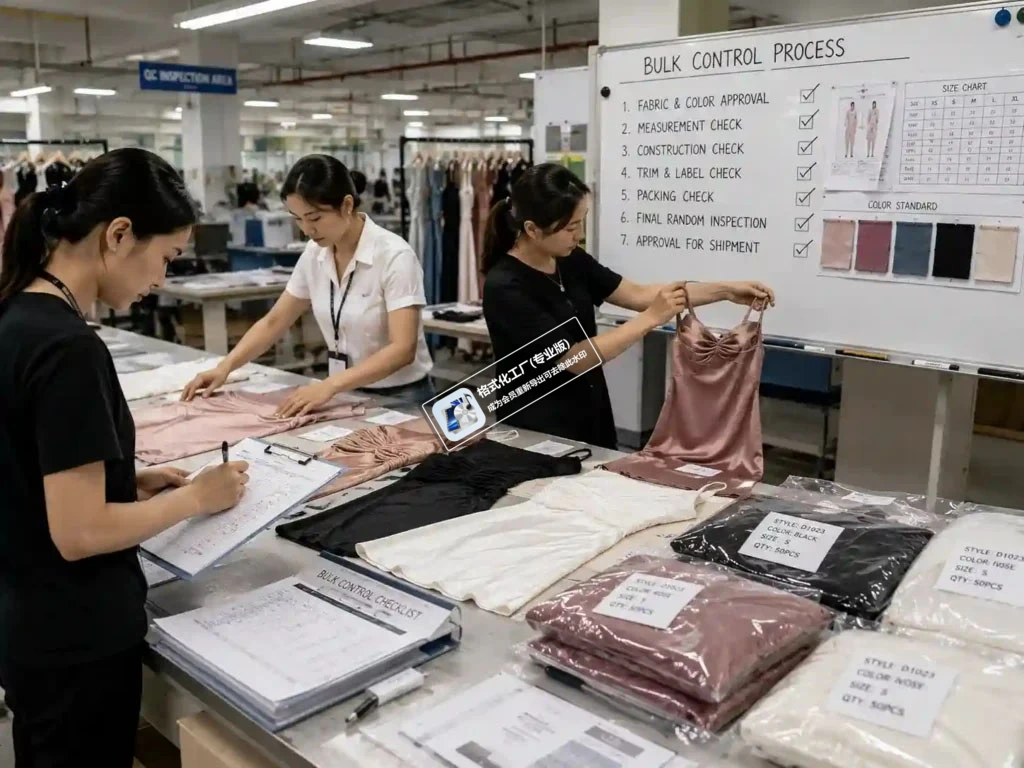
What Happens From PP Approval to Bulk Production?
Once the production version is approved, the dress can move into the manufacturing process.
The sequence is generally:
PP Sample Approval
↓
Final Pattern Confirmation
↓
Bulk Fabric Inspection
↓
Fabric Preparation
↓
Bulk Cutting
↓
Sewing
↓
In-Line QC
↓
Pressing and Finishing
↓
Final Inspection
↓
Packing
The approved sample remains an important reference during production.
If the dress has a particular gathering ratio, strap position or lining length, the sewing team should not rely only on written descriptions. The approved physical sample helps the production and QC teams understand the intended result.
Bulk fabric should also be checked before cutting. Width, shade, defects and shrinkage can become much more noticeable when working with a full production lot.
For printed dresses, fabric direction and print placement need additional attention. A small placement error repeated across hundreds of pieces becomes a much larger problem than it was on one sample.
What Commonly Causes Problems During Dress Development?
In our experience, development problems are more often caused by several small details being left unclear than by one major mistake.
The sketch looks clear, but the construction is still open
A photo can show the look but not the construction. The factory then has to make assumptions.
The fabric changes after the first sample
A new material can change drape, fit, transparency and fabric consumption.
The fit comment does not give the factory enough information
The factory knows there is a problem but not exactly what should change.
Too many changes are made in one sample round
It becomes difficult to identify which change caused the new result.
A fitting correction never reaches the production file
The fitting comment may be correct, but the pattern or measurement chart still shows the previous version.
Bulk cutting starts before the final version is locked
Once fabric has been cut, correcting the pattern becomes much more expensive.
From the buyer’s side, adding another sample round does not always solve the problem. The goal is to keep the development information clear enough that each sample answers a specific question.
How Can You Make the Development Process Easier?
For each style, keep one development record from the first reference through PP approval.
For each style, keep:
Design reference — the latest sketch, photo or sample.
Measurement chart — the current approved measurements.
Fabric information — composition, weight, width, color and relevant requirements.
Sample comments — what changed and why.
Approved sample — the physical reference for production.
Bulk specifications — labels, packaging, quantity and other production details.
Use the same style number across these records.
This matters even more when several styles are being developed at the same time. A folder containing multiple versions of “Dress Final,” “Dress Final 2” and “Dress Final New” can quickly become difficult for both the brand and factory to manage.
A simple version system is often more useful than a complicated one.
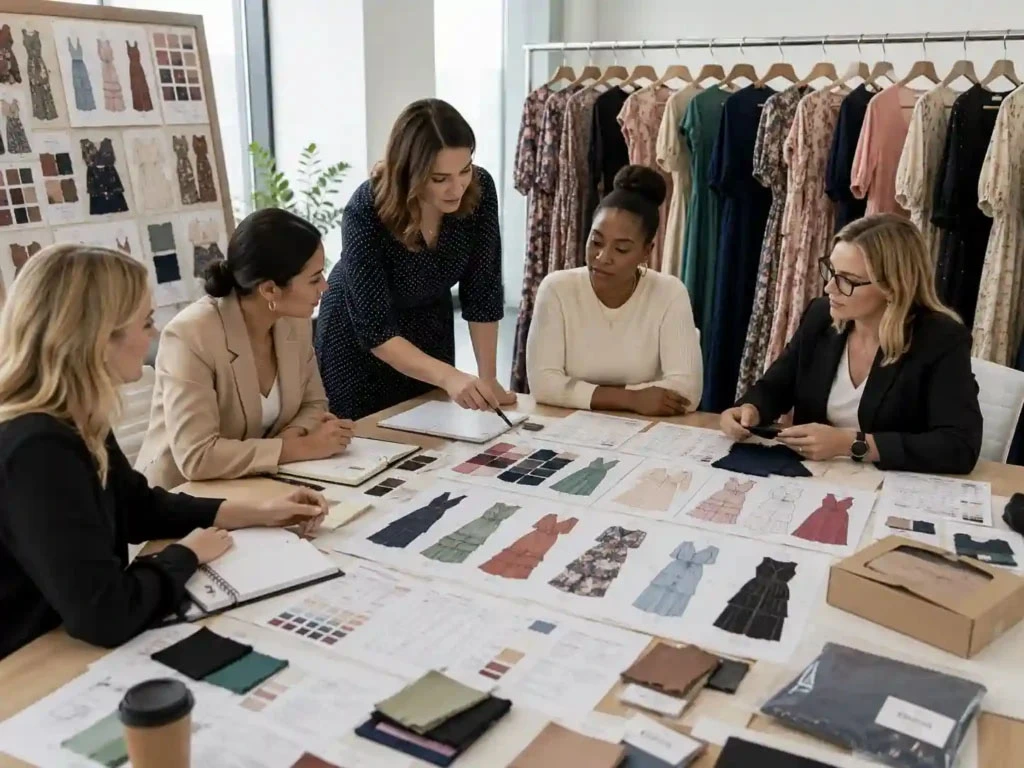
What Should You Consider When Choosing a Dress Development Partner?
If you are comparing clothing manufacturers, do not only ask whether they can make your first sample.
Ask what happens after the sample.
You need to know whether the same production team can handle the pattern correction, fabric confirmation, PP approval and bulk handover.
It is also worth asking how sample comments are recorded and how the final approved version is passed to production and QC.
For a new fashion brand, this matters because the first order is often not the end of development. If the dress becomes a repeat style, the factory needs enough information to reproduce the same fit and construction later.
The more clearly the approved version is documented, the easier repeat production becomes.
Frequently Asked Questions
Can you start custom dress development without a complete tech pack?
A complete tech pack is helpful, but it is not always necessary. A sketch, reference garment or detailed photos can also be enough to start the discussion. You should explain the intended fit, important design features and any measurements you already know. The factory can then identify the missing information before the first sample rather than making assumptions silently.
What if the dress design is not fully finalized?
You can still start development, but separate confirmed details from ideas that may change. If the neckline, fabric and silhouette are still undecided, making a final sample too early can create unnecessary work. Clarifying the major design decisions first usually gives the development team a cleaner starting point.
How should you handle a dress that fits well but does not look right?
Do not change the measurements immediately. First check the fabric, drape, seam placement, gathering and overall proportions. A dress can fit the body correctly and still have the wrong visual balance. Identifying the cause first helps you avoid correcting the wrong part of the pattern.
Can the factory develop several dress styles at the same time?
Several styles can be developed at the same time, but each one should have its own development record and approval status. This is especially important when the dresses use similar fabrics or silhouettes. Keeping the style number, sample comments, measurements and approved version separate helps prevent one style’s correction from being applied to another.
What should you check before approving the PP sample?
Check the details that will be difficult or expensive to change later: fabric, color, measurements, lining, construction, trims, closures and finishing. If the dress is for a new size range, also review the grading and key measurements before bulk cutting. What you approve as PP should be the version used as the bulk production reference.
Conclusion
Custom dress development is rarely a straight line from sketch to bulk production.
A sketch still needs to be tested with the intended fabric and developed into a workable pattern. The first sample shows what needs to change, while the PP sample gives the production team a fixed reference for bulk manufacturing.
For a new brand, keeping these records clear can save more time than simply trying to reduce the number of samples. Each sample should answer a specific question, and each approved correction should reach the production file before bulk cutting starts.
Related Dress Manufacturing Services
If your project involves a specific dress fabric or construction, you can also review our related manufacturing pages:
- Maxi Dress Manufacturer
- A Line Dress Manufacturer
- Bodycon Dress Manufacturer
- Prom Dress Manufacturer
- Chiffon Dress Manufacturer
Get a Quote for an Existing Dress Style
If you are transferring an existing dress style to a new manufacturer, send us the latest approved sample, tech pack, product photos, or measurement chart together with your target quantity.
As a dress manufacturer, we can review the construction, fabric, trims, measurements, and current production status with you before confirming the sampling requirements.

