

When you compare China and Turkey for dress manufacturing, the first quotation rarely tells you the full cost of an order. Fabric availability, sample revisions, MOQ, production planning, quality control, and freight can all change the calculation. A supplier that looks cheaper on paper may not stay cheaper once sampling, materials, shipping, and repeat orders are included.
China vs Turkey Dress Manufacturing: What Changes?
China and Turkey both have established apparel manufacturing bases, so a supplier shortlist can look fairly similar at first. When you compare clothing manufacturers, the practical differences tend to show up once the factory receives the actual product requirements. The practical differences tend to show up once the factory receives the actual product requirements.
A cotton day dress, a bias-cut satin dress, and a fitted evening style can require very different sourcing, pattern work, sampling, and production control.
| Factor | China | Turkey |
|---|---|---|
| Fabric sourcing | Large supplier base for fabrics, trims and garment accessories | Strong textile base, particularly within the regional European supply chain |
| Dress development | Many factories offer OEM, ODM, pattern making and private label services | Established apparel development and manufacturing base |
| MOQ | Depends on the factory, fabric and order quantity | Depends on the factory, fabric and order quantity |
| Customization | Wide range of fabric, construction and branding options available across suppliers | Good access to textile and apparel customization |
| Production scale | Options range from smaller production programs to larger repeat orders | Factory capacity varies considerably by supplier |
| European market | Longer transport distance to Europe | Geographic proximity can shorten some European supply routes |
| US market | Well-established export routes and container shipping options | Export is available, but the freight route needs to be calculated for the final destination |
| Main point to check | Fabric network, production capacity, development support and repeat orders | Factory capability, textile sourcing and distance to the target market |
This table is only a starting point. The more useful comparison begins when you send both suppliers the same tech pack, quantity, fabric requirement, measurements and delivery target.
Start With Your Dress, Not the Country
Before comparing manufacturing countries, define the product you want to make.
A cotton day dress, a bias-cut satin style, a fitted evening dress, and an embellished design can place very different demands on fabric sourcing, pattern making, lining, pressing, grading, and sewing.
Start the comparison with your actual specifications rather than the country name.
Your specification may include:
- Custom fabric or color matching
- Lining
- Stretch materials
- Bias cutting
- Pleating
- Smocking
- Embroidery
- Beading or sequins
- Appliqué
- Special seam construction
- Invisible zippers
- Multiple size grades
- Detailed pressing
The more specific the construction, the less useful a country-level comparison becomes. Send both suppliers the same sketch, reference garment or tech pack and see how their production teams respond.
One useful sign is the questions they ask. Do they check fabric weight? Do they notice stretch in the reference fabric? Do they ask how a print should match across seams? Do they question a measurement that may affect fit?
Those questions give you a better indication of how the production team actually thinks about the garment.
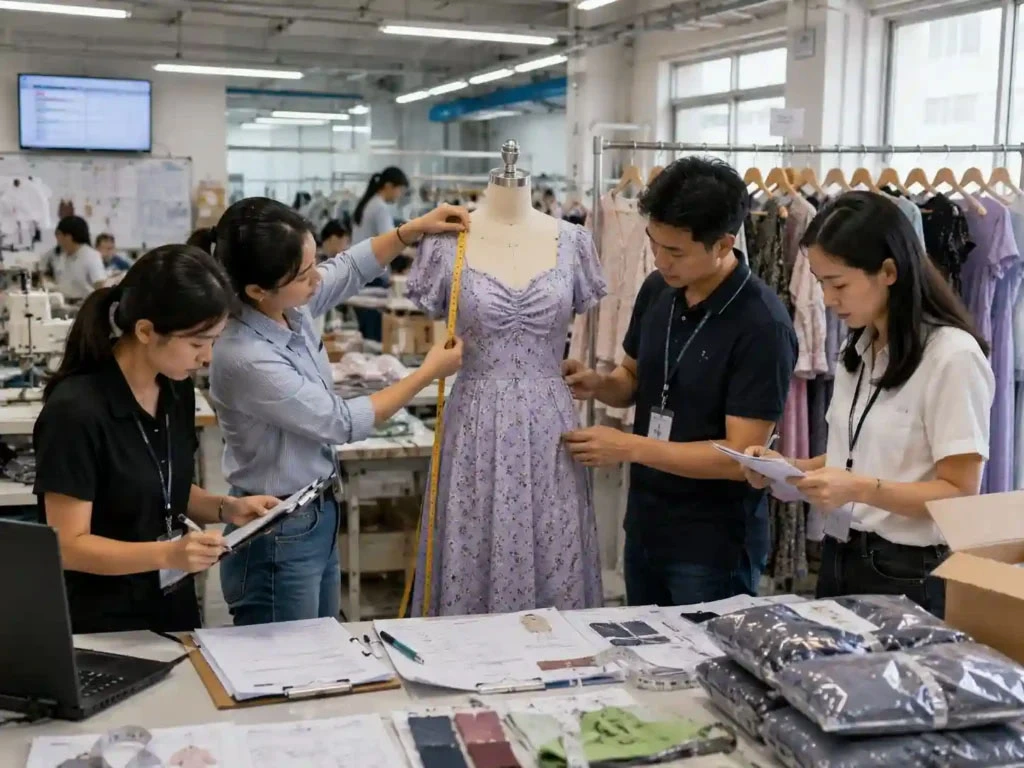
Manufacturing Cost: Look Beyond the Unit Price
A low unit price does not tell you what the finished order will cost.
Your production cost may include:
- Main fabric
- Lining
- Trims
- Sample development
- Garment production
- Labels and hangtags
- Packaging
- Inspection
- Freight
- Duties and taxes
- Rework or replacement
Two quotations are only comparable when the garment specifications are the same. Send both factories the same fabric requirements, measurements, construction details, quantity, branding, and packaging instructions.
Then check what each quotation actually includes.
If the target cost is tight, discuss the product with the factory instead of asking for a lower price alone. Fabric composition, lining, trims, and some construction details may offer room for adjustment without changing the overall look.
MOQ: Check the Fabric MOQ Too
MOQ is often discussed as if it belongs entirely to the garment factory. In practice, fabric can create another minimum.
Suppose you want to make 100 pieces of a dress in two colors. The garment factory may accept the quantity. But if each color needs custom dyeing, the fabric supplier may have a higher minimum.
Printed fabrics can create the same issue.
You should therefore ask about:
- MOQ per style
- MOQ per color
- Fabric minimum
- Custom dyeing minimum
- Print minimum
- Reorder quantity
Small collections make this issue more noticeable.
A startup brand may plan six styles, two colors per style, and a relatively small quantity for each. The total order can look reasonable on paper while the individual material quantities remain difficult to source.
For a first collection, ask the manufacturer which part of the order is creating the minimum: the garment production, fabric, dyeing, printing or trims.
You should also ask what happens if one style sells well. Can the same fabric and pattern be used for a repeat order? Will the minimum change? Can the factory reproduce the approved specifications?
Those questions are more useful than simply asking whether the factory has a “low MOQ.”
Fabric Sourcing Can Change the Whole Project
A photograph can show a flowing satin dress, but it cannot tell you the fabric’s exact weight, fiber content, width, shrinkage, or stretch recovery.
Two fabrics can look similar on a screen and behave very differently on the cutting table.
For dress production, the key fabric points are:
- Fiber composition
- GSM or fabric weight
- Width
- Stretch and recovery
- Shrinkage
- Color consistency
- Drape
- Hand feel
- Surface finish
- Lining compatibility
China has a broad network of fabric, trim and garment suppliers. Turkey also has a well-developed textile and apparel supply chain.
What matters at this stage is whether the factory can source that material in your required quantity, specification and price range.
This becomes important with custom colors, printed fabrics, lace, embroidery, sequins and specialty trims.
At our factory, we pay particular attention to fabric behavior before bulk cutting. If a fabric shrinks, stretches or drapes differently from the approved sample, the pattern may need to change. Fixing that after bulk cutting is far more troublesome than correcting it during development.
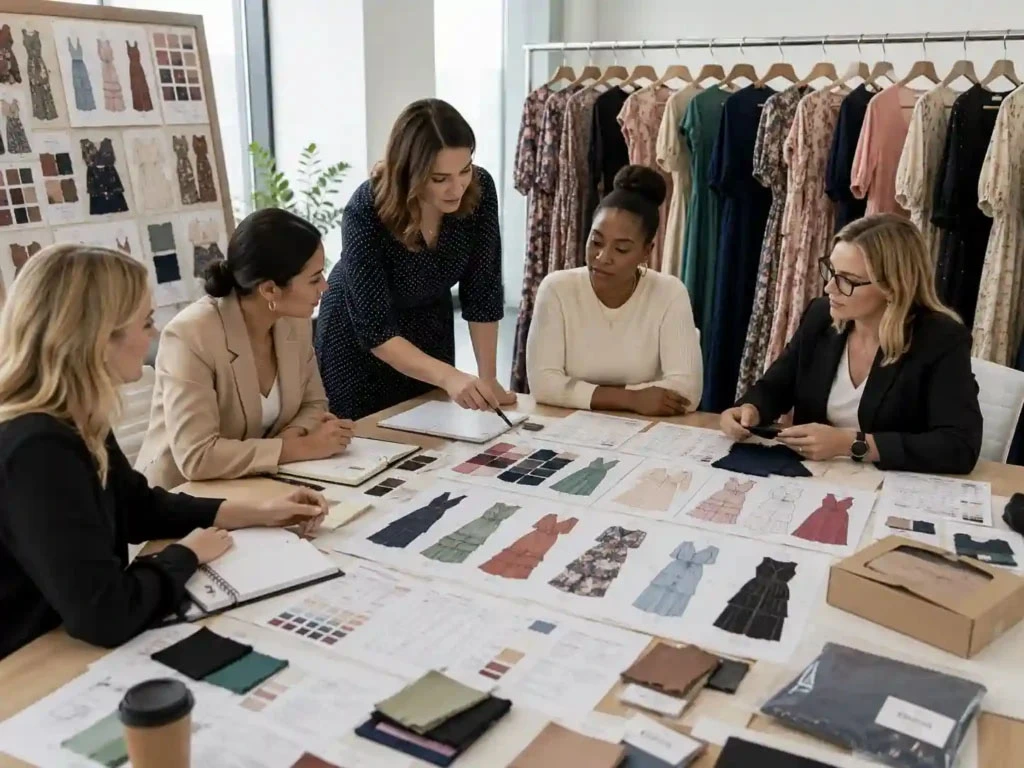
Sampling: Pay Attention to What Happens After the First Sample
A fast first sample sounds good, but it does not tell you how the factory handles revisions.
You should ask how the development process works after you receive the first sample.
A dress may go through several rounds before bulk production:
Pattern making → First sample → Fit comments → Pattern correction → Revised sample → PP sample → Bulk production
Your design may need more than one correction.
The neckline might be too open. The waist could sit slightly too high. The armhole may pull when the model moves. A bias-cut skirt might hang unevenly. The lining may be showing at the hem.
These are pattern and construction issues, not simply sewing issues.
When you compare a dress manufacturer, look at how they record your comments and transfer approved changes back to the production pattern.
A correction can also get lost between the sample and bulk stage if it is only discussed in messages and never added to the final measurement chart or production pattern.
For that reason, keep the approved sample and final measurement chart clearly identified before bulk production begins.
Production Capacity: What Can the Factory Handle Later?
You may only need 100 pieces today.
Six months later, one style may sell much better than expected and you may need 1,000 or more pieces. Your manufacturer needs to be able to handle the change without losing control of the product.
When you evaluate production capacity, ask about more than monthly output.
Look at:
- Number of styles running at the same time
- Sewing line organization
- Cutting capacity
- Sample room capability
- Finishing and pressing
- QC staffing
- Repeat-order handling
- Peak-season scheduling
A large workforce is only one part of production capacity. A clothing manufacturer may have substantial monthly output on paper, but a complicated collection can still create bottlenecks in cutting, sewing, finishing, or QC.
For you as a buyer, usable capacity means the factory can produce your specific styles at the required quantity and quality within the agreed schedule.
That is different from a factory simply telling you its maximum monthly output.
Quality Control: Find Out Where Problems Are Caught
One question worth asking is where the factory catches defects during production.
If the answer is simply “before shipment,” ask what checks happen earlier in the process.
Dress production can include several checkpoints:
Fabric Inspection
Incoming fabric should be checked before cutting for the agreed composition, color, width, weight, shrinkage, and visible defects.
Cutting Check
Once the fabric is released for cutting, check whether the panels follow the approved pattern and marker.
Inline QC
Sewing problems are easier to fix while the line is running than after the full quantity has been completed.
Finishing Check
Pressing, loose threads, closures, hems, and appearance are checked before packing.
Final Inspection
Finished garments are checked against the approved sample, measurements, workmanship, and packing requirements.
You should also ask how defects are recorded and who decides whether a problem requires rework.
This is especially important for fitted dresses. A small measurement difference at the waist, bust or shoulder can change the appearance of the whole garment.
Quality control is therefore not something you should leave until the cartons are ready.
Lead Time: Separate Development From Production
When a supplier tells you “30 days,” ask what those 30 days include.
Your actual timeline may look more like:
Fabric sourcing → Sample development → Fit revisions → PP sample approval → Fabric confirmation → Bulk cutting → Sewing → Finishing → QC → Packing → Shipping
The sewing stage may be only one part of the schedule.
If your fabric is available from stock, development can move differently than if you need custom dyeing or printing. If your sample needs two rounds of revisions, the calendar changes again.
For your launch planning, separate:
- Sample development time
- Fabric preparation time
- Bulk production time
- Inspection and packing time
- Freight time
At Xiuyu’s production side, we normally plan bulk production after the PP sample is approved and fabric is confirmed. For standard dress orders, bulk production is usually around 25–30 days, while sample development is generally 3–7 days. The actual schedule still needs to be checked against the product and order requirements.
Shipping: Compare the Route to Your Warehouse
The manufacturing country matters, but so does where your goods need to go.
Turkey’s location can be useful when your main market is Europe and shorter regional transport is important.
China is farther from Europe geographically, but it has extensive export infrastructure and established shipping routes to major markets, including the US.
Calculate the route from the actual factory to your warehouse rather than comparing countries only on a map.
Check:
- Factory location
- Nearest port
- Freight method
- Transit time
- Freight cost
- Customs requirements
- Duties
- Final delivery location
For a larger order, ocean freight may be suitable. For urgent samples or smaller shipments, air freight may be considered, but the cost can be significantly different.
If your launch date is fixed, start with the warehouse arrival date and work backward through freight, packing, QC and production.
Compare the Manufacturing Setup With Your Order Requirements
The country should be matched to the requirements of your order.
When Reviewing a China Factory
- Fabric and trim sourcing network
- Experience with multiple dress styles
- OEM / ODM development
- Private label requirements
- Construction complexity
- Small initial orders and repeat production
When Reviewing a Turkey Factory
- Distance to European customers
- Textile sourcing network
- Regional freight requirements
- Experience with your specific dress category
- Production quantity and repeat-order capacity
Country-level information can narrow the search, but the supplier still needs to be checked against your actual order.
Give both factories the same specifications, ask the same technical questions, and compare their answers, samples, costing, lead time, QC process, and repeat-order terms.
A Practical Factory Comparison Sheet
Before placing a bulk order, put the key supplier information into one comparison sheet.
| Area | Questions to Ask |
|---|---|
| Product development | Can the factory work from your tech pack, sketch, reference garment or sample? |
| Pattern making | Who develops and adjusts the pattern? |
| Fabric | Can they source the required composition, weight and finish? |
| MOQ | Is the minimum based on style, color, fabric or production quantity? |
| Sampling | How are fit comments and revisions handled? |
| Production | Can the factory support your current quantity and future repeat orders? |
| QC | What checks happen during cutting, sewing and finishing? |
| Lead time | When does the quoted production period actually start? |
| Branding | Can they handle labels, hangtags and packaging? |
| Repeat orders | Can the approved pattern and specifications be maintained? |
| Communication | Who handles technical and production questions? |
The physical sample should also be checked before committing to a large order.
A factory website can show finished dresses and production equipment. It cannot show you whether your particular pattern fits correctly, whether your fabric behaves as expected, or how the team reacts when the first sample needs correction.
The development process is where this becomes clear.
Why the Manufacturer Matters More Than the Country
China and Turkey are large sourcing markets. The dress manufacturer you choose is much more specific to your order.
Look at the factory’s pattern department, sample room, fabric sourcing, production organization, QC process, and repeat-order system. More importantly, see how those teams handle your own product during sampling.
A factory may have the right equipment and capacity on paper. Your sample and production process will show whether that capability matches the order you are planning.
Frequently Asked Questions
1. Should you visit a factory before placing your first dress order?
A visit can be useful, but it is not the only way to assess a supplier. If you cannot visit, ask for a live video walkthrough of the production and sample areas, confirm who handles your order, and request clear sample and production procedures. You are trying to verify how the factory actually works, not just how its showroom looks.
2. What should you do when a manufacturer stops replying during sample development?
Do not wait until the planned production date to raise the issue. Send one clear message listing the unanswered technical points, required approvals and the date you need a response. If communication remains inconsistent during sampling, treat that as a production risk because bulk orders require much more coordination.
3. How can you compare two factories when their sample quality is similar?
Look at the less visible parts of the process. Compare how clearly each supplier explains costing, fabric sourcing, pattern changes, production timing, QC and repeat orders. You can also ask both factories the same technical questions. In many cases, the differences only become visible when you start discussing fabric, pattern changes, production timing and repeat orders.
4. What should you do if your approved fabric becomes unavailable before bulk production?
Do not let the factory replace it automatically. Ask for alternative fabrics with comparable composition, weight, drape, stretch and appearance. Request a new costing and, where the difference could affect fit or appearance, approve a physical fabric or revised sample before bulk cutting starts.
5. How should you prepare if you expect your first order to be followed by repeat orders?
Keep the production information organized from the first sample. Save the approved measurements, pattern version, fabric details, color references, trims, labels and packaging specifications. When the style sells well, these records give the factory a clear production reference instead of forcing the team to reconstruct the original order from old messages.
Conclusion
China and Turkey both have established dress manufacturing industries. The practical choice comes down to the factory, product requirements, order size, target market, and delivery route.
If you are comparing suppliers, send each one the same specifications and compare the response from fabric sourcing through sampling, bulk production, QC, freight, and repeat orders.
Pay particular attention to the first sample and the revisions that follow. The first sample and its revisions will tell you a lot about how the factory will handle the bulk order.
Related Dress Manufacturing Services
If your project involves a specific dress fabric or construction, you can also review our related manufacturing pages:
- Cocktail Dress Manufacturer
- Evening Dress Manufacturer
- Velvet Dress Manufacturer
- Slip Dress Manufacturer
- Wrap Dress Manufacturer
Get a Quote for an Existing Dress Style
If you are transferring an existing dress style to a new manufacturer, send us the latest approved sample, tech pack, product photos, or measurement chart together with your target quantity.
As a dress manufacturer, we can review the construction, fabric, trims, measurements, and current production status with you before confirming the sampling requirements.

