

When we develop a jersey dress, we rarely approve the fabric from the fiber content alone. A 200 GSM cotton jersey and a 200 GSM polyester jersey can behave quite differently once they are cut and sewn.
In the factory, we normally check stretch, recovery, shrinkage and GSM first. As a clothing manufacturer, we also need to see how the fabric behaves in the actual sample. If it does not work on the finished dress, the numbers on the specification sheet do not help much.
Cotton Jersey vs Polyester Jersey: A Quick Comparison
We usually start with the dress itself. A relaxed T-shirt dress does not need the same fabric as a fitted midi or bodycon style.
| Factor | Cotton Jersey | Polyester Jersey |
|---|---|---|
| Hand feel | Usually soft and natural | Often smooth and more uniform |
| Breathability | Generally good | Depends on fabric construction |
| Drying time | Usually slower | Usually faster |
| Shrinkage | Needs closer control | Usually lower |
| Stretch | Depends on knit and blend | Many stretch options available |
| Recovery | Depends on construction and elastane | Often strong in suitable blends |
| Drape | Usually soft and relaxed | Can be more controlled |
| Typical use | Casual and comfort-focused dresses | Fitted, easy-care and performance-focused styles |
| Main production check | Shrinkage and dimensional stability | Stretch, recovery and heat response |
A 200 GSM cotton jersey and a 200 GSM polyester jersey can behave very differently once they are cut, stretched and sewn into a dress.
How Does Cotton Jersey Work for Dresses?
Cotton jersey is often a practical choice when softness and everyday comfort are more important than a technical feel.
For a casual dress, T-shirt dress or relaxed everyday style, cotton jersey gives the garment a soft, familiar feel.
One point we pay particular attention to is dimensional stability.
Cotton-rich jersey can change after washing. The amount depends on the blend, knitting method, finishing and washing process. On a fitted dress, even a small change in body length can move the waist position or change the overall proportion.
Cotton Jersey for Casual and Relaxed Dresses
For a loose mini, midi or T-shirt dress, you may not need extremely strong recovery.
Instead, you may care more about:
- softness
- breathability
- fabric weight
- drape
- coverage
- shrinkage
A lighter cotton jersey can give you a comfortable summer feel, but it may also be less opaque. A heavier version may solve the coverage problem while making the dress feel warmer or heavier.
That is why we prefer to check the fabric against the actual design.
Cotton Jersey for Fitted Dresses
Cotton jersey can also work for fitted dresses, particularly when elastane is added.
Here, stretch alone is not enough. We also look at how well the fabric recovers.
A fabric can stretch easily during fitting and still have poor recovery. The first sample may look fine. After the fabric has been stretched around the waist and hips several times, the garment may start to look less fitted.
For this type of dress, recovery becomes just as relevant as comfort.

Where Polyester Jersey Usually Works Better
Polyester jersey often makes sense when easy care, faster drying or better dimensional stability is important.
It is commonly considered for fitted dresses, travel-friendly styles, active-inspired womenswear and garments that need to keep their appearance through repeated washing.
The term “polyester jersey” is quite broad in actual sourcing.
A lightweight polyester jersey may behave very differently from a dense knit or a polyester-spandex quality, even when all three are simply listed as “polyester jersey.”
If a fabric supplier only gives the composition, that is still not enough information to approve the fabric.
Polyester Jersey for Fitted Dresses
For a bodycon dress, polyester-spandex jersey can be useful when you need both stretch and recovery.
For a close-fitting style, the main checks are:
- stretch percentage
- stretch direction
- recovery after stretching
- fabric growth
- seam stability
- behavior around high-stress areas
A loose swatch can look fine on the table, but the bust, waist and hip areas may behave differently once the fabric is under body tension.
Polyester Jersey for Easy-Care Styles
Polyester jersey can be easier to work with when easy washing, faster drying and shape retention are important.
We still check the care process before production, especially if heat is involved. Some knitted fabrics react differently after washing, drying or pressing.
Which Jersey Is Better for Different Dress Styles?
We usually start with the dress itself. This is also how we approach fabric selection when developing styles for brands as a dress manufacturer.
Bodycon Dresses
For bodycon dresses, stretch is only part of the check. The fabric needs enough stretch for movement, but it should still return to shape after repeated stretching and wear.
A polyester-spandex jersey may be a good starting point for some bodycon styles, but a cotton-rich stretch jersey can also work when a softer hand feel is preferred.
We normally confirm it during fabric testing and sample fitting.
T-Shirt Dresses
For a relaxed T-shirt dress, cotton jersey is often worth considering when comfort and a casual appearance are priorities.
In this case, shrinkage, GSM, drape and opacity can have a bigger effect on the finished garment.
Ruched Dresses
Ruching puts repeated tension on the fabric.
If you are developing a ruched waist, side seam or hip detail, the fabric needs to recover consistently after being gathered and stretched.
A fabric with good stretch but poor recovery can make the ruching look uneven after wear.
Fitted Midi Dresses
With a fitted midi dress, we look at stretch, recovery, weight and drape together.
If the fabric is too light, the dress may show more body lines than expected. If it is too firm, movement can become uncomfortable.
The hem and side seams are worth checking too, because garment length can affect how the fabric hangs.
Summer Jersey Dresses
For a summer collection, you may put more weight on breathability, fabric weight and moisture behavior.
A lightweight cotton jersey may be suitable for a relaxed summer dress. A lightweight polyester construction may make more sense when quick drying and easy care are higher priorities.
The right choice depends on the product positioning rather than the fiber name alone.
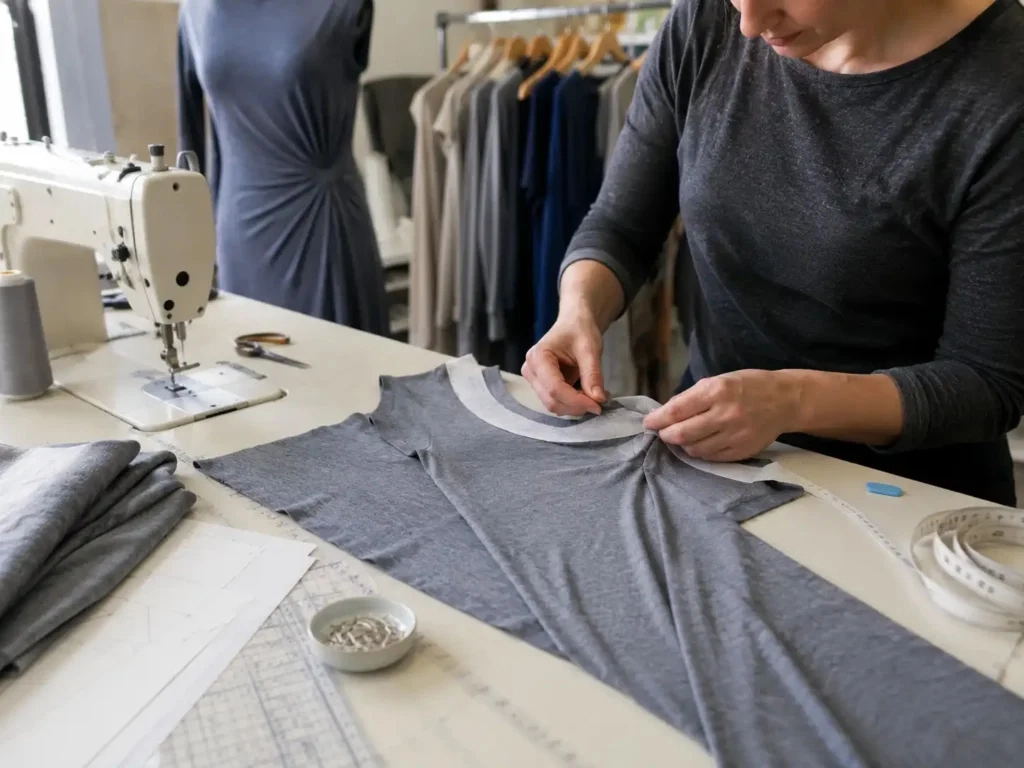
The Fabric Checks We Make Before Approval
When you receive two jersey fabrics that look similar, the specification sheet is only the beginning.
GSM
GSM tells us the fabric weight, but it does not tell us how the finished dress will fit or hang.
Two fabrics can have the same GSM and still differ in:
- stretch
- recovery
- opacity
- drape
- hand feel
- shrinkage
For a knit dress, GSM is one reference point, not the only approval standard.
Stretch
We check how far the fabric stretches and in which direction.
A fitted dress may need substantial crosswise stretch, while the lengthwise behavior can affect the way the garment hangs.
If you only record one stretch percentage, you may miss a problem that appears later in fitting.
Recovery
Recovery becomes especially important when the garment is designed to fit closely to the body.
We stretch the fabric, release it and check how well it returns to its original size. For a fitted dress, we repeat the test because the first stretch does not always show how the fabric will behave after repeated tension.
If the fabric stays noticeably longer or wider after repeated stretching, you need to consider whether that behavior is acceptable for the design.
Shrinkage
For cotton jersey, shrinkage deserves particular attention.
We test the fabric using the washing and drying method expected for the finished garment.
The important point is not simply knowing the shrinkage percentage. You also need to know where the change occurs.
A dress can have an acceptable overall shrinkage result and still have a noticeable change in body length or width.
Drape
A fabric can look good on a roll and still hang badly once it becomes a garment.
For dresses, we prefer to check the fabric on the actual pattern or sample rather than judging the roll alone.
This helps you see how the material behaves around the bust, waist, hip and hem.
Opacity
This matters especially for white, pastel and lightweight dresses.
You should check the fabric when it is relaxed and when it is stretched.
A fabric that looks sufficiently opaque on the table may become much more transparent when pulled across the body.
Why the Same Jersey Can Produce a Different Dress Fit
We have seen this happen even when the fabric was listed under the same composition. The difference was small on the roll, but more noticeable after the dress was sewn and fitted.
This is something buyers sometimes discover only after receiving a sample.
The fiber composition may be the same, but the finished garment can still change because of:
- fabric width
- GSM variation
- stretch direction
- recovery
- shrinkage
- pattern ease
- sewing tension
- finishing process
For example, we may approve a sample made from fabric with strong recovery, but find that the bulk lot has slightly weaker recovery. The difference may not be obvious from the roll, but it can change how the dress sits around the waist and hip.
That is why we use the approved fabric as the production reference, rather than relying only on composition or color.
Our Jersey Fabric Check Before Bulk Cutting
Before bulk cutting, we test the fabric and sample together because problems are much easier to deal with at this stage. This is especially important for OEM and ODM dress production, where the fabric and pattern may be developed together.
1. Check the Incoming Fabric
We start with the actual production fabric, not only the supplier’s specification sheet. Before cutting, we check the composition, GSM, usable width, shade, surface appearance and hand feel.
When we work with a new supplier or a new fabric quality, we record the results so the bulk lot can be compared with the approved reference later.
2. Test Stretch and Recovery
We measure stretch in the directions that matter for the dress, then check how much of that stretch comes back after release. For fitted styles, we repeat the test because one stretch does not always tell us how the fabric will behave after repeated tension.
3. Make the Garment Sample
A fabric swatch is not enough at this stage. We make the sample using the actual construction and check the bust, waist, hip, neckline, seams and hem. This is where problems often become visible that were not obvious from the fabric alone.
4. Wash the Sample
Use the intended care method.
After washing, we compare the measurements with the pre-wash sample and also check whether the dress still has the same overall shape.
5. Compare Bulk Fabric With the Approved Reference
This matters even more on fitted styles. A small recovery difference may hardly be noticed on a loose T-shirt dress, but it can show up quickly around the waist or hip of a bodycon dress.
Before bulk cutting, compare the production fabric with the fabric used for the approved sample.
If the bulk lot has noticeably different stretch, recovery, GSM, width or finishing, it should be reviewed before production continues.
It is much easier to deal with a fabric difference before cutting than after hundreds of pieces have already been sewn.
Cotton or Polyester: Which One Should You Choose?
We normally make the choice from the dress requirements first, then select the fabric.
| If Your Dress Needs… | A Starting Point |
|---|---|
| Soft, casual hand feel | Cotton or cotton-rich jersey |
| Relaxed T-shirt dress | Cotton jersey |
| Strong stretch and recovery | Suitable polyester-spandex or other stretch jersey |
| Easy-care performance | Polyester or polyester blend |
| Close body fit | Stretch jersey with tested recovery |
| Lightweight summer comfort | Lightweight cotton or suitable jersey blend |
| Ruched construction | Jersey with reliable recovery |
| Lower shrinkage | Polyester or a controlled blend |
These are only starting points. We still check the fabric and sample before bulk approval.

Common Mistakes Buyers Make With Jersey Fabric
Choosing by Fiber Name
“Cotton” or “polyester” tells you what the main fiber is. It does not tell you how the fabric will behave in your dress.
Comparing GSM Without Comparing Width
If two fabrics have different usable widths, their consumption can be different even when their GSM is similar.
This can affect your actual cost per finished garment.
Checking Stretch Only Once
A fabric that performs well in the first stretch test may behave differently after repeated stretching or washing.
For fitted styles, repeated testing gives you a better picture.
Approving the Fabric Before Checking the Garment
The fabric needs to work with the pattern.
If the dress has negative ease, gathers or tight areas, the fabric should be checked under those actual conditions.
Changing the Pattern to Compensate for the Wrong Fabric
We sometimes see buyers try to solve a fabric problem by changing the pattern. That does not always work.
If the material has poor recovery or excessive shrinkage, making the pattern smaller may create a garment that fits during the first fitting but does not perform well after wear or washing.
What Should You Tell Your Clothing Manufacturer?
When a new jersey dress project comes to us, specific fabric and fit requirements make the development process much easier. For brands starting a new collection, this can also make communication with a private label clothing manufacturer much more straightforward.
You can provide:
- Reference sample or tech pack
- Dress silhouette
- Finished measurements
- Size range
- Target fabric composition
- Preferred GSM
- Stretch requirement
- Hand-feel reference
- Color reference
- Washing requirements
- Expected order quantity
- Fabric swatch, if you already have one
For example, “polyester jersey” is quite a broad requirement.
A more useful specification would be:
Medium-weight polyester-spandex jersey for a fitted midi dress, with four-way stretch, good recovery, smooth surface and suitable opacity.
That gives the production team something specific to work with during fabric sourcing and sampling.
FAQ
Can cotton jersey be used for a private label dress collection?
Yes. Cotton jersey works well for many casual and comfort-focused dress styles. Before bulk production, we normally check shrinkage and recovery because both can affect the fit after washing.
How can a buyer control fabric cost when ordering jersey dresses?
We normally look at fabric consumption together with the fabric price. Width, GSM, shrinkage and pattern layout can all change the amount used per dress. When comparing quotations, ask for the fabric specification and estimated consumption so the garment cost is easier to compare.
Should buyers approve every new jersey color separately?
Not necessarily, but a production-quality shade should be checked before bulk approval. Dyeing and finishing can slightly change fabric hand feel, width or performance, so we would not treat every color as identical without checking the actual fabric.
What happens if the fabric supplier changes the jersey finishing?
The fabric should be reviewed before it is used for production. A change in finishing can affect hand feel, width, shrinkage, stretch or recovery even when the composition remains unchanged. We would compare the new fabric with the approved reference and check whether the existing pattern and sample are still suitable.
Can a buyer use a fabric swatch to approve a fitted dress?
A swatch is useful when we first select the fabric, but we would not use it as the only approval for a fitted dress. The final garment puts tension on the fabric in specific areas, and seams can change its behavior. For a close-fitting dress, the safer approach is to test the fabric in the actual garment construction before bulk production.
Conclusion
Cotton jersey and polyester jersey can both work well for dresses, but they do not behave the same way once the fabric is cut and sewn.
For us, the sample is usually where the decision becomes clear. We look at stretch, recovery, shrinkage, drape and the finished fit rather than approving a jersey simply because the composition and GSM look right on paper.
For a buyer, checking these points before bulk cutting is much easier than fixing a fit problem after production has started.
Explore More Dress Manufacturing Services
If you are developing a new dress and need support with fabric selection, internal construction, sampling, and bulk production, working with an experienced clothing manufacturer can help reduce unnecessary development changes.
At Xiuyu Apparel, we work with fashion brands, startups, designers, and private label companies from sample development through bulk production.
Get a Clothing Manufacturing Quote Based on Your Design
If you already have a garment design, send us the product photo, tech pack, or reference sample together with your target quantity.
As a dress manufacturer, we can review the fabric, lining, construction, trims, workmanship, and finishing requirements and prepare a quotation based on the actual garment rather than a general price range.

