

When we develop a chiffon dress as a custom chiffon dress manufacturer, the hem can look fine on the sample table and still give us trouble later in production. The fabric may stretch during sewing, a curved edge may ripple after pressing, or the finished width may change around the skirt. We normally test the rolled hem and baby hem on the actual fabric before deciding which one works better for the garment.
Rolled Hem or Baby Hem: Which One Should You Use?
We do not use the same hem finish for every chiffon dress.
For a simple skirt edge, a rolled hem can work well when the finish needs to stay very narrow. With softer chiffon or a more complicated curve, we usually make a second test with a baby hem.
The difference is easier to see on the actual garment. A full skirt, ruffle or bias-cut panel can behave quite differently from a small fabric swatch once it has been sewn and pressed.
We normally make the final hem decision during sampling, after seeing how the fabric behaves on the actual garment.
| Chiffon dress situation | Finish worth testing |
|---|---|
| Simple straight hem | Rolled hem |
| Very lightweight chiffon | Rolled or baby hem, depending on handling |
| Soft flowing skirt | Baby hem may be easier to control |
| Curved hem | Test on the actual pattern |
| Ruffles or flounces | Baby hem is often practical |
| Bias-cut skirt | Test after the fabric has settled |
| Very narrow clean edge | Test both on the actual fabric |
When Does a Rolled Hem Make Sense?
We use a rolled hem when the edge needs to stay narrow and clean without adding much weight to the bottom of the dress.
On chiffon dresses, it is most useful where the edge needs to stay light and narrow, especially on simple skirt or sleeve sections.
With chiffon, however, the sewing machine setting is only part of the job. The fabric needs to feed through the machine without being pulled or pushed. If the operator has to keep adjusting the fabric by hand, the finished width can become inconsistent.
This is easier to spot on a long dress. One section may look almost perfect while another section has a slightly wider edge or a few small ripples.
We pay closer attention to this when the chiffon is very light or the skirt has a long, flowing edge. In those cases, we check several sections around the garment because one clean section does not always represent the whole hem.
When Can a Baby Hem Be a Better Choice?
A baby hem can be useful when the edge is soft, curved or more difficult to control.
This matters when your chiffon dress has:
- curved skirt sections
- ruffles
- flounces
- layered panels
- lightweight sleeves
- irregular or flowing edges
Making the hem smaller does not always solve the problem. The finish still needs to move with the chiffon without making the edge look stiff.
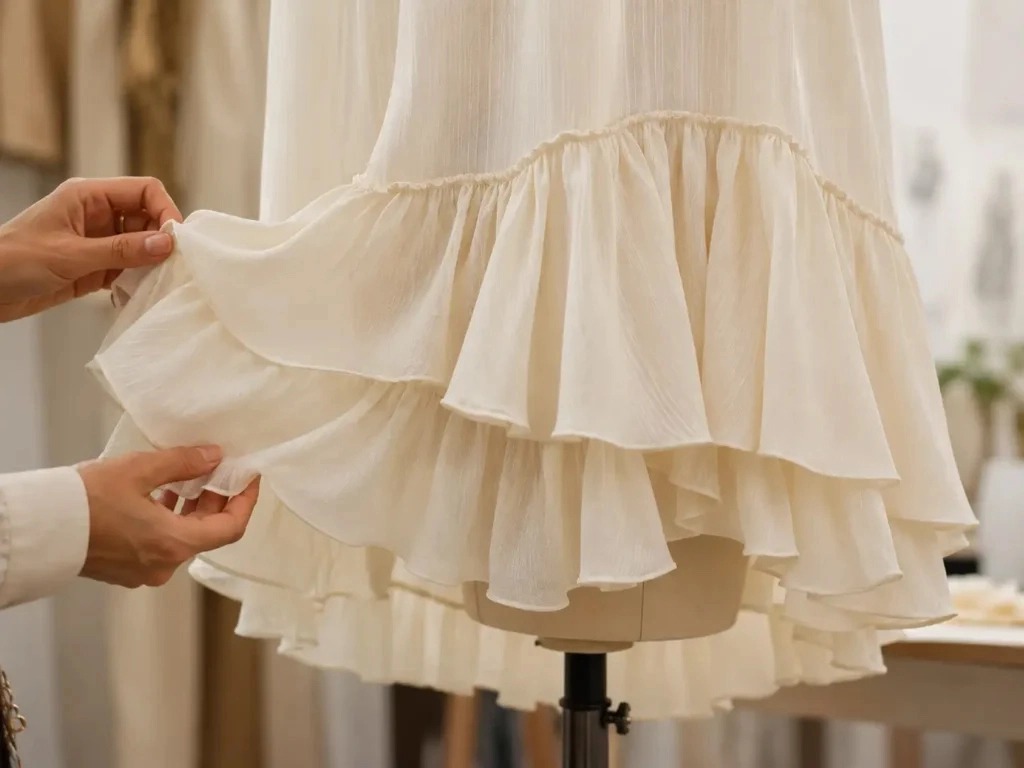
For a soft chiffon ruffle, for example, a technically neat finish may still be unsuitable if it restricts the movement of the fabric. We normally check how the ruffle falls after sewing and pressing rather than judging the stitch line alone.
A quick test on the actual fabric usually gives us the clearer answer.
The Fabric Can Change the Result
Two chiffon fabrics can have the same fiber composition and still behave differently during sewing. This is one reason we pay close attention to fabric behavior during development as a clothing manufacturer.
One may be slightly firmer and easier to feed through the machine. Another may be softer, more slippery or more sensitive to tension.
The difference becomes more obvious when a buyer changes chiffon suppliers during development. Even if the composition and GSM are the same, the new fabric may feel different or behave differently on the machine. In that situation, we test the hem again before bulk cutting.
We also compare the replacement fabric with the approved fabric for hand feel, weight, width and sewing behavior.
We also compare the replacement fabric with the approved fabric for hand feel, weight, width and sewing behavior. If there is a noticeable difference, we test the hem again rather than assuming the original construction will work in the same way.
This check is especially useful before bulk cutting, when there is still time to adjust the construction.
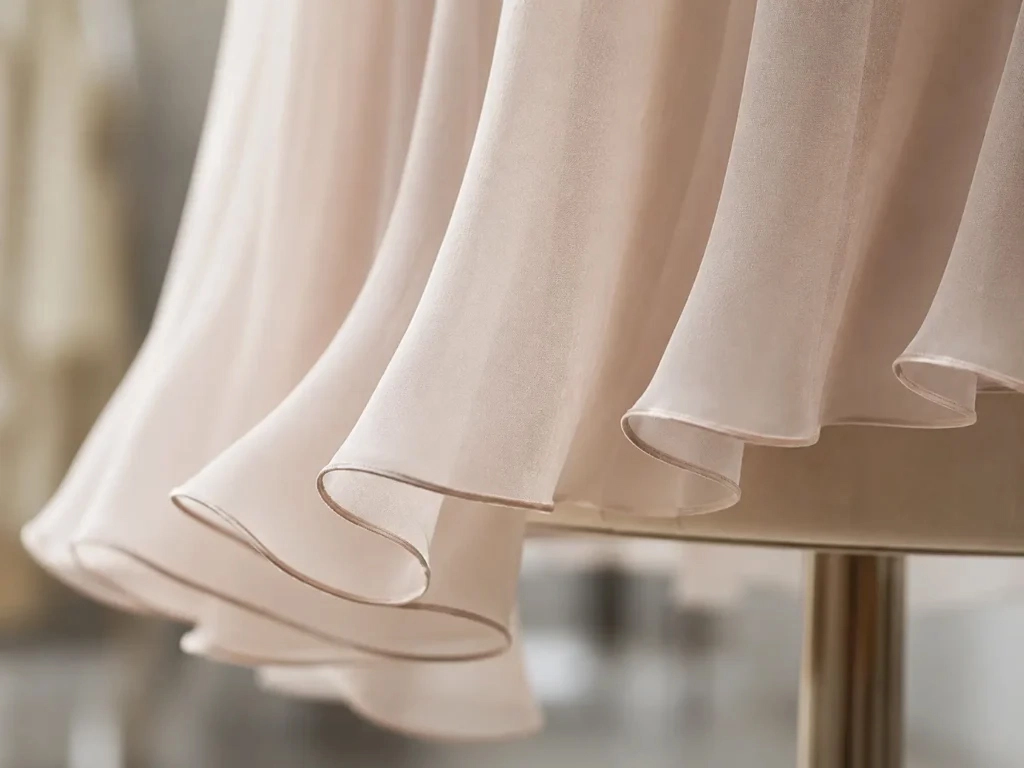
How Hem Shape Affects Chiffon Sewing
Straight hems are usually easier to control because the fabric follows a more consistent path through the machine.
Curved hems need more attention. As the curve changes, the amount of fabric entering the sewing area changes too. On lightweight chiffon, small differences in handling can show up as rippling or an uneven edge.
If your dress has a strongly curved hem, do not judge the construction from the center front alone. Check the tighter curves, side areas and transition points. These are often the first places where an uneven edge becomes visible.
What About Bias-Cut Chiffon Dresses?
Bias-cut chiffon deserves separate attention.
When fabric is cut on the bias, it can relax and change shape after being handled. This means the hem length you measure immediately after cutting may not behave exactly the same way after sewing and hanging.
For a bias-cut dress, it is better to allow the garment to settle before final hem measurements are confirmed.
We have seen samples that looked correct at the first fitting but changed slightly after hanging. In some cases, the sewing was fine. The bias-cut fabric had simply relaxed.
For approval, we normally base the final garment length on how the dress behaves after hanging, not only on the original pattern measurement.
Why Does a Chiffon Hem Become Wavy?
A wavy hem is not always caused by the choice between a rolled hem and a baby hem. In production, we usually check the fabric handling and sewing process as well.
Several things can contribute:
- the fabric is being stretched while sewing
- thread tension is too high
- the fabric is not feeding evenly
- the hem is folded inconsistently
- the operator is pulling the garment through the machine
- the fabric changes shape after pressing
The problem is not always obvious during sewing.
A hem may look acceptable when the garment is laid flat but become uneven once the dress is hanging. Pressing can reveal another difference.
For the final check, we look at the dress hanging as it would normally be worn or displayed.
How We Check the Hem During Sampling
When we sample a new chiffon dress, we do not check the stitch line alone. As a dress manufacturer, we also check the finished hem at several points because some problems do not show up until the dress has been pressed or hung.
For long or bias-cut skirts, we normally leave the garment hanging before confirming the final hem length.
Finished width
We measure the hem at several points around the garment. This helps us catch width changes that are easy to miss when looking at only one section.
Curved areas
Tighter curves receive more attention because they are more sensitive to fabric handling.
After pressing
The hem is checked again after pressing. Some rippling or distortion only becomes obvious at this stage.
While hanging
For long skirts and bias-cut styles, we also check the hem after the garment has settled. This is especially important for long skirts and bias-cut styles.
Against the approved sample
For bulk production, the approved sample remains the reference. If the bulk fabric behaves differently, the production team needs to know before the difference becomes a finished-garment problem.
What Should You Put in the Tech Pack?
You do not need to put every sewing-machine setting into the tech pack. For us, the useful part is being clear about the finished result you want from the factory.
If you are developing a collection with a private label clothing manufacturer, it also helps to make the hem requirements clear in the tech pack from the beginning.
For a chiffon dress, your tech pack can include:
- fabric composition
- fabric weight or GSM
- hem type
- finished hem width
- hem shape
- garment length
- bias-cut or straight-cut construction
- lining requirements
- reference photos or construction details
If the hem is a visible design feature, include it in the first sample instructions.
A clear reference at this stage can save a lot of discussion after the sample has already been made.
What Should You Check Before Approving the PP Sample?
Before approving the PP sample, check the hem from more than one angle.
Check whether:
- the hem width is consistent
- the edge follows the pattern correctly
- curved sections remain smooth
- the fabric still drapes naturally
- the hem looks the same after pressing
- the garment length is correct after hanging
- the finish matches the approved construction
If the dress is made from very soft chiffon, it is also worth checking the hem after the garment has been left hanging for a period of time.
These checks only take a few extra minutes during approval and can save a much bigger correction once bulk production has started.
Which Hem Is Better for Your Chiffon Dress?
If the design has a relatively simple hem and needs a very narrow, clean edge, a rolled hem is often a good starting point.
For soft flowing sections, ruffles or more complicated curves, we would normally test a baby hem as well.
We normally make the final decision after checking the sample. Test the finish on the actual fabric and pattern, then check it after sewing, pressing and hanging.
That gives you a much better indication of how the hem will behave in bulk production.
FAQ
Can the same hem construction be used when the chiffon color changes?
Usually, yes. We still check the fabric lot before bulk cutting, though, because different colors or dye lots can handle slightly differently. If the chiffon feels or sews differently from the approved sample, we would rather test the hem again than assume the original construction will work.
What should you do if the supplier changes the chiffon before production?
If the supplier changes the chiffon before production, we would treat the replacement as a new fabric for approval, even if the composition and GSM are the same.
Compare the hand feel, width, drape and sewing behavior with the approved fabric. If there is a difference, make a quick hem test before bulk cutting. It is much easier to correct the construction at this stage than after the bulk garments have been sewn.
How can a buyer control the finished dress length more accurately?
For lightweight or bias-cut chiffon, we recommend checking the finished length after the garment has been sewn and allowed to hang. The fabric can relax during this time, so the length measured from the cut panels may not be the same as the final garment length.
Is a narrow hem suitable for every chiffon dress?
Not always. A narrow finish can look clean on chiffon, but the edge still needs to suit the fabric and garment shape.
Very detailed ruffles, tightly curved edges or unstable chiffon may need more careful handling. If the hem becomes stiff or starts to ripple, we would test another construction rather than forcing the original specification.
What should a brand do when the first sample and bulk garment look slightly different?
Start by comparing the bulk fabric with the approved fabric. We would then check the garment measurements, hem construction and pressing process.
A difference between the sample and bulk garment is not always a sewing-operator issue. The fabric lot, handling, pressing or construction can all affect the final appearance, so it helps to check these points before changing the sewing method.
Conclusion
For chiffon dresses, we normally confirm the hem during sampling rather than choosing the construction from the sewing method alone. This is one of the practical checks we use as a chiffon dress manufacturer before a style moves into bulk production.
Test the rolled hem or baby hem on the actual fabric and pattern, then check the garment after sewing, pressing and hanging. This is especially important for curved and bias-cut styles.
A short hem test before bulk production is much easier than correcting an uneven hem after production has started.
Explore More Dress Manufacturing Services
If you are developing a new dress and need support with fabric selection, internal construction, sampling, and bulk production, working with an experienced clothing manufacturer can help reduce unnecessary development changes.
At Xiuyu Apparel, we work with fashion brands, startups, designers, and private label companies from sample development through bulk production.
Get a Clothing Manufacturing Quote Based on Your Design
If you already have a garment design, send us the product photo, tech pack, or reference sample together with your target quantity.
As a dress manufacturer, we can review the fabric, lining, construction, trims, workmanship, and finishing requirements and prepare a quotation based on the actual garment rather than a general price range.

