

A zipper can look like a small detail on a dress tech pack, but it can affect fitting, sewing and the final appearance once production starts. From the factory side, the zipper is not confirmed on its own. Fabric, opening position, pattern and fit all affect how it will work on the finished dress. For most dresses, a closed-end zipper is the practical choice, especially for fixed back or side openings. An open-end zipper can work for specific designs, but it requires different construction from the beginning.
Closed-End vs Open-End Zippers: What Is the Difference?
The main difference is at the bottom. A closed-end zipper stays joined when opened, while an open-end zipper separates into two sides.
A closed-end zipper stays connected at the bottom when you open it. The two sides do not come completely apart. This construction is commonly used for dresses, skirts, trousers and other garments with a fixed opening.
An open-end zipper separates completely at the bottom. One side has an insertion pin and the other has a retaining box, allowing both sides to come apart. You will see this construction more often on jackets, coats, hoodies and other garments that need to open fully rather than on conventional fitted dresses.
For you as a brand owner, designer or buyer, the difference is mainly about how the garment needs to open, not simply which zipper looks better.
Closed-End vs Open-End Zipper Comparison
| Feature | Closed-End Zipper | Open-End Zipper |
|---|---|---|
| Bottom | Remains connected | Separates completely |
| Common use | Dresses, skirts, trousers | Jackets, coats, outerwear |
| Typical dress position | Back or side opening | Full front opening |
| Main purpose | Provides access to the garment | Allows complete separation |
| Dress application | Very common | Less common |
| Construction | Fixed opening | Separating opening |
If you are developing a conventional dress with a center-back or side opening, you will normally start with a closed-end zipper.
That does not mean every dress should use one. The construction should be settled before the zipper specification is finalized.
Which Zipper Is Better for Dresses?
For most dresses, a closed-end zipper is the more practical choice.
Think about a typical evening dress. The back zipper needs to open far enough for the wearer to put the dress on, but there is normally no need for the two sides to separate completely. Keeping the bottom connected works well for this type of construction.
This construction is common on fitted, cocktail, evening, satin, slip and bodycon dresses, as well as many skirts where the opening stays fixed.
An open-end zipper becomes more relevant when the design is intended to open completely, such as a full-front dress influenced by jacket or outerwear construction.
The first question is whether the garment actually needs to open completely.
If the answer is no, a closed-end construction will usually be the starting point.
Why the Fabric Matters More Than You Might Expect
A zipper that worked well on one style is not necessarily suitable for another. Fabric weight, surface finish and seam construction can all change how it behaves.
The same zipper can behave differently on different fabrics.
Satin
Satin needs more attention around the zipper because the surface is smooth and small sewing problems can show clearly on the finished dress. A zipper may look acceptable during installation but show puckering, waviness or fabric pulling after pressing.
For a satin dress, the zipper should be tested on the sample fabric before the construction is approved. A zipper that looks fine on its own can behave differently once it is sewn into a smooth, lightweight fabric.
You may see:
- Puckering
- Wavy zipper tape
- Fabric pulling
- Uneven seam appearance
Chiffon
Chiffon is much less stable than a heavier woven fabric, so the zipper area can move during sewing. If the seam is not supported properly, the zipper may look wavy or pull the fabric after installation.
This is why the zipper needs to be tested on the chiffon selected for the dress, rather than judged from the zipper specification alone.
A zipper that feels perfectly acceptable on a stable woven fabric may not produce the same result on chiffon.
Velvet
Velvet needs a different approach because the pile can be affected by sewing and pressing. Around the zipper, we check not only whether the zipper runs smoothly, but also whether the fabric surface has been flattened or marked during production.
When reviewing the sample, look at the zipper area from several angles rather than checking only the opening and closing.
Stretch Fabric
With stretch dresses, the zipper area can be affected by body movement and garment tension.
If the dress is tight around the waist or hips, the fabric beside the zipper may be pulled when the wearer moves.
In that situation, changing the zipper alone may not fix the problem. You may need to look at the pattern, seam allowance, garment ease and zipper placement together.
How Your Dress Design Affects the Zipper
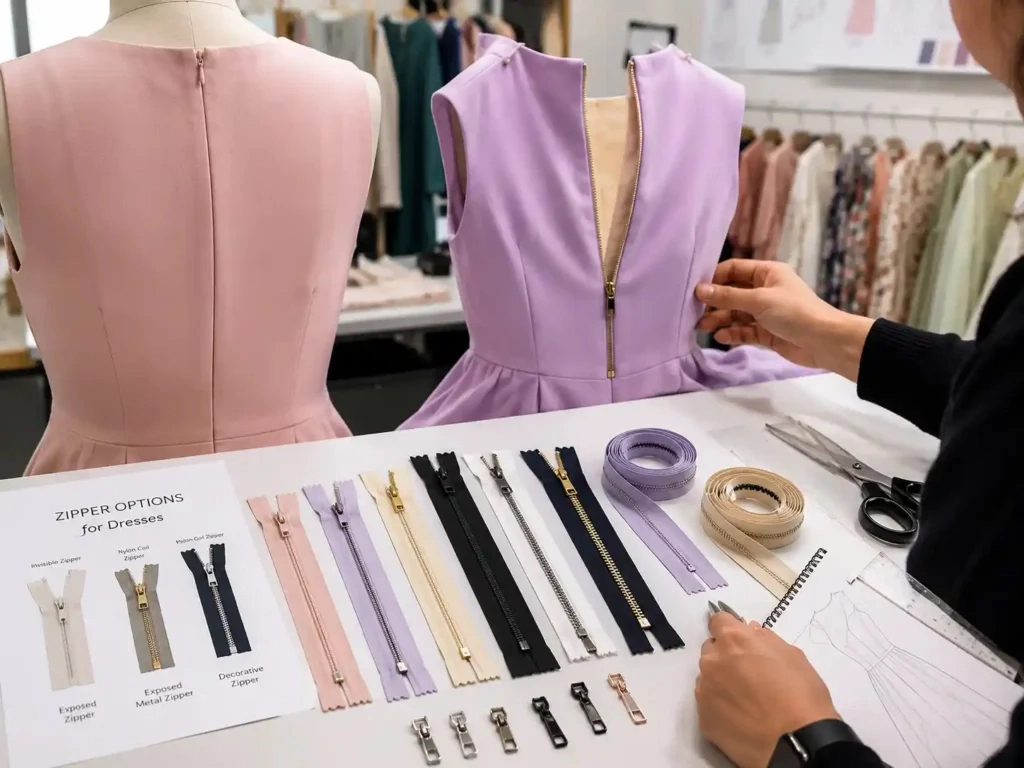
The zipper specification is best confirmed together with the pattern rather than waiting until the sewing stage. Opening position, finished length, garment ease and fabric stretch can all affect how the zipper works on the finished dress.
At the sample stage, the main points to review are:
- Where the opening is located
- How long the opening needs to be
- How the garment is put on
- Where the zipper ends
- How much ease the dress has
- Whether the fabric stretches
- Whether the dress is lined
- How much tension reaches the zipper area
For example, a fitted dress that goes over the hips may need a longer opening than a loose dress, even when both styles use a similar zipper construction.
For this reason, we check the actual sample before finalizing the zipper specification. A tech pack drawing gives a dress manufacturer the construction details, but the finished sample shows how the zipper behaves with the actual fabric and fit.
Closed-End Zippers for Back and Side Openings
A closed-end zipper is particularly common when your dress has a back opening.
For a center-back zipper, the zipper length needs to match the finished opening and the way the garment is put on. The top and bottom positions also need to work with the neckline, waist, lining and seam construction.
Side zippers need a little more attention around the waist, hip and lining.
You may use a side opening to keep the back and front of the dress visually clean. But because the zipper is positioned closer to the side seam, you still need to check how it interacts with the waist, hip and lining.
The important point is not simply choosing a “standard zipper length.”
The finished garment should determine the specification.
When Would You Use an Open-End Zipper on a Dress?
Open-end zippers are not normally the first choice for conventional dresses.
But there are designs where they make sense.
You might use one when:
- The front of the dress needs to open completely
- The garment has a detachable construction
- The design is intentionally based on outerwear
- The zipper is part of the visual design
- The wearer needs to separate both sides completely
If your designer specifies an open-end zipper, the pattern needs to accommodate the construction from the beginning.
You should not simply replace a closed-end zipper with an open-end version without checking the opening, bottom construction and fitting.
Zipper Length Can Cause Problems During Production
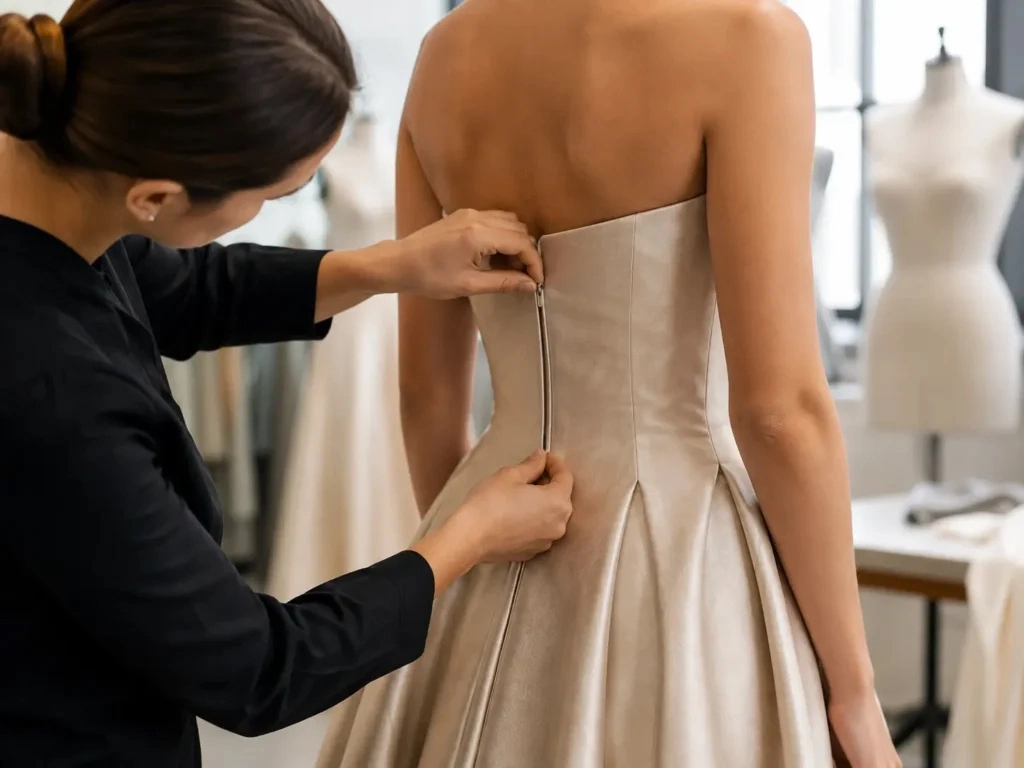
Zipper type gets most of the attention, but length is often where production problems start.
If the zipper is too short, you may find that the wearer struggles to get the dress over the shoulders or hips.
If it is unnecessarily long, the pattern and finishing may need to be adjusted.
When you are preparing a tech pack, it is better to specify the finished zipper length and opening position rather than leaving the factory to make a general assumption.
The finished sample will show whether the opening actually works for the garment.
If the sample needs a longer or shorter zipper, make that change before bulk production rather than trying to solve it after cutting.
What Happens If the Zipper Is Changed After Sampling?
This is where a small trim change can become a production issue.
A different zipper may have:
- Different tape width
- Different tooth size
- Different slider
- Different stiffness
- Different tape color
- Different thickness
Even when the replacement zipper has the same nominal length, the result can still be different. Tape width, stiffness, tooth size and slider shape can change how the zipper sits against the garment and how easy it is to sew.
For a new brand placing its first production order, this matters because the approved sample becomes the reference for bulk production.
If a zipper needs to be changed after approval, you should request confirmation of the replacement before the factory starts bulk production.
Common Dress Zipper Problems
The zipper itself is not always the root cause when something looks wrong.
Zipper Puckering
Puckering is not always caused by the zipper itself. Sewing tension, seam allowance, fabric handling and pressing should be reviewed before the zipper specification is changed.
Wavy Zipper Tape
This is more noticeable on lightweight fabrics. If the tape is straight before sewing but becomes wavy afterward, the sewing operation and fabric tension around the seam are the first places to investigate.
Fabric Pulling
On a tight dress, the fabric beside the zipper can be under tension when worn. In that case, the pattern, fit and zipper placement need to be reviewed together before changing the zipper itself.
Difficult Opening
The zipper may work normally but still provide insufficient opening for the wearer to put the garment on.
Uneven Installation
If the zipper is not positioned consistently, one side of the garment can look higher or lower than the other.
When you inspect a pre-production sample, check the zipper while the garment is flat and again when it is worn. Some problems are difficult to see until the fabric is under normal body tension.
How We Check a Dress Zipper During Sampling
When developing a new dress sample, the zipper is reviewed as part of the finished garment rather than as a separate trim.
After the zipper is sewn into the dress sample using the approved fabric and pattern, we check:
- Opening and closing
- Finished zipper length
- Straightness of installation
- Seam appearance
- Fabric tension
- Zipper visibility
- Lining behavior
- Garment fit
For satin, chiffon and other delicate fabrics, the zipper area needs another check after pressing. Some problems only become visible after the garment has gone through the normal finishing process.
If you are developing several colors of the same style, compare the fabric weight and finish between colors as well. A construction that works well in one color should still be verified if the fabric specification changes.
What Should You Put in Your Dress Tech Pack?
If you are sending a dress design to a clothing manufacturer, avoid writing only “zipper” in the trim section.
Give the production team enough information to reproduce the approved sample.
Your tech pack can include:
- Zipper type
- Finished zipper length
- Zipper position
- Zipper color
- Zipper finish
- Slider or puller details
- Zipper reference or supplier
- Seam construction
- Opening measurement
- Construction drawing
You do not necessarily need to specify every component if you are open to factory sourcing, but the performance and appearance requirements should be clear.
This gives the factory room to source suitable materials while keeping the finished garment close to your approved design.
What Should Buyers Check Before Bulk Production?
Before you release the order, check the zipper on the approved dress sample rather than relying only on the written specification.
Before bulk production starts, make sure the approved sample confirms the following:
- The zipper opens smoothly.
- The finished opening is long enough.
- The zipper sits flat on the garment.
- The surrounding fabric does not pull excessively.
- The zipper color and finish match the design.
- The lining does not catch in the zipper.
- The approved zipper specification is recorded for bulk production.
For private-label and wholesale orders, this last step is easy to overlook.
A clear trim specification gives the production team a reference when materials are ordered again, especially when you plan to repeat the same dress in new colors or future seasons.
FAQ
Can a manufacturer source the zipper if I only provide the garment design?
Yes. We can source the zipper based on the garment design, fabric, color and construction. During sample development, we first confirm the type, length and finish, then test the zipper after it is sewn into the dress. If something does not work well, it is easier to adjust at this stage than during bulk production.
What should I do if my zipper supplier has a long lead time?
If your zipper supplier has a long lead time, let us know before bulk production starts. We can check our regular zipper suppliers for available stock or a similar specification. For urgent orders, confirming the zipper during sampling helps avoid a supplier delay later in the production schedule.
Should the same zipper be used for every color of the same dress?
Not always. We usually match the zipper color and finish to each garment color, especially for light or delicate fabrics where the zipper can be noticeable. For bulk orders, we check the zipper against the actual fabric rather than assuming one zipper color will work across every colorway.
Can I change the zipper specification after the purchase order is placed?
You can request a change, but it depends on where we are in production. If the zipper has not been ordered, it is usually easier to adjust. Once materials are purchased or cutting and sewing have started, a change may affect cost, lead time, or the approved sample.
What is more important: zipper quality or zipper construction?
Both matter, but we usually look at construction first because even a good zipper can cause problems if it is sewn with the wrong seam allowance, tension, or placement. The zipper also needs to suit the fabric weight. In production, we check the zipper and garment construction together, not separately.
Conclusion
For most dresses, a closed-end zipper is the practical choice for a fixed back or side opening. But the zipper still needs to work with the fabric, pattern, opening length, stretch and lining. Testing it on the finished sample before bulk production is the safest way to catch construction problems early.
If you are developing a new dress, Xiuyu Apparel can review the zipper construction and sample details with you before production. We work with brands, designers and wholesale buyers on OEM and private-label dress production, including sample development and bulk manufacturing.
Explore Our Clothing Manufacturing Solutions
- Dress Manufacturer
- OEM Dress Manufacturer
- Maxi Dress Manufacturer
- Corset Dress Manufacturer
- Lace Dress Manufacturer
Get a Clothing Manufacturing Quote Based on Your Design
If you already have a garment design, send us the product photo, tech pack, or reference sample together with your target quantity.
We can review the fabric, lining, construction, trims, workmanship, and finishing requirements and prepare a quotation based on the actual garment rather than a general price range.