

How to Compare Custom Dress Manufacturers Before Placing a Bulk Order
When you compare custom dress manufacturers, the first quotation only shows part of the picture. Problems often show up later, during sampling or production: the fabric was quoted differently, a measurement needs to be changed, the MOQ does not fit your order plan, or the quoted lead time starts from a different point than you expected.
Before placing a bulk order, compare the production details behind the quotation, not just the unit price.
Start With the Same Product Information
Before you compare manufacturers, make sure they are pricing the same dress.
The problem is that suppliers often do not receive the same information. One may get a complete tech pack, while another only gets a reference photo. One may know the fabric composition and weight, while another has to make an assumption.
That makes the quotations difficult to compare later.
For a custom dress, the information that can affect the quotation includes:
- Fabric composition and weight
- Lining
- Measurements
- Size range
- Construction details
- Closures
- Trims
- Printing or embroidery
- Embellishment
- Quantity by color and size
- Label requirements
- Packaging
If some of these details are not decided yet, tell the manufacturer.
If the fabric is still being selected, say so. The same applies if the quantity is only an estimate or the packaging has not been finalized. The factory can then make clear which assumptions are being used for the quotation.
A fitted satin dress is a good example. The fabric can affect the pattern, lining, sewing and pressing. A loose cotton dress may have a completely different production setup.
In our sample room, garment construction is one of the things we check before treating a quotation as a production price. Make sure the manufacturers you compare are working from the same level of detail.
Check Whether the Factory Has Relevant Dress Experience
A factory may make dresses every day and still have more experience with some constructions than others.
This is especially noticeable when the style includes fitted panels, structured bodices, delicate fabrics, stretch materials, draping, sequins, beading or unusual closures.
Instead of asking only:
Do you make dresses?
Ask questions that relate to your product.
- Have you made similar silhouettes?
- Have you worked with this type of fabric?
- Can you handle the required size range?
- Have you produced similar lining or closure constructions?
- Can you handle the finishing details?
- Can you show examples of comparable work?
You do not need a factory that has produced your exact design. A new collection may contain details the factory has never seen before.
More importantly, see whether the production team can identify the difficult parts before sampling or bulk production starts.
For example, a stretch fitted dress may need a different approach to pattern allowance and sewing tension than a loose woven dress. A heavily embellished style may require different handling from a simple printed dress.
A long list of dress styles on a factory website does not tell you much by itself. The better question is whether the factory has handled constructions similar to yours.
Look at How the First Sample Is Developed
A first sample will usually tell you more about the factory’s working process than a company profile will.
You can see whether the manufacturer understood your measurements, fabric, construction and finishing requirements.
When you receive the sample, check the obvious points first:
- Bust, waist and hip measurements
- Garment length
- Neckline and armhole
- Sleeve or strap position
- Closure placement
- Fabric and lining
- Seam construction
- Finishing
Then look at what happened before the sample arrived.
Did the factory ask about unclear measurements?
Did someone question a construction detail that might be difficult in production?
Did the fabric need to be changed?
Did the pattern require adjustment?
A first sample may need corrections. That is not unusual in custom clothing.
The more useful question is whether the correction process is controlled.
For a fitted dress, for example, changing the bust measurement may also affect the waist, side seam and overall balance. A simple instruction such as “make the bust larger” may therefore require more than changing one number on a measurement sheet.
Keep the comments and revised measurements for each supplier. After two or three rounds, you will have a clearer record of how each factory handled the revisions.

Pay Attention to How the Factory Handles Corrections
This is one of the areas buyers often discover only after placing an order.
A sample may come back with several points that need adjustment:
- Length is too short
- Waist is too loose
- Strap position needs changing
- Lining is pulling
- Sleeve opening needs adjustment
- Closure needs to move
- Fabric does not behave as expected
What happens next?
You want to know whether the manufacturer can connect the correction to the pattern and the next sample.
A correction list by itself is not enough. The pattern maker also needs to know what changed and whether that change affects other measurements or construction points before the next sample is cut.
Keep the first sample, your comments, and the revised sample together. After a few rounds, you can see whether the factory is actually fixing the pattern or simply making isolated changes.
You can then ask:
Did the second sample actually solve the problems found in the first one?
A “free revision” promise does not tell you whether the second sample will actually fix the first sample’s problems.
Check How Production Information Is Controlled
A custom dress can have several versions before bulk production.
The fabric may change.
The color may change.
The length may change.
A designer may revise the neckline.
A buyer may change the quantity.
The packaging may be updated later.
These changes are manageable when the final information is clear. They become risky when different versions remain in circulation.
Imagine that the pattern room has an earlier measurement sheet while the purchasing team has already approved a revised version.
The difference may not be noticed until garments are on the sewing line.
Before bulk production, ask:
Which documents are the final production reference?
Before bulk production starts, our production team needs one clear reference for the approved sample, final measurements, fabric, trims, labels and packaging. If two versions are still circulating, the risk is no longer just a paperwork issue.
This is why the factory may ask you to confirm the latest version before production. The pattern room, cutting room and sewing line all need to work from the same information.
If several people from your company are involved, keep the same rule internally. A designer, buyer and purchasing manager can all provide input, but the factory should receive one confirmed production version.
Compare MOQ Against Your Actual Order Plan
“MOQ: 100 pieces” does not tell you everything you need to know.
A supplier may tell you:
MOQ: 100 pieces
That still leaves several questions.
Is the 100 pieces:
- Per style?
- Per color?
- Per fabric?
- Per order?
- Mixable across sizes?
- Different for custom colors?
- Different for custom fabric?
- Different for special trims?
This becomes particularly important for new fashion brands.
Suppose you are preparing four styles and want two colors for each. A factory quoting 100 pieces per style gives you a very different buying requirement from a factory asking for 100 pieces per color.
Fabric can also have its own minimum.
Your garment order might be small enough for the factory to accept, while a fabric supplier requires a larger quantity for a custom color or special material.
Ask about these conditions before you approve the quotation.
A low MOQ written on the first page of a quotation does not necessarily mean the whole product can be developed at that quantity.
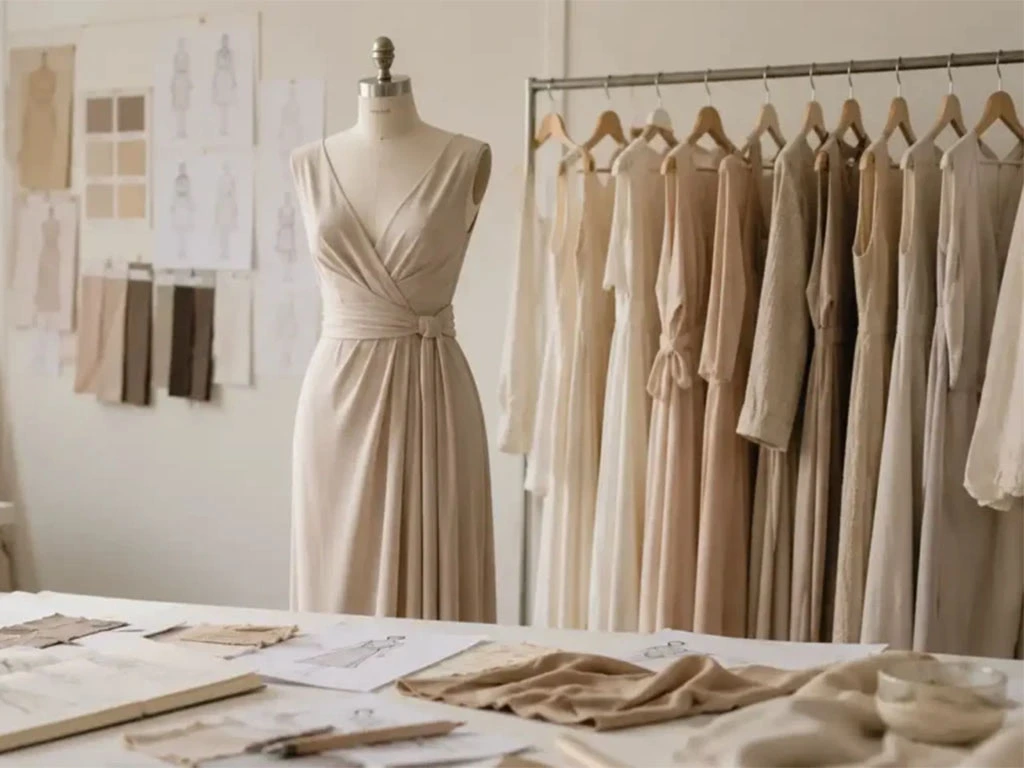
Do Not Compare Unit Prices Until the Quotations Match
You may receive three prices:
| Supplier | Quoted Unit Price |
|---|---|
| A | $18.20 |
| B | $19.40 |
| C | $17.80 |
The $17.80 price will probably get your attention first.
First check what each number represents.
Compare:
| Cost Item | Supplier A | Supplier B | Supplier C |
|---|---|---|---|
| Main fabric | |||
| Lining | |||
| Trims | |||
| Labels | |||
| Packaging | |||
| Printing | |||
| Embroidery | |||
| Special finishing | |||
| Sampling | |||
| Quantity basis |
Fabric is often where a simple price comparison becomes misleading.
“Polyester satin” is not one exact fabric. Weight, width, finish, hand feel and drape can vary considerably.
If one supplier uses a lighter satin for the quotation and another prices the fabric specification in your tech pack, their unit prices are not really comparable.
Packaging creates similar differences.
One quotation may include branded labels, hangtags, individual polybags and cartons. Another may cover the garment only.
Before calling one factory cheaper, make sure the three quotations are based on the same specifications.
Ask What Happens to the Fabric Before Cutting
The fabric is already part of the production risk before the first garment is sewn.
When comparing manufacturers, ask what checks are carried out after the fabric arrives.
Depending on the material, the factory may need to check:
- Fabric width
- Color and shade
- Weight
- Surface defects
- Shrinkage
- Stretch and recovery
- Fabric direction
- Dye lot consistency
Some materials may also require pre-shrinking or other preparation.
Two manufacturers can use the same fabric specification but handle the incoming material differently.
A difference in usable width can affect the cutting marker.
Unexpected shrinkage can affect finished measurements.
Different dye lots can create shade differences within the same order.
These issues are much easier to deal with before bulk cutting.
Instead of asking only whether a factory has QC, ask:
What do you check before the fabric is released to cutting?
This tells you more about where QC happens than simply knowing that the factory has a QC department.
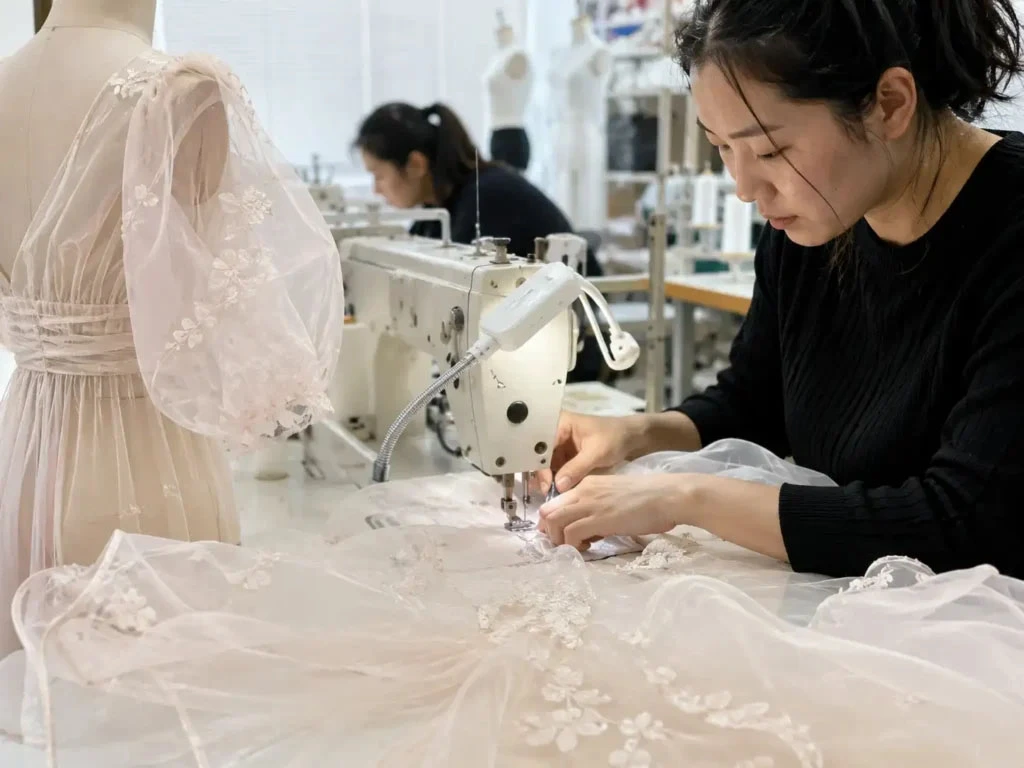
Find Out Where Quality Is Checked During Production
A final inspection is important, but it is not the only point where production quality should be checked.
Ask how the factory checks the garment while the order is running.
A dress may pass through:
Bulk Cutting → Sewing → In-line Inspection → Pressing → Final Inspection → Packing
The checks are different at each stage. Cutting is mainly about panel accuracy and fabric direction. During sewing, measurements and construction become the main concerns. Pressing can change the shape of the garment, while final inspection catches issues before packing and shipment.
In-line inspection matters because repeated sewing problems are cheaper to correct while production is running than after the full quantity is finished.
For example, if a sewing operation is creating an uneven seam on the first part of the production run, finding it early gives the production team a chance to correct the process. Finding the same issue after the entire quantity is finished creates a much larger rework problem.
A longer QC checklist does not necessarily tell you more.
Ask where the checks happen and what happens when an issue is found.
Compare Lead Time From the Same Starting Point
“25 days” does not mean much unless you know when the factory starts counting.
One factory may say:
25 days after order confirmation.
Another may mean:
25 days after fabric arrival.
Another may start counting only after PP sample approval and material confirmation.
Before accepting the quoted lead time, ask what event starts the clock:
What needs to be completed before bulk production starts?
Confirm whether the following are ready:
- Final pattern
- Approved PP sample
- Fabric
- Color
- Trims
- Quantity
- Labels
- Packaging
- Purchase order
In practice, the schedule may look more like:
Sample Development → Fit Revision → PP Approval → Fabric Preparation → Bulk Production → Final Inspection → Shipment
If you compare lead times without checking the starting point, a supplier with a shorter quoted production period may not actually give you the earlier shipment date.
This is especially important for seasonal collections.
Your launch date depends on the whole development and production schedule, not just the days the garments spend on the sewing line.
Check Whether Capacity Fits Your Buying Pattern
Factory capacity also needs to match the way you buy.
You may start with several styles in smaller quantities. If one style sells well, the order may later move from 100 pieces to 500 or 1,000 pieces.
Ask:
- What order quantities does the factory normally handle?
- How is capacity planned during peak seasons?
- Can the factory run several styles at the same time?
- What happens when a repeat order is needed?
- Can production volume increase later?
Do not judge capacity from the monthly production figure alone.
A factory may have a large total capacity but limited room for your type of dress during the weeks you need production.
Repeat orders are worth discussing at the same time. If a style becomes a core product, you will want the same fabric, pattern, measurements and construction to be available when you reorder.
Check Private Label Details Before Bulk Production
For private label orders, sewing the dress is only part of the production.
You may also need:
- Brand labels
- Size labels
- Care labels
- Hangtags
- Barcodes
- Custom polybags
- Cartons
- Folding instructions
These requirements should be settled before packing begins.
Some details can also affect sewing.
For example, a label position needs to be known before the relevant operation reaches the sewing line. It is much easier to confirm this during sample development than after hundreds of garments have been completed.
Packaging needs the same attention.
If your retailer requires a specific barcode, carton marking or quantity per carton, make sure the factory receives that information before packing.
When comparing factories, ask how these details are recorded and checked. “Private label available” by itself does not tell you how the factory will handle them.
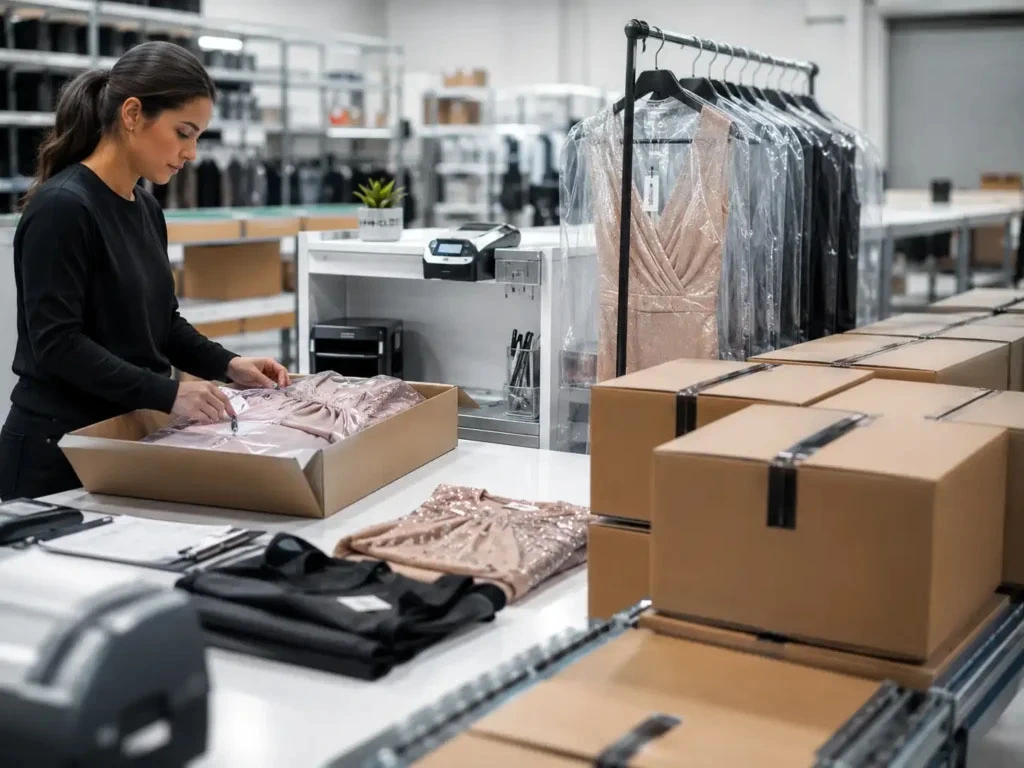
Look at the Questions Asked Before Sampling
The questions a manufacturer asks before sampling can also tell you how they are approaching the order.
Suppose you send a dress reference and receive a price immediately.
That may be useful for an early estimate, but you should still ask what assumptions were used.
Now compare that with a factory that asks about:
- Fabric composition
- Fabric weight
- Lining
- Measurements
- Size range
- Construction
- Quantity
- Color
- Trims
- Finishing
Asking more questions does not automatically make a factory the right fit. But it does show which production details they are looking at before giving you a price.
In production, unclear information is much easier to correct before the pattern is finalized and fabric is cut.
Pay attention to what the factory needs to know before giving you a firm quotation.
Build One Comparison Sheet for All Manufacturers
Once you have contacted several suppliers, put their information into the same format.
| Comparison Point | Manufacturer A | Manufacturer B | Manufacturer C |
|---|---|---|---|
| Relevant dress experience | |||
| Fabric capability | |||
| MOQ conditions | |||
| Sample development | |||
| Sample revision | |||
| Quotation scope | |||
| Fabric inspection | |||
| In-line QC | |||
| Final inspection | |||
| Lead time | |||
| Production capacity | |||
| Private label | |||
| Packaging | |||
| Repeat-order process |
Do not turn this into a scorecard too quickly.
First record the actual differences.
For example:
- One factory has a lower garment price but excludes packaging.
- Another accepts your order quantity but has a separate fabric minimum.
- Another takes longer to develop the first sample but provides more detailed production feedback.
- One manufacturer can handle the dress construction but has limited availability during your required production period.
Those differences are more useful than a simple 1-to-10 score.
You can then discuss the comparison with your designer, buyer, or purchasing team based on the requirements of the actual order.
Send the Same Information to Each Manufacturer
Once you have your comparison sheet ready, use the same information when contacting each factory.
For an initial quotation, this may include:
- Reference photos or sketches
- Tech pack, if available
- Measurements
- Fabric requirements
- Color
- Size range
- Estimated quantity
- Construction details
- Label requirements
- Packaging requirements
- Target delivery date
Not every detail has to be final. If the fabric is still open, say so. If the quantity is an estimate, give a range. If the design is changing, mark which details are fixed and which are still under discussion.
The important part is that the factories are working from the same starting information. Otherwise, the price difference may come from different assumptions rather than different manufacturing costs.
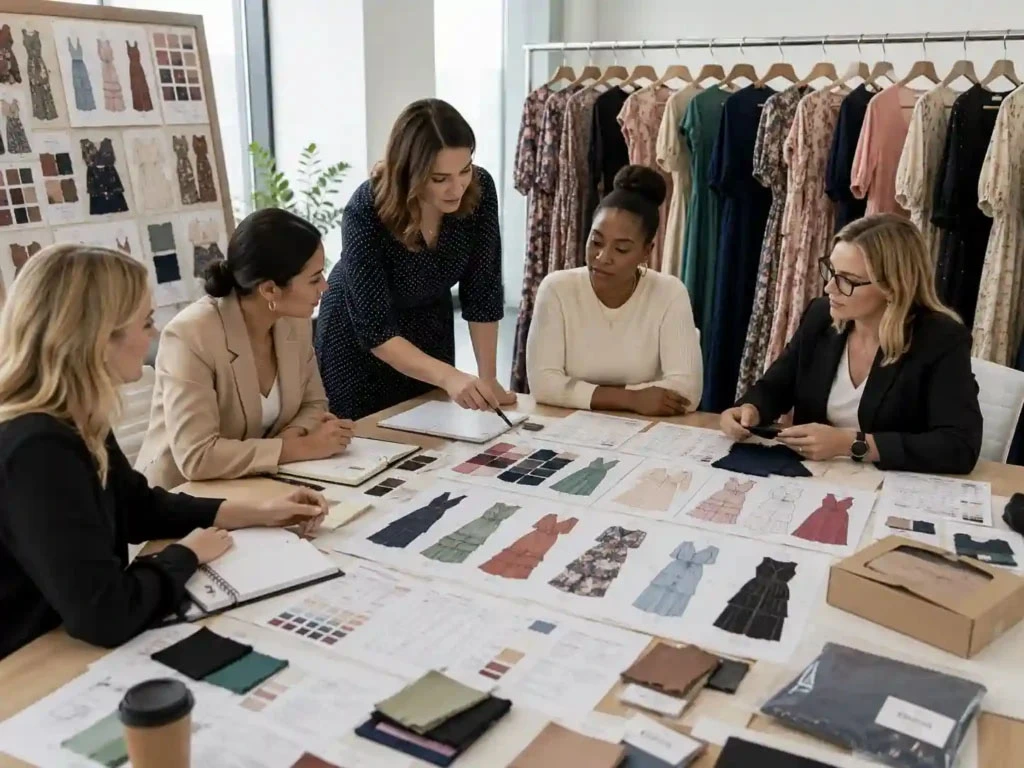
Before You Place the Bulk Order, Check the Production Reference
Before bulk cutting, make sure the factory has one confirmed production reference covering:
- Approved sample or PP sample
- Final measurements
- Final pattern reference
- Approved fabric
- Color
- Lining
- Trims
- Quantity
- Labels
- Packaging
- Delivery requirements
If anything changed after the original quotation, make sure the latest version is reflected in the production documents.
For example, if the first quotation used one fabric and the final order uses another, the original price is no longer a useful reference. The same applies to changes in construction, quantity or packaging.
The final comparison should be based on the product you are actually ready to put into production.
A Practical Way to Compare the Final Options
Before placing the order, review the quotations and sample notes together.
Check:
- Relevant product experience
- Sample development
- Revision handling
- Material control
- MOQ conditions
- Quotation scope
- Production QC
- Lead time
- Capacity
- Private label requirements
- Repeat-order control
One factory may have a lower garment price but exclude packaging. Another may accept your garment quantity but require a larger fabric minimum. Another may need more time for sampling but have already identified a construction issue in your design.
These are the details worth discussing with your purchasing team before the PO is released.
The factory you choose needs to fit the actual order: the construction, quantity, production window and commercial requirements.
FAQ
What should you do if a factory refuses to quote from a reference photo?
Ask which information is missing rather than asking the factory to guess. For many dresses, fabric weight, lining, measurements, construction and quantity can change the cost considerably. A factory may still provide a rough range, but the final quotation should wait until the important assumptions are clear.
Is it normal for a manufacturer to request a physical reference sample?
Yes, particularly when the garment has construction or fit details that are difficult to describe in a photo. A physical sample can show proportions, fabric behavior, stitching and finishing more clearly. If you send one, keep a record of exactly what the factory is expected to copy and what you want changed.
What if your brand has no fixed delivery date yet?
Give the manufacturer the target selling season or approximate launch period. You do not need to give an exact date if the launch schedule is not fixed. This allows the factory to discuss sampling and production timing while there is still room to adjust the development schedule.
Should you ask a manufacturer for customer references?
You can ask, but some factories cannot disclose customer information because of confidentiality agreements. In that case, ask for examples of similar products, production photos, sample-development information, or an explanation of how comparable orders are handled. These can still help you understand the factory’s experience.
What should you do if a manufacturer changes the quotation after sampling?
First identify what changed between the original quotation and the sample. The difference may come from fabric, construction, measurements, trims, quantity, or another specification that was unclear initially. Ask the factory to identify the changed cost item rather than discussing only the new total price.
Conclusion
Before placing a bulk order, make sure the factories are quoting the same product, material requirements, quantity basis and production starting point.
A $17.80 quotation and a $19.40 quotation may look far apart at first. The difference could come from fabric, lining, packaging, MOQ, sampling, or simply different assumptions in the quotation.
Once those points are confirmed, you can compare how each factory handles sampling, revisions, material control, production QC, quantity and delivery.
By then, the unit price is only one part of the comparison. You also know what is included in the price and how the factory plans to handle the order.
Related Dress Manufacturing Services
If your project involves a specific dress fabric or construction, you can also review our related manufacturing pages:
- Silk Dress Manufacturer
- Mini Dress Manufacturer
- Party Dress Manufacturer
- Formal Dress Manufacturer
- One Shoulder Dress Manufacturer
Get a Quote for an Existing Dress Style
If you are transferring an existing dress style to a new manufacturer, send us the latest approved sample, tech pack, product photos, or measurement chart together with your target quantity.
As a dress manufacturer, we can review the construction, fabric, trims, measurements, and current production status with you before confirming the sampling requirements.

