

When you are sourcing dresses for a new collection, the choice between OEM and private label can change how much development work your team needs to handle. From the factory side, we normally discuss this before sampling. As a clothing manufacturer, we often see buyers unsure whether an existing style can be adapted enough for their brand. The right starting point usually becomes clearer once we look at the actual dress, the changes required, and the expected order.
OEM and Private Label Start From Different Places
The starting point is usually the clearest difference.
With OEM dress manufacturing, you normally bring the product requirements to the manufacturer. That might be a tech pack, sketch, reference garment, measurement chart, fabric specification, or a combination of these.
The factory then works from those requirements to develop the garment for sampling and production.
With private label dress manufacturing, you normally start from an existing or adaptable style. You may select a dress from a manufacturer’s available range and change the fabric, color, length, fit, labels, or packaging for your brand.
The amount of development required can be very different between the two.
What OEM Dress Manufacturing Looks Like in Practice
OEM works well when the product itself is already an important part of your brand strategy.
You may have designed a dress with a specific neckline, waist position, skirt volume, sleeve shape, or fabric. You need those details to remain close to your original concept when the garment moves from drawing to sample and then into bulk production.
In that situation, the factory is doing more than producing a finished design. There is usually development work before the garment is ready for bulk production.
A sample may reveal that the neckline needs support, the fabric is too soft for the intended shape, the sleeve needs more ease, or the skirt is using more fabric than expected. Those changes are part of getting the product ready for production.
For a designer or brand with a clear product direction, keeping those details under control is often more important than getting the first sample out as quickly as possible.
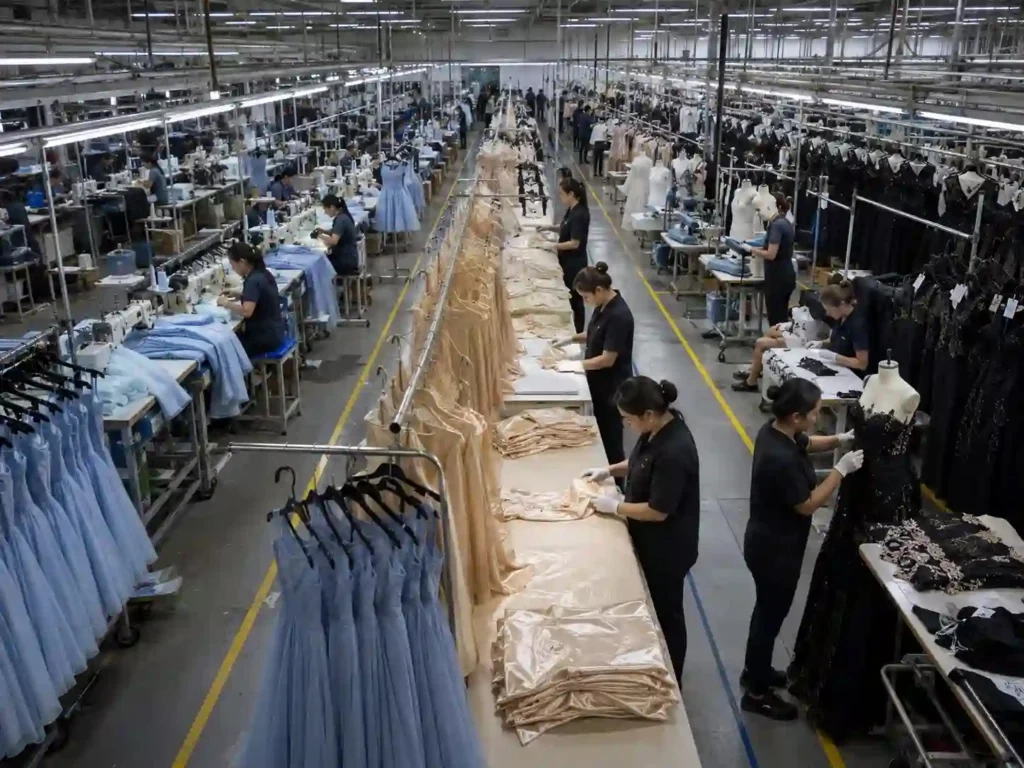
What Private Label Dress Manufacturing Looks Like in Practice
Private label can make sense when you want to build a collection without developing every style from the first pattern.
You might start with an existing silhouette and change selected parts to suit your brand.
For example, you could keep the basic dress shape but change:
- Fabric
- Color
- Finished length
- Sleeve style
- Neckline details
- Fit
- Labels
- Hangtags
- Packaging
What you change is important.
Changing a label or packaging is very different from changing the bodice, sleeve construction, fabric behavior, and skirt shape. Once several construction details change, the original pattern may no longer be suitable. At that point, the factory may need to revise the pattern and handle the style more like a custom development project.
It is better to clarify this before sampling, rather than treating the order as a simple private label job and discovering the extra development work later.
OEM vs Private Label: A Practical Comparison
| Production Point | OEM Dress Manufacturing | Private Label Dress Manufacturing |
|---|---|---|
| Starting point | Your design or product specification | Existing or adaptable dress style |
| Design control | High | Usually lower |
| Pattern | Developed around your requirements | May already exist |
| Fabric | More flexibility | Depends on the selected style |
| Fit changes | Can be developed in detail | Depends on the base style |
| Branding | Custom | Custom |
| Development work | Usually more involved | Often simpler |
| Best starting point | Defined product concept | Collection testing or faster development |
| Long-term flexibility | Higher | Depends on how much customization is available |
In actual production, these categories can overlap. The amount of development depends more on the garment than on the name of the service.
The garment itself usually tells you how complicated the project will be.
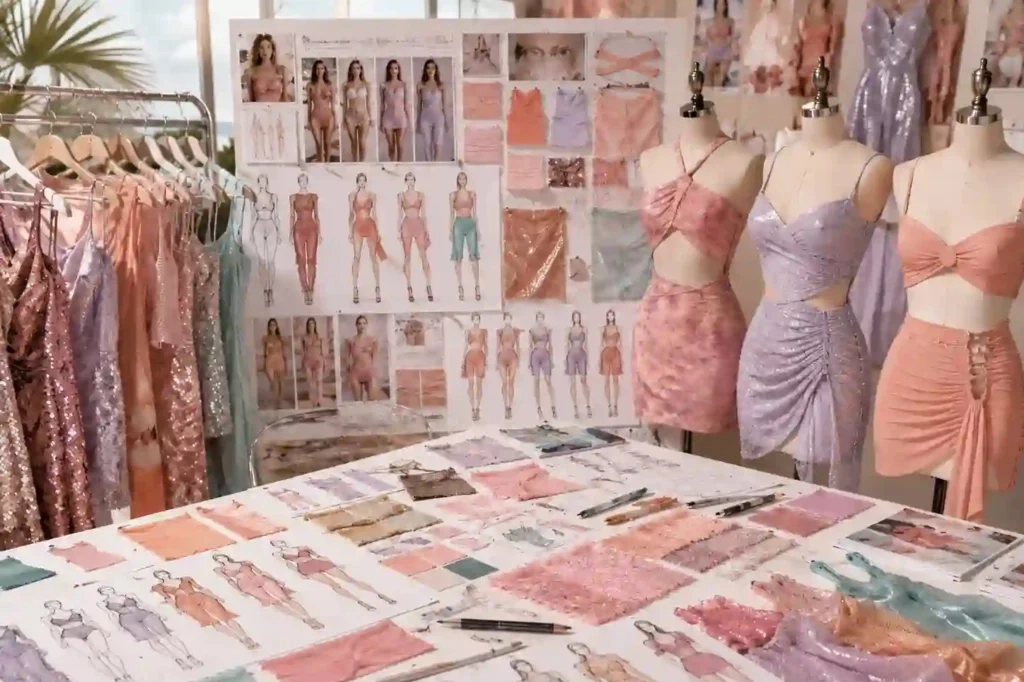
Which Option Makes More Sense for a Fashion Startup?
If you are launching your first collection, you may not need every dress to be completely custom.
A first collection usually comes with a lot of unknowns. You may still be working out which silhouettes sell, what price points your customers accept, which colors are worth repeating, and how many units you can realistically move.
That is one reason private label can be useful for a startup. You can begin with an existing construction instead of putting the same development time into every style.
Private label can be useful here because you can start from a proven or existing construction and concentrate your effort on the parts that matter to your brand.
The situation changes if your brand depends heavily on a distinctive design language. Using an existing style may save time for the first collection, but it can also make differentiation harder later.
If your whole brand is built around a distinctive design language, using existing styles may create problems later. You may save time on the first collection but end up with products that are difficult to differentiate.
In that case, OEM can make more sense even when your initial order is relatively small.
What If You Are a Designer?
If you already have detailed designs, OEM is usually easier to work with.
You may have spent considerable time developing the silhouette, proportions, and construction. The factory then needs to translate those decisions into a garment that can actually be cut, sewn, fitted, and repeated in bulk production.
A good starting package might include:
- Sketches
- Tech pack
- Measurement chart
- Reference sample
- Fabric information
- Construction details
- Label requirements
You do not necessarily need all of these before contacting a factory.
A sketch and reference garment can be enough to start a discussion, but more production information normally means fewer assumptions later.
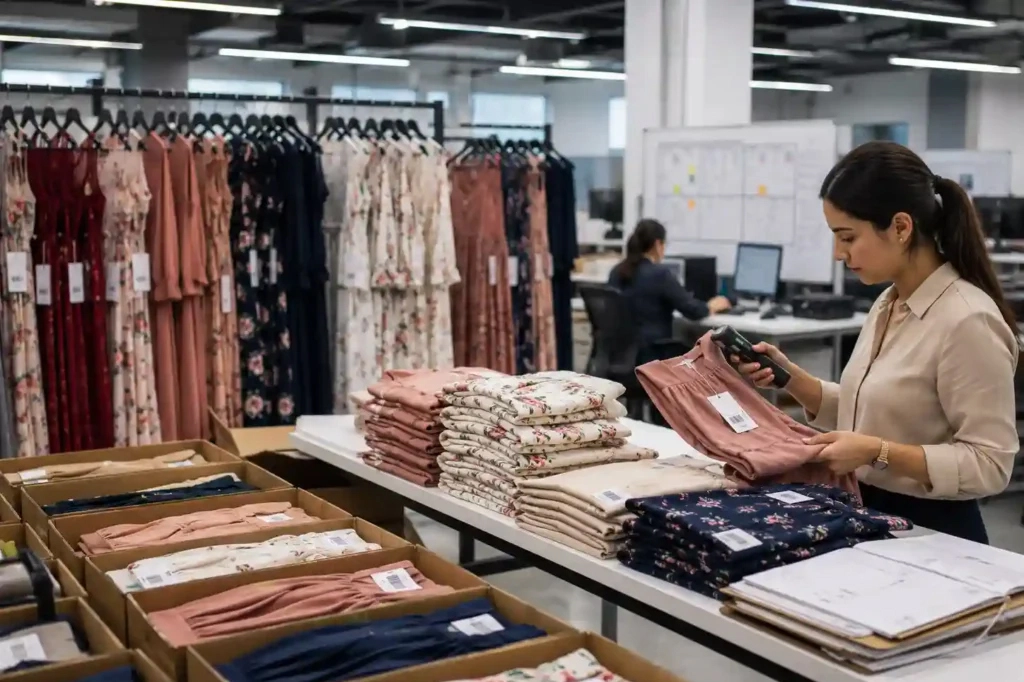
What If You Are a Boutique, Retailer, or Wholesaler?
Your priorities can be different.
You may care less about developing a completely original pattern and more about whether the dress can be produced consistently at the required quantity.
For these buyers, repeat production can be more important than developing a completely new pattern. Before placing the order, it is worth checking whether the factory can repeat the same construction, source the fabric again, keep measurements consistent across sizes and colors, and meet the delivery window for the selling season.
You should also ask what happens when the style is reordered. A fabric that is available for the first order is not necessarily guaranteed to be available several months later.
A private label model may work well if the existing style already meets your product requirements.
If it does not, OEM gives you more room to adjust the garment around your market. In either case, it helps to work with a dress manufacturer that can handle pattern adjustments, fabric sourcing, sampling, and repeat production rather than treating each order as a separate project.
The Construction of the Dress Matters
A dress is not only a shape on a drawing.
The fabric, pattern, construction, and finishing all affect how the final garment looks.
Take a satin slip dress as an example. The same pattern can behave quite differently depending on the fabric weight, surface, drape, and lining.
An A-line dress can also change significantly when the fabric has more body or when the skirt volume is increased.
A fitted bodycon dress brings another set of concerns around stretch, recovery, seam placement, and fit.
Looking at the actual dress usually gives a clearer answer than comparing the two service names.
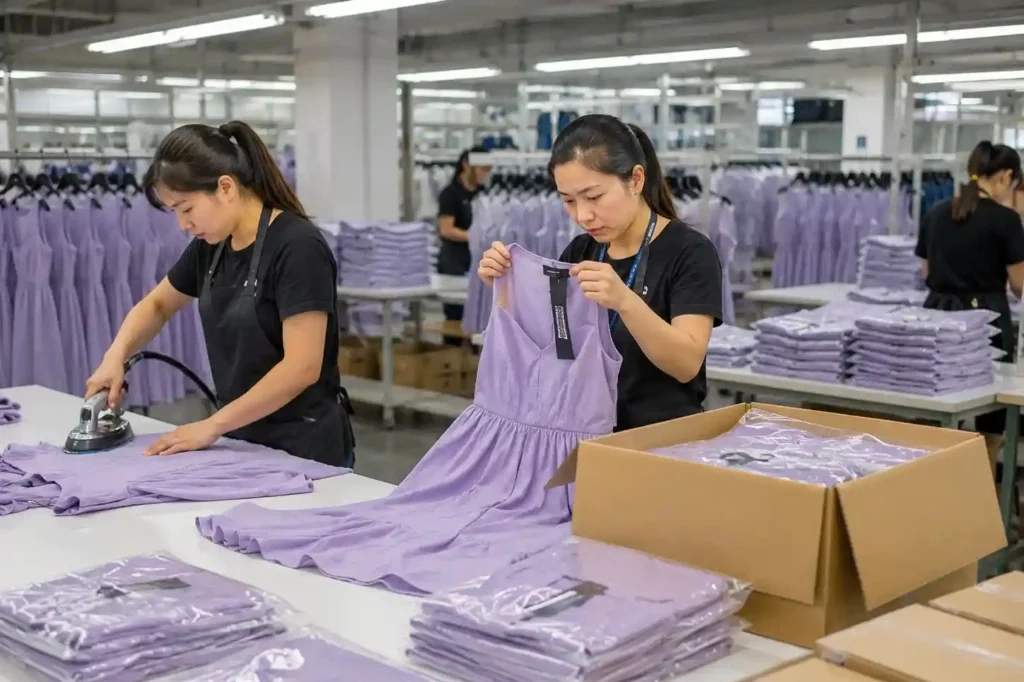
Fabric Can Change the Production Decision
Fabric is one of the first things we check before a dress goes into sampling, because the wrong fabric can change the fit and construction even when the original pattern looks correct.
A fabric that looks right in a photograph may not work once it is cut into the intended silhouette.
You may find that:
- The skirt does not fall as expected
- The fabric is too transparent
- The lining changes the drape
- The garment stretches differently
- The fabric shrinks after treatment
- The original pattern needs adjustment
For an OEM project, these issues can be addressed as part of the development process.
With a private label style, you need to know whether the available fabric is already suitable or whether changing it will require pattern and construction adjustments.
MOQ Should Be Considered With the Whole Project
Startups often ask about MOQ first. In production, however, the MOQ number alone does not tell you what the order will actually cost.
A low MOQ can be useful if you are testing a new style. However, your actual production cost can also depend on fabric, color, pattern work, trims, labels, packaging, and the number of variations in the order.
For example, custom-dyed fabric can have different minimum requirements from using an available stock fabric.
The same applies to several colors of the same dress. The garment quantity may look reasonable overall, but splitting it across many colors can change the production setup.
So when comparing OEM and private label, compare the whole order, not only the MOQ number.
Sampling Is Where the Real Difference Shows
The first sample is usually where you discover how much development a dress actually needs.
A dress may look correct in a sketch but require changes after fitting.
You may notice that:
- The armhole feels too tight
- The waist sits too high
- The skirt needs more volume
- The sleeve shape is not right
- The neckline needs reinforcement
- The lining pulls differently from the outer fabric
- The finished length changes after fitting
We see this kind of adjustment regularly during fitting.
For OEM, they are usually expected as part of turning your specifications into a production-ready garment.
For private label, fewer changes may be needed if the base style is already close to your target. But if the fitting process becomes extensive, the project starts to require more custom development.
Which Option Gives You More Design Control?
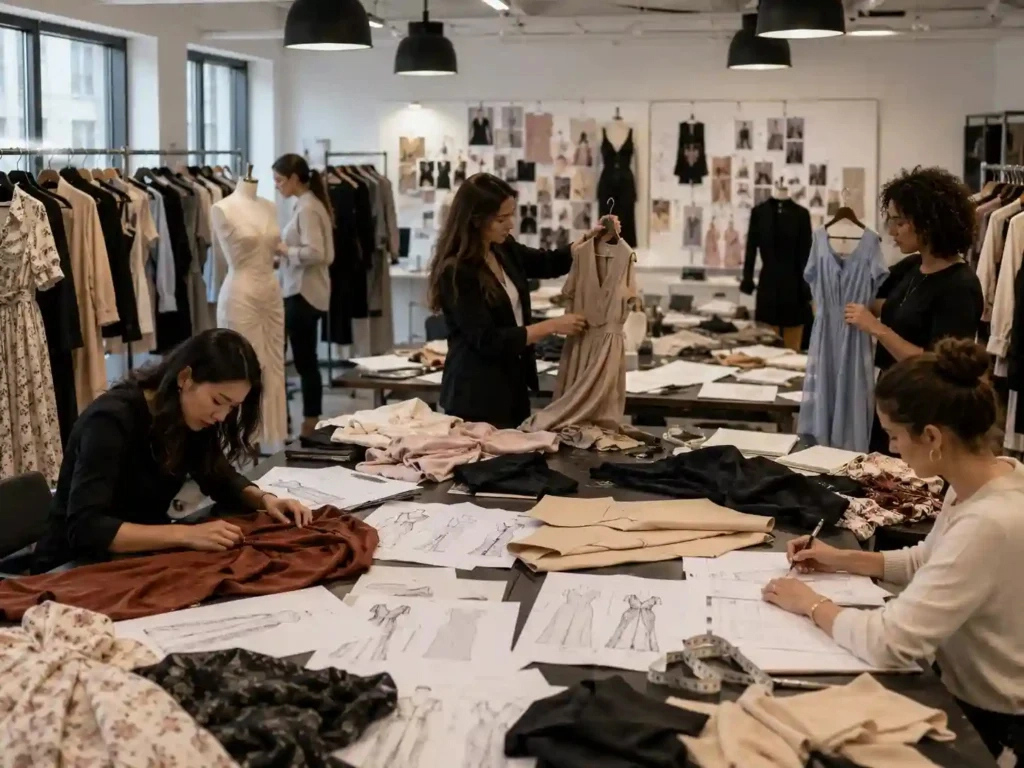
If you want to control the product from the pattern stage onward, OEM is normally the stronger choice.
You can specify the construction instead of adapting your collection around an existing garment.
Private label gives you a different advantage: you can reduce some of the early development work.
The better choice depends on what you need the factory to do.
Spending months developing ten completely new styles may not make sense for a startup that is still testing demand. At the same time, adapting existing styles can be limiting when the collection depends on distinctive silhouettes or fit.
The useful question is not:
Which model is better?
It is:
How much of the dress do you need to control?
When Private Label Is Usually the Better Starting Point
Private label is usually easier to start with when the main goal is to test a collection, work from an existing construction, or get branded styles into production without developing every pattern from scratch. It can also suit brands that do not yet have an internal product development team.
It can also be useful when you have a clear commercial direction but do not yet have an internal product development team.
You can learn from the first collection and decide later which styles deserve deeper customization.
When OEM Is Usually the Better Starting Point
OEM is generally more suitable when you:
- Already have your own designs
- Need specific measurements or fit
- Have detailed construction requirements
- Need particular fabric characteristics
- Want control over pattern development
- Are building signature styles for repeated production
- Need a dress to follow a specific design concept closely
This is particularly relevant when the product itself is part of your competitive advantage.
If customers recognize your brand because of a particular silhouette or fit, giving up control over those details can create problems further down the line.
Can You Combine the Two Approaches?
Yes.
In real production, the line between OEM and private label is not always completely clean.
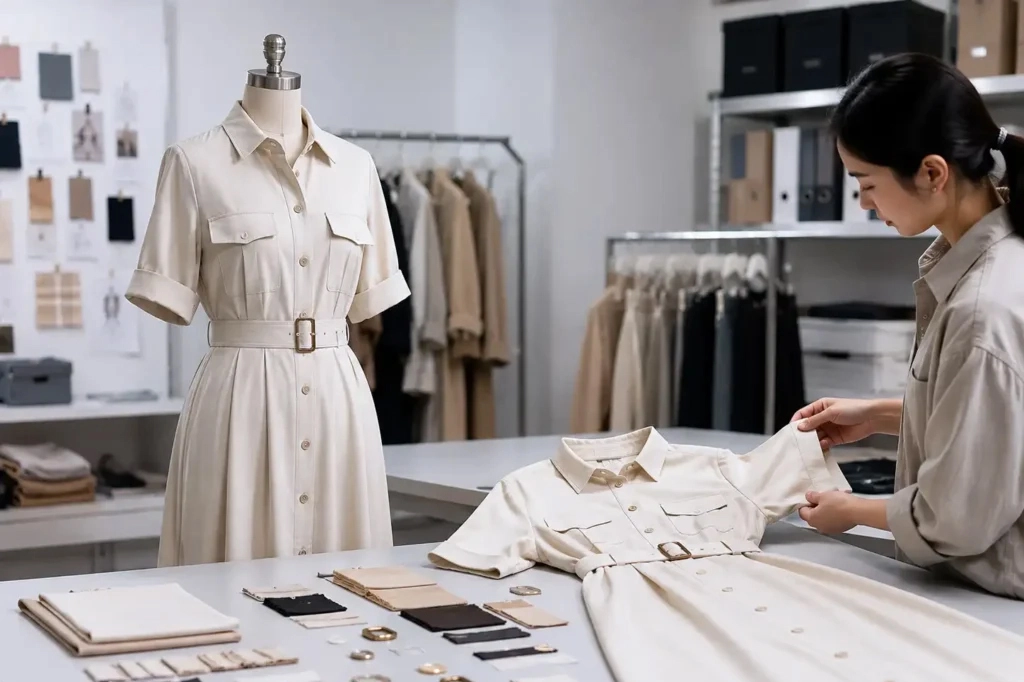
You might start with an existing dress silhouette, then change the fabric, neckline, sleeve, and fit. Another brand might provide a complete design but use an existing construction method to simplify production.
The practical question is how much needs to change.
If only branding and minor details change, private label may remain appropriate.
If the pattern, construction, fabric behavior, and fit all change, it should be discussed as a custom development project from the beginning.
This distinction helps avoid misunderstandings about sampling time, cost, and production requirements.
A Practical Way to Decide
Before asking a factory to quote the project, define what you already have and what still needs to be developed.
If you mainly need a starting point, an existing private label style may save development time. If you already know the design, fit, fabric, or construction you need, OEM gives the factory a clearer brief to work from.
If the project sits somewhere in between, describe the changes rather than worrying too much about the label. Once the factory understands how much of the original style needs to change, it can usually tell you whether the project is still a simple private label order or needs custom development.
That is also a better way to discuss sampling time, cost, MOQ, and bulk production before the order is placed.
FAQ
1. Can I use my own fabric for a private label dress?
Usually, this needs to be checked before sampling. Your fabric may have a different width, weight, stretch, shrinkage, or drape from the original material. If those properties affect the existing pattern, the manufacturer may need to adjust the garment before production.
2. Can I protect my dress design when working with a manufacturer?
Before sending complete design files, agree with the manufacturer on how your designs, samples, patterns, and production information will be handled. You should also be clear about which elements are your original designs and which are based on an existing manufacturer style. Keep approved specifications and production samples documented for future reference.
3. Can the same private label dress be made in several fabrics?
Sometimes, but changing fabric is not always a simple material swap. Different fabrics can behave differently during cutting, sewing, pressing, and fitting. Before approving bulk production, check whether the new fabric requires pattern changes or affects the finished measurements.
4. What happens if my first OEM sample does not fit correctly?
Sample revisions are a normal part of garment development. Record the specific changes needed rather than giving only general comments such as “make it smaller.” Measurements, photos, marked samples, and clear notes on the problem areas make the next revision much easier to evaluate.
5. Should I develop every style as OEM for my first collection?
Not necessarily. Developing every style from scratch can add work before you know which products will sell. You can use different approaches within one collection, depending on the role of each style. Your core signature styles may deserve custom development, while simpler styles used to test demand can often start from an existing construction.
Conclusion
OEM and private label are simply two different ways of starting a dress project.
If the design, fit, fabric, or construction is important to your brand, OEM gives you more control over development. If you already have a suitable style and mainly need branding, selected changes, and a practical way to test the market, private label may require less development at the beginning.
From a manufacturer’s side, we would not choose the service first and then try to fit the dress into it. We would look at the style, the changes required, the fabric, the expected quantity, and what needs to happen when the style is reordered.
That usually gives a much clearer answer than the label alone.
Related Dress Manufacturing Services
If you are developing a new dress and need support with fabric selection, internal construction, sampling, and bulk production, an experienced clothing manufacturer can help you deal with these decisions before they become production problems.
At Xiuyu Apparel, we work with fashion brands, startups, designers, and private label companies from sample development through bulk production.
Get a Clothing Manufacturing Quote Based on Your Design
If you already have a garment design, send us the product photo, tech pack, or reference sample together with your target quantity.
As a dress manufacturer, we can review the fabric, lining, construction, trims, workmanship, and finishing requirements before preparing a quotation based on the actual garment rather than a general price range.

