

When we review a new dress collection with a brand, the first problem is rarely a lack of design ideas. More often, there are too many of them. A style may look great on a mood board but become expensive to sample, difficult to construct, or unsuitable for the planned order quantity once we start working through the details.
That is why we normally look at the collection as a production plan, not just a group of designs. Before every style goes into sampling, we want to know where it fits, what it is likely to cost, and whether it makes sense to produce at the quantity the brand expects.
Start With the Customer, Not the Dress
Before choosing individual styles, define the customer you are trying to sell to.
Your collection will look different if you sell through boutiques, an online fashion store, department stores, or wholesale buyers. The customer, selling price, occasion, and season all affect the type of dress that makes sense.
Start with a few practical questions:
- Who is buying the dress?
- Where will they wear it?
- What retail price feels realistic for your market?
- What quantity do you expect to sell?
- Is the collection aimed at everyday wear, occasionwear, resortwear, or another category?
The price point is particularly important.
You can have a strong design that simply does not work at the price your customer expects. Once the target retail price is known, you can work backward toward a reasonable production cost and make design decisions around that limit.
This approach also gives your clothing manufacturer a clearer starting point when costing the collection.
Give Each Dress a Clear Role
A collection becomes difficult to manage when every dress is trying to do the same job.
You might have ten designs that all look attractive individually, but if six of them are similar fitted midi dresses in the same fabric and price range, your customer has not gained much choice.
Instead, give the styles different roles.
| Style Role | What It Does |
|---|---|
| Core | Provides dependable, easy-to-understand products |
| Commercial | Carries a large part of expected sales |
| Trend | Brings current fashion details into the range |
| Statement | Gives the collection a stronger visual identity |
You do not need to follow a fixed percentage for each group. Your market will determine the balance.
For a new fashion brand, however, putting too much of the collection into complicated statement pieces can create unnecessary development and inventory risk.
A few stronger designs can attract attention. The rest of the collection still needs to give customers practical reasons to buy.
Look at the Silhouette Before the Details
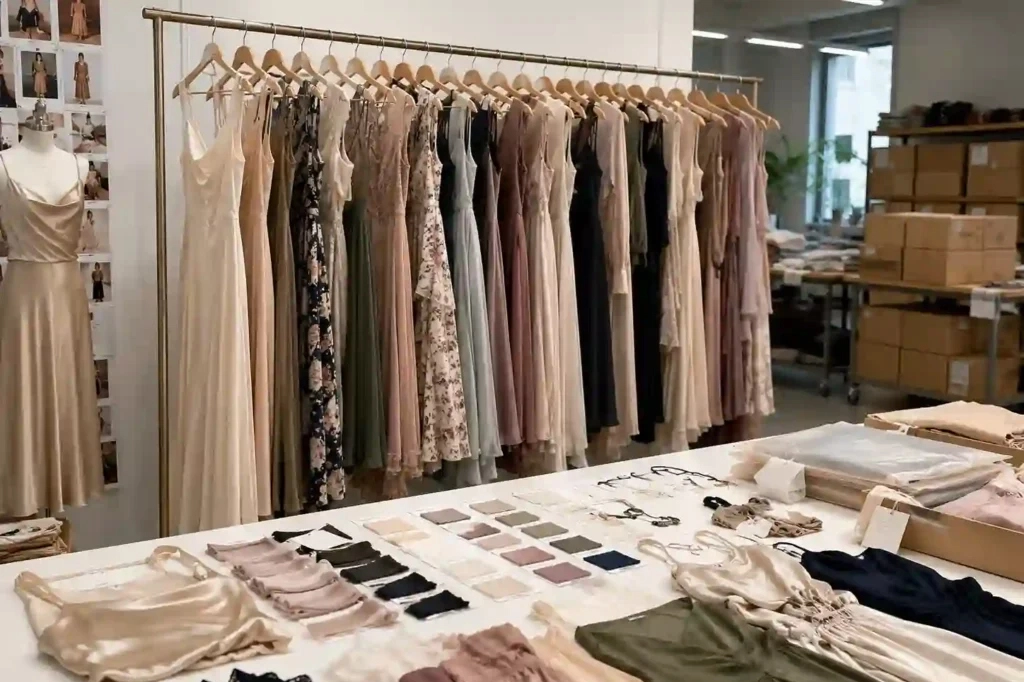
When a design reaches the factory, we normally look at the main shape before discussing smaller details.
A dress may have an interesting bow, neckline, sleeve, or trim, but those details cannot fix a silhouette that does not suit the intended customer.
Look at:
- Overall fit
- Dress length
- Waist position
- Skirt volume
- Neckline
- Sleeve shape
- Body proportion
- Intended occasion
You should also compare the silhouettes across the whole collection.
If you already have a fitted mini dress, for example, adding another fitted mini with only a different neckline may not add enough value to the range.
Sometimes a small change in proportion does more for the collection than adding another decorative feature.
Choose Fabric With the Pattern in Mind
Fabric selection becomes more important once you move from a sketch to an actual garment.
Satin, silk, chiffon, crepe, jersey, velvet, and cotton blends can behave very differently in production. We normally check the fabric weight and width first, then look at drape, stretch, recovery, shrinkage, transparency, and whether the garment will need lining.
A swatch is useful for the first decision, but it does not always tell you how the finished dress will behave.
A long flowing skirt is a good example. A fabric may look soft and attractive in a small swatch, but once it is spread across a full skirt, its drape, transparency, weight, and fabric consumption become much more obvious.
We also check how the fabric works with the pattern. A lower-priced fabric can still produce a more expensive dress if its usable width leads to poor marker efficiency or higher consumption.
So when we compare fabrics for a commercial collection, the price per meter is only one part of the calculation.
Set a Target Cost Before Sampling
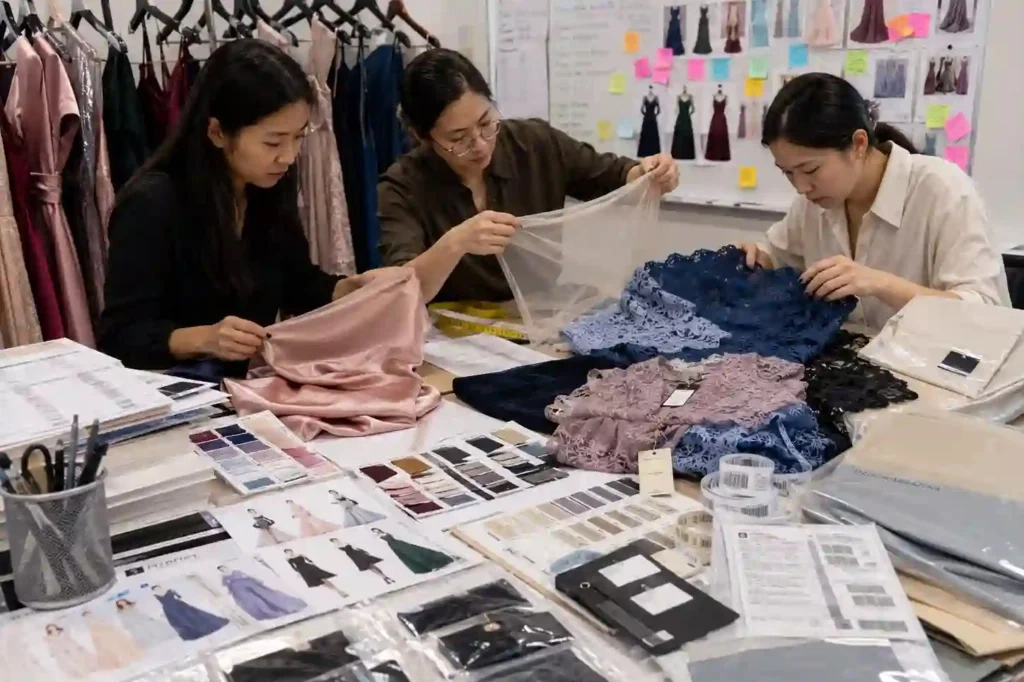
We prefer to look at cost before a sample is completely finished. Waiting until the end can leave you with a pattern, sample fabric, trims, and development work that are already difficult to change.
At the early stage, we normally look at the main cost drivers:
- Fabric consumption
- Lining
- Sewing operations
- Pattern complexity
- Trims
- Embroidery or embellishment
- Special finishing
- Washing or dyeing
- Packaging
The first costing does not have to be exact. Its purpose is to show whether a style is heading in the wrong direction.
If a dress is already above the target because of fabric consumption, for example, there may still be room to change the skirt volume, adjust the pattern, review the fabric width, or test another material with similar behavior.
Finding that out before approval is much easier than changing the garment after the sample has already been signed off.
Keep Complex Construction Where It Adds Value
This is something we see quite often with first collections.
A brand wants every style to look special, so several dresses end up with gathered panels, layered skirts, boning, unusual closures, embroidery, or other labor-intensive details.
The problem is not that these details are difficult by themselves. The problem comes when too many of them appear across the same collection. Sampling takes longer, costing becomes less predictable, and keeping the construction consistent in bulk production becomes harder.
A complicated bodice may be worthwhile on one hero style. It may not make sense on five different styles.
The same applies to fabric. If every dress needs a different special-order material, purchasing becomes harder and minimum quantities can start working against the collection.
We usually prefer to have a few styles that carry more construction risk, supported by other designs that are simpler to produce and easier to reorder.
Build Around Your Expected Quantity
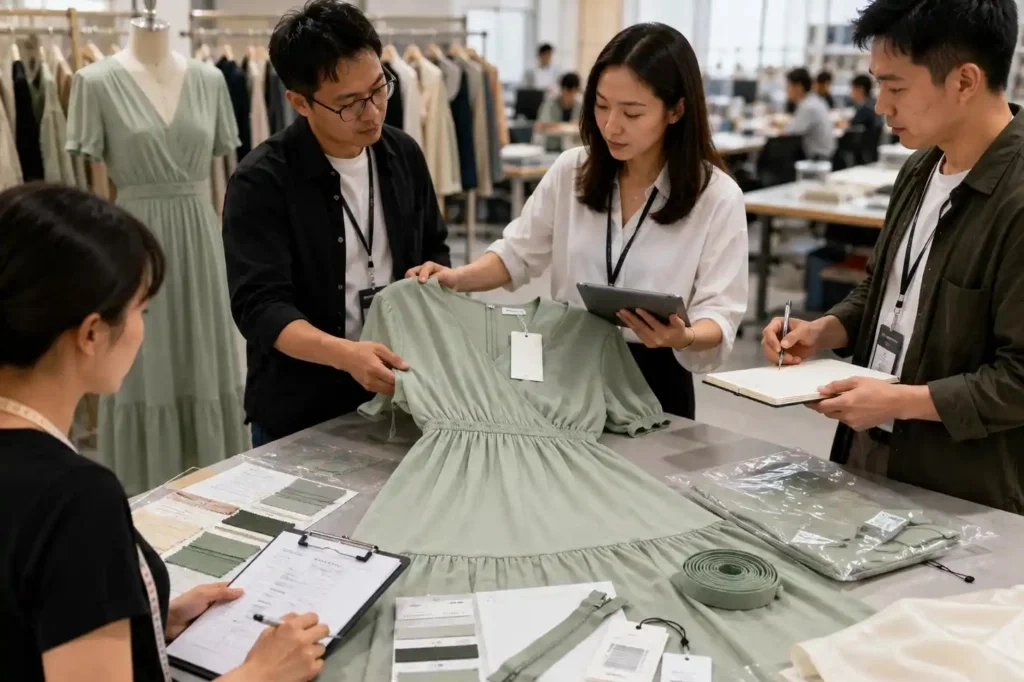
Your expected order quantity should influence the collection from the beginning.
This matters particularly for startups and smaller private label companies.
If you plan to order only a small number of pieces per style, some materials, trims, or custom colors may not be practical. A supplier’s minimum may be higher than the quantity you actually need.
Before approving a material, check:
- Fabric MOQ
- Color MOQ
- Trim MOQ
- Stock availability
- Repeat-order availability
- Fabric lead time
You may also be able to use the same fabric across several styles. This can make the purchasing side easier and give the collection a more consistent appearance.
However, do not force one fabric into every design simply to reduce the number of materials. A fabric still needs to suit the silhouette and construction.
Develop the Riskier Styles Early
If several dresses use the same chiffon, we would normally start with the style that puts the most pressure on the fabric.
That sample can tell us quite a lot before the other styles move forward: how the fabric drapes, how transparent it becomes after construction, whether shrinkage affects the measurements, how the seams behave, whether the hem stays stable, and how much fabric the pattern actually consumes.
A problem found on one sample is much easier to deal with than the same problem appearing across several approved styles.
For a fabric-sensitive dress, we normally want the development to follow this order:
Design → Fabric Selection → Pattern Development → Sample → Fit Test → Pattern Adjustment → PP Sample → Bulk Production
If the fabric changes after fit approval, we may need to review part of the pattern and development work again.
Review the Sample as a Product
When the sample arrives, photographs are only the first check.
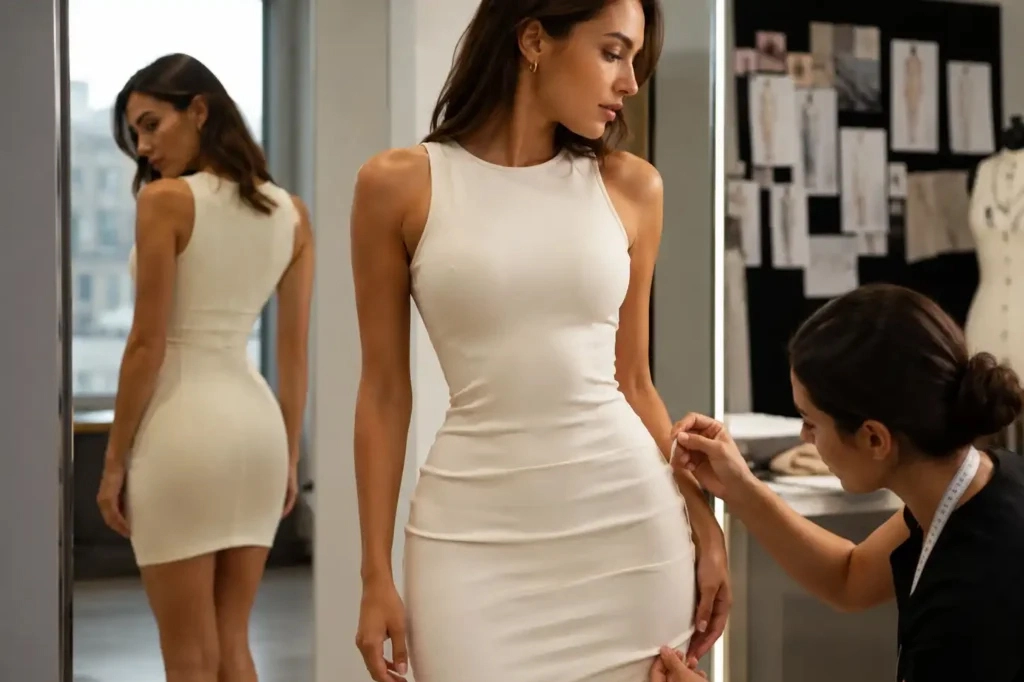
Put the dress on the intended size and look at how it actually sits on the body. Check the fabric after pressing, whether the lining moves correctly with the outer layer, and how the neckline, seams, hem, closures, and higher-tension areas behave.
Then look at the commercial side.
Does the finished garment still make sense at the planned retail price?
Does it look different enough from the other styles in the collection?
Would you be comfortable placing the same style into a repeat order?
These checks can lead to changes that were not obvious on the original sketch. A lining can change the weight and movement of a lightweight dress, while a small construction change can add sewing operations and affect the final cost.
Check the Collection, Not Just Individual Styles
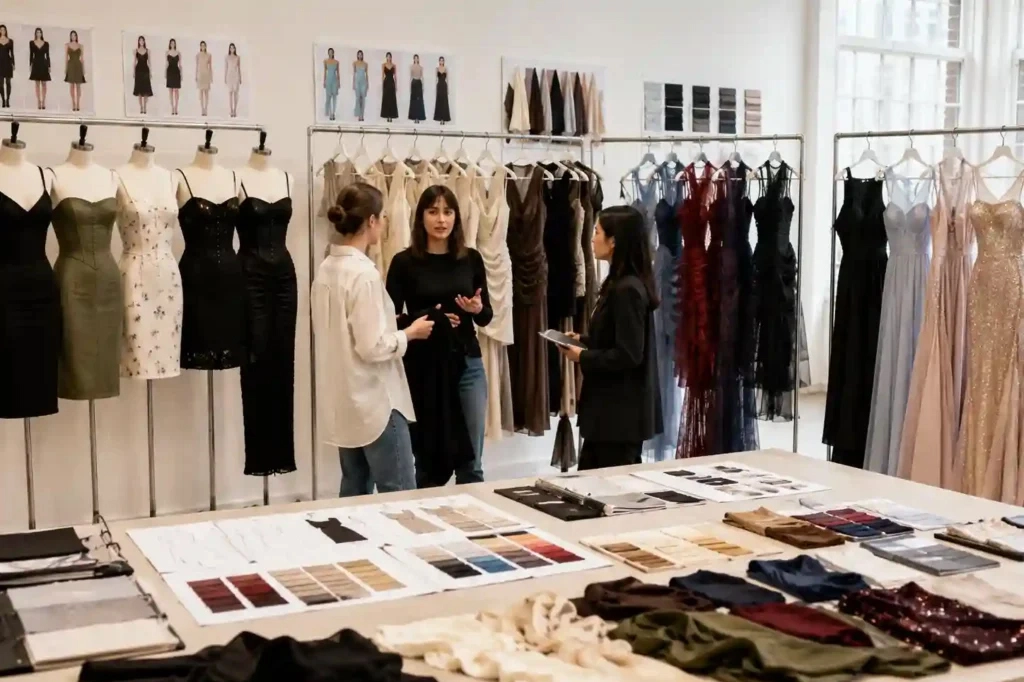
After sampling, put all the dresses together.
This is where you can see problems that are difficult to notice when reviewing one design at a time.
Compare:
- Silhouettes
- Lengths
- Colors
- Fabrics
- Price points
- Occasions
- Construction
- Level of detail
You may find that two styles are too similar.
You may also notice that your collection has several premium-looking dresses but not enough simpler products to support the main price range.
Removing one weak or repetitive style can sometimes improve the collection more than adding another design.
A smaller range can work better when each style has a clear commercial purpose.
Use a Simple Commercial Review Before Bulk Production
Before approving the final collection, review each style against five areas.
Customer
Does the dress fit the customer you are targeting?
Price
Does the production cost support your intended retail price and margin?
Product
Does the fabric, fit, and construction deliver the look you designed?
Production
Can the style be produced consistently at the required quantity?
Collection
Does it add something that another style does not already provide?
If one style fails in several areas, it is worth revisiting before bulk production.
You may not need to remove it completely. Sometimes a fabric change, simpler construction, different length, or revised quantity is enough to make the product workable.
FAQ
1. Should you show your manufacturer the entire collection or only individual designs?
If several dresses belong to the same launch, showing the broader collection can be useful. The manufacturer can see which fabrics, colors, trims, and construction methods may overlap. That does not mean every design needs to be developed at once, but the wider picture can help avoid unnecessary purchasing decisions.
2. What if you are not sure how many pieces you will sell?
Use your best estimate rather than waiting for certainty. Share your expected quantity range with the manufacturer and material suppliers. If the forecast is uncertain, prioritize fabrics and trims that are easier to source again. This gives you more flexibility if one style sells faster than expected.
3. Should you develop every size before approving a dress?
Not usually. Early samples are generally used to check the design, construction, fabric behavior, and fit before the full size range is graded. Once the base pattern is approved, you can move into grading and size-specific checks. The exact process depends on the style and your fit requirements.
4. What should you do when two dresses have similar sales potential?
Compare the differences that matter commercially, not just visually. Look at expected cost, fabric availability, production difficulty, target customer, and whether one design gives you a stronger price point. If both remain too similar, keeping the better-developed style may be more useful than carrying both.
5. How early should a manufacturer review a new collection?
Ideally, before every design is fully finalized. Early review gives you more options if a fabric, construction method, target cost, or planned quantity creates a problem. Once patterns and samples are approved, changes become more expensive because several connected decisions may need to be revised.
Conclusion
A collection can look strong on paper and still become difficult once the dresses move into sampling and production.
From our side, the useful checks are fairly practical: who the customer is, what the target price allows, how the fabric behaves, how much the style costs to make, what quantity you can realistically order, and whether the factory can reproduce the construction consistently.
You do not have to develop every idea at the same time. Start with the styles that matter most to the collection and test the ones with the highest production risk early.
If each dress has a clear reason to be in the range—and you already understand how that dress will be made—the move from collection development to bulk production is usually much easier.
Related Dress Manufacturing Services
If you are developing a new dress and need support with fabric selection, internal construction, sampling, and bulk production, an experienced clothing manufacturer can help you deal with these decisions before they become production problems.
At Xiuyu Apparel, we work with fashion brands, startups, designers, and private label companies from sample development through bulk production.
Get a Clothing Manufacturing Quote Based on Your Design
If you already have a garment design, send us the product photo, tech pack, or reference sample together with your target quantity.
As a dress manufacturer, we can review the fabric, lining, construction, trims, workmanship, and finishing requirements before preparing a quotation based on the actual garment rather than a general price range.

