

When a knit dress is still at the fabric selection stage, GSM is one of the numbers we usually check first. But it is not the number we use to approve the fabric by itself.
A 180 GSM jersey, a 220 GSM rib and a 280 GSM ponte can all be suitable for dresses, but they will give you very different results in fit, coverage and drape. The right choice depends on the construction of the fabric and the way the dress is supposed to fit.
For buyers, the important part is not finding one “correct” GSM. It is finding a fabric weight that works with the pattern, stretch and finished garment.
What Does GSM Mean in Knit Fabric?
GSM stands for grams per square meter. In simple terms, it tells you how much one square meter of fabric weighs.
When we compare knit fabrics for a dress, GSM gives us a quick way to separate lighter and heavier options. It is useful during fabric sourcing, especially when several suppliers are quoting fabrics that look similar.
The problem is that GSM only tells you the weight.
For example, two fabrics can both be 220 GSM, but one may stretch much more, feel softer and drape around the body, while the other feels firmer and holds its shape. On a fitted dress, the difference can be quite obvious.
So when we review a knit fabric, GSM is normally checked together with composition, construction, stretch, recovery and finishing.
How Does GSM Affect a Knit Dress?
Fabric weight can change several things that matter once the fabric becomes a finished dress.
Coverage
Weight can help with coverage, but we would not approve a knit fabric based on GSM alone.
This is especially important for fitted dresses. Once the fabric is stretched over the bust or hips, a fabric that looked opaque on the roll can become noticeably more transparent.
Light colors usually make this easier to see. We normally check the fabric both flat and under stretch before approving it for a fitted style.
If coverage is still a concern, we look at the actual dress rather than simply moving to a heavier GSM. Sometimes the better solution is a different knit construction, color, or lining.
Drape
GSM changes the way a knit hangs, but the relationship is not always straightforward.
A lighter jersey may give you a softer, more relaxed look. A heavier knit usually has more body and can make a fitted or structured dress look cleaner.
The issue usually shows up when the fabric is used on a larger silhouette. For example, a heavy knit may work well on a short bodycon dress but feel too heavy once the same construction is used for a long, gathered skirt.
This is why we prefer to check the fabric on the actual pattern before making a final decision.
Fit
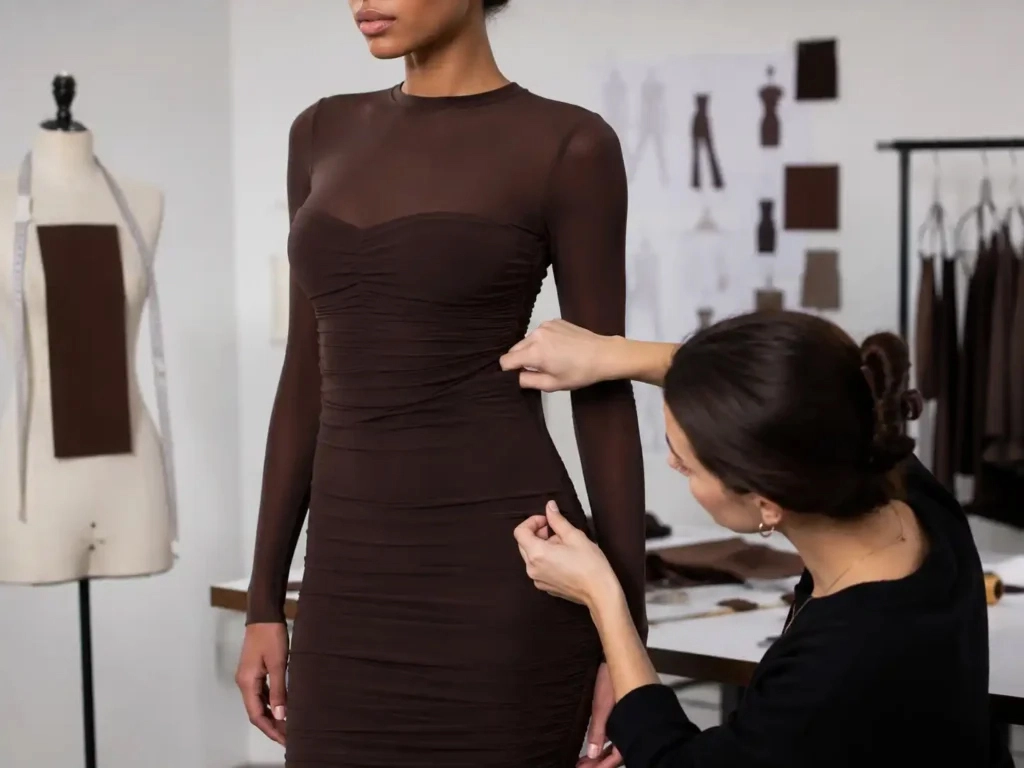
For a fitted dress, stretch and recovery are usually more important than simply increasing the GSM.
The fabric needs enough stretch to go over the body without making the dress difficult to wear. At the same time, it needs to recover after being stretched, especially around the waist, hips and seat.
We have seen fabrics that feel quite substantial in the hand but lose shape once they are stretched through the finished garment. That is why a fabric swatch alone is not always enough for a bodycon style.
The pattern and fabric need to be tested together.
Fabric Consumption
Fabric weight is also connected to your production cost, although GSM alone does not determine it.
Fabric width, pattern layout and garment length can have a bigger effect on actual consumption. A heavier fabric may also increase the weight of each finished piece, which can matter for packing and shipping.
When buyers compare fabric quotations from different suppliers, it is better to compare the complete specification rather than looking only at the price per kilogram or per meter.
What GSM Is Suitable for Different Knit Dress Styles?
There isn’t one GSM that works for every knit dress.
The right range depends on the silhouette and the performance you need from the fabric. The following ranges can be used as a starting point during development:
| Knit Fabric | Approx. GSM | Suitable Dress Styles | Main Considerations |
|---|---|---|---|
| Lightweight Jersey | 140–180 GSM | Summer, casual and relaxed dresses | Coverage, shrinkage, drape |
| Medium Jersey | 180–260 GSM | Fitted, casual and bodycon dresses | Stretch, recovery, opacity |
| Rib Knit | 180–320 GSM | Bodycon, fitted and midi dresses | Stretch, recovery, fabric growth |
| Interlock Knit | 200–300 GSM | Casual and structured dresses | Stability, thickness, drape |
| Ponte / Roma | 250–380 GSM | Structured and fitted dresses | Body, bulk, recovery |
Treat these ranges as development starting points, not factory specifications.
A 200 GSM rib knit can behave very differently from a 200 GSM jersey. Yarn, stitch construction, fiber content and finishing all affect the final result.
For a new style, we would normally use these ranges to shortlist fabrics first, then confirm the final choice through sampling.
What GSM Should You Choose for a Bodycon Dress?
For a bodycon dress, 200–300 GSM is a reasonable range to start sampling, although the final choice depends heavily on stretch, recovery and fabric construction.
A 240 GSM knit with good recovery can work better than a heavier fabric that becomes loose after repeated stretching. For fitted styles, we pay particular attention to:
- Bust coverage
- Hip coverage
- Waist recovery
- Stretch direction
- Fabric growth
- Seam stability
- Surface appearance when stretched
A fabric may feel substantial when you hold it in your hand but become much thinner when pulled across the hips.
This is why a small fabric swatch can sometimes give you the wrong impression.
For a fitted style, the better test is to put the fabric through the actual pattern or at least a representative section of the garment.
What GSM Works Well for a Knit Midi Dress?
Midi dresses give you a wider range of fabric choices because the silhouette can be fitted, relaxed or somewhere in between.
For a fitted midi, a medium or heavier knit can give better body and coverage. For a looser summer style, a lighter jersey may be more suitable.
One thing buyers sometimes overlook is the total garment weight. A heavy knit may be fine for a short dress, but the same GSM can make a long midi with gathers or a fuller skirt surprisingly heavy.
So we normally consider GSM together with the finished length and amount of fabric used.
Does Higher GSM Mean Better Quality?
Not necessarily.
GSM measures fabric weight. It does not measure overall fabric quality.
A 280 GSM knit with poor recovery may be a poor choice for a fitted dress, while a 220 GSM fabric with better recovery and construction may perform much better.
We have rejected heavier fabrics before because the recovery or sewing performance was not right for the style.
When comparing fabrics, look at:
- Composition
- GSM
- Knit construction
- Stretch
- Recovery
- Opacity
- Drape
- Shrinkage
- Fabric width
- Hand feel
Your target customer and price point also matter.
A premium bodycon dress may need a different fabric balance from a lightweight summer dress, even if both are technically knit dresses.
How Do Stretch and Recovery Change the GSM Decision?
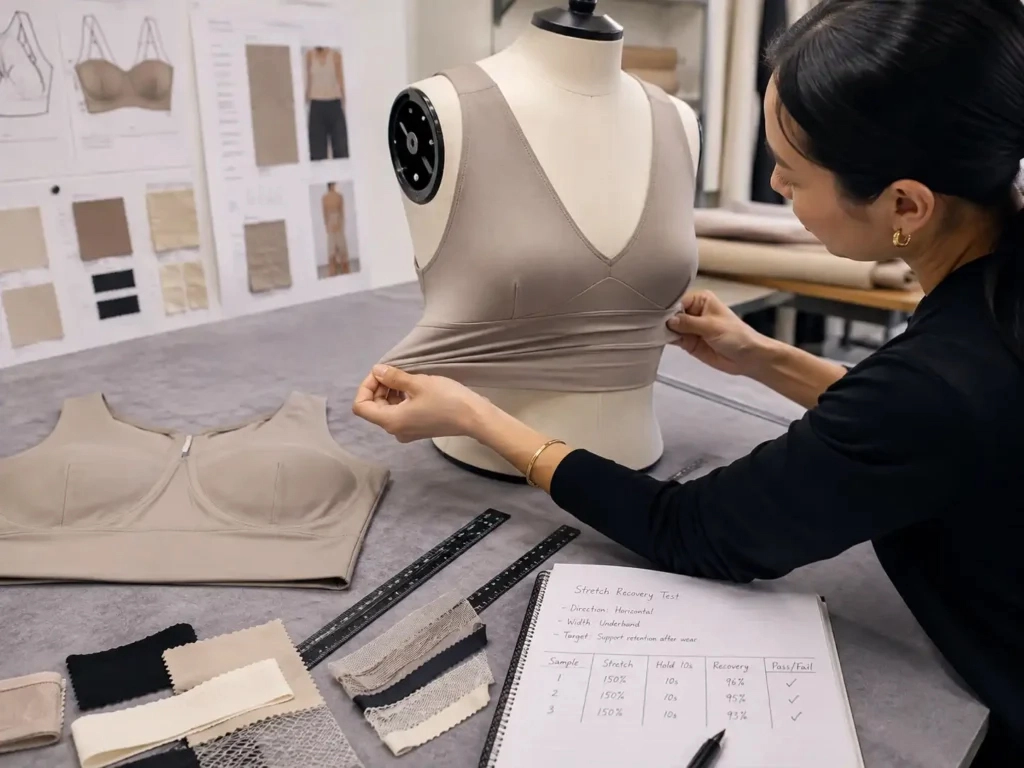
A fabric can have plenty of stretch and still be a poor choice for a fitted dress if the recovery is weak.
Stretch tells you how far the fabric can extend.
Recovery tells you how well it returns after stretching.
For fitted dresses, both affect the final fit.
A fabric with high stretch but weak recovery may fit well during the first try-on and then begin to lose its shape around the waist, hips or seat after repeated wear.
A heavier fabric with limited stretch can create the opposite problem. It may look stable but make the garment difficult to pull on or uncomfortable when worn.
During fitting, we pay closer attention to the areas that stay under tension:
- Bust
- Waist
- Hip
- Armhole
- Neckline
- Side seams
For a body-hugging style, fabric growth is also worth checking. Some knits gradually become longer or wider after being stretched or handled during production.
That behavior may not be obvious from the original fabric roll.
Why Can Two Fabrics With the Same GSM Look Different?
Because GSM only tells you the fabric weight, not how that weight is built into the fabric.
A 220 GSM jersey and a 220 GSM rib can have very different stretch, recovery and surface appearance. Yarn type, stitch construction and finishing also affect the final result.
Color can change the appearance as well. Light colors, particularly white, can show more transparency when the fabric is stretched.
For this reason, when several colors are being developed for the same dress, we prefer to check the actual dyed fabric rather than assuming that all colors will perform exactly the same.
Should You Add Lining Instead of Choosing a Heavier Knit?
Not always.
Lining can improve coverage, but it also becomes another part of the garment construction.
This can happen with fitted knit dresses when the outer fabric has good stretch but the lining does not move with it.
It can also change the weight and drape of the dress.
For a lightweight summer knit, adding a heavy lining may solve the transparency issue while making the garment warmer and heavier than intended.
If coverage is the main concern, first look at whether a more suitable outer fabric can solve the problem. Lining can then be considered if the design still requires it.
Before Approving a Knit Fabric
If you are developing a new style with a dress manufacturer, it is also worth checking the fabric after cutting and sewing, rather than approving it from the roll alone.
For a new knit dress, we normally check:
- GSM — Is the actual weight within the agreed range?
- Stretch and recovery — Does it stretch in the required direction and return properly?
- Shrinkage — What happens after washing?
- Opacity — Does it remain sufficiently covered when stretched?
- Width — What is the usable cutting width?
- Hand feel and drape — Does it suit the silhouette?
- Sewing performance — Does it feed cleanly without puckering or distortion?
- Finished sample — Does the fabric still look right after cutting, sewing and pressing?
If you are comparing two fabrics, put both through the same pattern.
This last step usually tells you more than comparing the fabric swatches side by side.
A fabric that looks suitable on the table can behave differently once it has been cut, stretched and sewn into the actual dress.

What Should You Put in a Knit Dress Fabric Specification?
If you are preparing a tech pack or sending requirements to a clothing manufacturer for a new knit dress, avoid writing only:
Fabric: Knit
That leaves too much room for interpretation.
A clearer fabric specification can include:
| Fabric Requirement | Example |
|---|---|
| Composition | 95% Polyester / 5% Spandex |
| Target GSM | 220–260 GSM |
| Stretch | 4-way stretch |
| Recovery | Good recovery after stretching |
| Fabric Width | 150 cm usable width |
| Color | Pantone / approved lab dip |
| Shrinkage | Agreed tolerance |
| Lining | Not required / stretch lining |
| Reference | Physical swatch or approved sample |
If some of these details are not available yet, that is not necessarily a problem. A reference garment, fabric swatch or even a clear product photo can give the factory a starting point for development.
What If You Need to Replace an Approved Knit Fabric?
This is a common production issue, especially when a fabric is discontinued, unavailable or cannot be supplied in the required quantity.
Do not replace it simply because the new fabric has the same GSM.
For example, if the original fabric is 240 GSM and the replacement is also 240 GSM, that does not mean the finished dress will fit the same way.
Compare:
- Stretch
- Recovery
- Composition
- Width
- Shrinkage
- Surface
- Hand feel
- Drape
- Opacity
We would normally run the replacement fabric through the existing pattern before approving the bulk order.
If the new fabric changes the fit or appearance, you can decide whether to adjust the pattern or select another material before bulk cutting.
How Should You Choose the Right GSM for Your Knit Dress?
Start with how the dress needs to fit and behave. Then use GSM to narrow down the fabric options.
For a bodycon dress, recovery and coverage may matter more than simply choosing a heavier knit. For a loose summer dress, a lighter fabric with better drape may be more suitable. A structured midi may need more body and stability.
If two fabrics are close on paper, make them up using the same pattern and compare the finished garments side by side.
That usually gives you a more reliable answer than choosing between two GSM numbers on a fabric quotation.
FAQ
Can a lower GSM fabric sometimes work better than a heavier one?
It can. A lighter knit may be a better choice when the dress needs soft drape, movement or a lighter feel. We look at GSM together with construction, stretch, recovery and coverage. For some styles, adding weight can actually make the dress feel too heavy or stiff.
How should you compare two knit fabrics from different suppliers?
We compare more than the fabric swatches. GSM, width, stretch, recovery, shrinkage, color and hand feel all matter. If the basic specifications are close, we prefer to make samples from both fabrics using the same pattern. The finished garments are much easier to compare.
Can a fabric specification change after the first sample?
Yes, and it is not unusual during development. The first sample may show that the fabric is too heavy, too soft, too stretchy or not holding the shape expected from the design. If needed, we adjust the fabric specification and resample before bulk production.
Should you order bulk fabric immediately after approving the first sample?
We would not recommend doing that in every case. Before the bulk order, confirm the final GSM, color, width, shrinkage and available quantity with the fabric supplier. If the sample was made with a temporary or substitute fabric, ordering too early can create a mismatch later.
What should you do if the factory recommends a different GSM than your tech pack?
First ask what problem the proposed GSM is intended to solve. It may be related to coverage, drape, recovery or sewing performance rather than cost. The practical way to check is to make a sample with the proposed fabric and compare it with the original requirement before approving the change.
Conclusion
GSM is useful when you are narrowing down knit fabrics, but it is only one part of the fabric specification.
For a new dress, we would normally check the fabric weight together with stretch, recovery, coverage, shrinkage, drape and sewing performance. The final sample is still the best way to confirm whether the fabric works with the pattern.
If you are choosing between two GSM options, do not automatically choose the heavier one. Check how each fabric behaves in the finished dress. The better choice is the fabric that gives the finished dress the fit, coverage and appearance you approved.
Explore More Dress Manufacturing Services
If you are developing a new dress and need support with fabric selection, internal construction, sampling, and bulk production, working with an experienced clothing manufacturer can help reduce unnecessary development changes.
At Xiuyu Apparel, we work with fashion brands, startups, designers, and private label companies from sample development through bulk production.
Get a Clothing Manufacturing Quote Based on Your Design
If you already have a garment design, send us the product photo, tech pack, or reference sample together with your target quantity.
As a dress manufacturer, we can review the fabric, lining, construction, trims, workmanship, and finishing requirements and prepare a quotation based on the actual garment rather than a general price range.

