

When you send a dress design to a clothing manufacturer, zipper selection needs to be confirmed before sampling, not left until the sewing stage. The wrong zipper can affect how easily the dress is put on, how the opening sits against the body and how clean the finished seam looks. From a factory’s perspective, the decision involves more than zipper type. Your fabric, pattern, opening position and garment fit all need to work together.
Closed-End vs Open-End Zippers: What’s the Difference?
The difference comes down to the bottom construction.
A closed-end zipper has a bottom stop that keeps both sides connected. When you open it, the slider moves along the teeth, but the two sides never separate completely. This construction is commonly used for dresses, skirts and trousers.
An open-end zipper, also called a separating zipper, has an insertion pin and retaining box at the bottom. These allow the two sides to come apart completely. This type is more common on jackets, coats and outerwear.
For your dress collection, the important question is how the garment needs to open. A fitted dress with a back or side opening generally uses a closed-end zipper. A design with a full-front opening may require an open-end construction.
| Feature | Closed-End Zipper | Open-End Zipper |
|---|---|---|
| Bottom construction | Remains connected | Separates completely |
| Typical applications | Dresses, skirts, trousers | Jackets, coats, outerwear |
| Common dress position | Back or side opening | Full-front opening |
| Main function | Provides access to the garment | Allows complete separation |
| Pattern requirements | Fixed opening | Separating construction |
One detail worth clarifying when preparing your tech pack: an invisible zipper is not simply another name for a closed-end zipper. Invisible describes how the teeth are constructed and concealed in the seam, while closed-end describes whether the bottom separates. An invisible zipper used on a dress is generally a non-separating zipper.
Which Zipper Is More Suitable for Dresses?
For most conventional dresses, a closed-end zipper is the practical starting point.
Take a fitted evening dress as an example. The wearer needs enough opening to get the dress over the shoulders or hips, but the two sides do not need to separate completely. A closed-end zipper provides the required opening without changing the basic garment construction.
You will commonly see this construction on:
- Bodycon and fitted dresses
- Evening and cocktail dresses
- Satin and slip dresses
- Corset-style dresses
- Mini and maxi dresses
- Skirts with back or side openings
An open-end zipper makes more sense when the design requires the front to separate completely, such as a dress with jacket-inspired construction.
There is another option worth considering: an invisible zipper. If you want a clean finish without visible zipper teeth, this construction is often used on eveningwear, fitted dresses and lightweight styles.
The choice should follow the design rather than a general preference. A visible metal zipper may be part of the styling on one dress, while another design needs the opening to disappear into the seam.
How Fabric Affects Zipper Selection
A zipper that works well on one dress may create problems on another. Fabric weight, surface texture and stretch all affect how the zipper behaves after installation.
Satin
Satin can show small sewing imperfections very clearly. Even when the zipper itself is straight, uneven fabric tension during attachment can create puckering or a wavy appearance.
When developing a satin dress, pay attention to how the zipper tape sits against the fabric. Check the seam after sewing and again after pressing. A smooth appearance before finishing does not always mean the same result after the garment is completed.
Common issues include:
- Puckering along the zipper seam
- Wavy zipper tape
- Fabric pulling around the opening
- Uneven seam appearance
Chiffon
Chiffon is lightweight and can move easily during sewing. This makes it harder to maintain a straight zipper opening, particularly on dresses with long back seams.
For your sample, check whether the fabric has stretched around the opening. Depending on the construction, the seam may need additional support to keep the zipper area stable.
Velvet
Velvet requires attention to the fabric surface as well as the zipper installation. Pressure from sewing and pressing can flatten the pile or leave visible marks.
When reviewing a velvet dress, inspect the zipper area under different lighting. The seam may look acceptable from one angle but show changes in the pile direction from another.
Stretch Fabrics
Stretch dresses need particular attention around the waist and hips.
When the garment is fitted closely, the fabric beside the zipper can be under tension as the wearer moves. If the zipper opening is not properly supported, it may become difficult to close or cause the surrounding fabric to pull.
In this situation, changing the zipper alone may not solve the issue. The pattern, garment ease, seam allowance and zipper placement should be checked together.
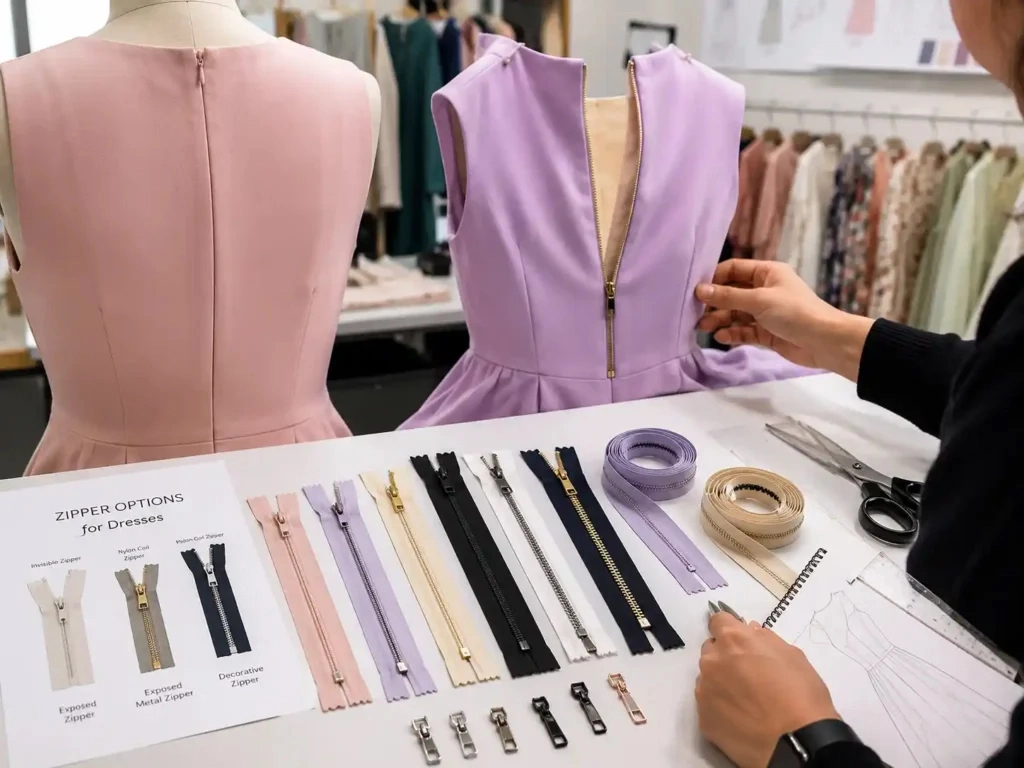
How Dress Design and Pattern Affect Zipper Construction
The zipper specification should be reviewed alongside the pattern. Waiting until the garment reaches the sewing stage can mean changing an opening that has already been incorporated into the sample.
Before confirming the zipper, consider:
- Opening position: Center back, side seam or front opening.
- Finished length: Enough room for the wearer to put on the dress.
- Garment fit: Close-fitting styles need more attention around the opening.
- Fabric stretch: Stretch materials may require additional seam support.
- Lining construction: The lining must not interfere with the zipper.
- Nearby seams: The zipper ending needs to work with the neckline, waist and hem construction.
For example, a fitted dress that needs to pass over the hips may require a longer opening than a loose dress with a similar neckline.
During sample development, the pattern maker needs to check the opening against the actual garment. A tech pack drawing gives the construction direction, but the sample shows whether the zipper length and position work with the finished fit.
Back Zipper vs Side Zipper: What Should You Consider?
Both positions are commonly used in dress manufacturing, but they create different construction requirements.
Center-Back Zipper
A center-back zipper is frequently used on fitted dresses and eveningwear. Its length needs to provide enough room for dressing without interfering with the neckline, waist seam or lining.
For a clean result, both sides need to align properly. If the zipper is slightly higher on one side, the difference may become noticeable around the waist or center-back seam.
Side Zipper
A side zipper helps keep the front and back of the dress visually clean. It is often used when the designer does not want a visible opening along the center back.
However, the side seam can experience more movement around the waist and hip. On fitted styles, the zipper needs to sit comfortably without creating unnecessary tension.
The lining also needs to be secured properly. If it is not controlled during sewing, it can fold toward the zipper or become caught in the slider.
When choosing between the two positions, look at the silhouette, fitting requirements and finishing details rather than simply following what is used on similar dresses.
When Does an Open-End Zipper Make Sense for a Dress?
Open-end zippers are less common in conventional dress construction, but they are useful for designs that need a completely separating front opening.
You may need one when:
- The dress has a full-front opening.
- The design incorporates jacket-style construction.
- The garment has detachable sections.
- The zipper is intended to be a visible design feature.
- Both sides need to separate completely.
If your designer specifies an open-end zipper, include this requirement in the original tech pack. The pattern and bottom finishing must accommodate the separating construction.
Replacing a closed-end zipper with an open-end version after sampling is not a simple trim change. The opening and surrounding construction may need to be revised.
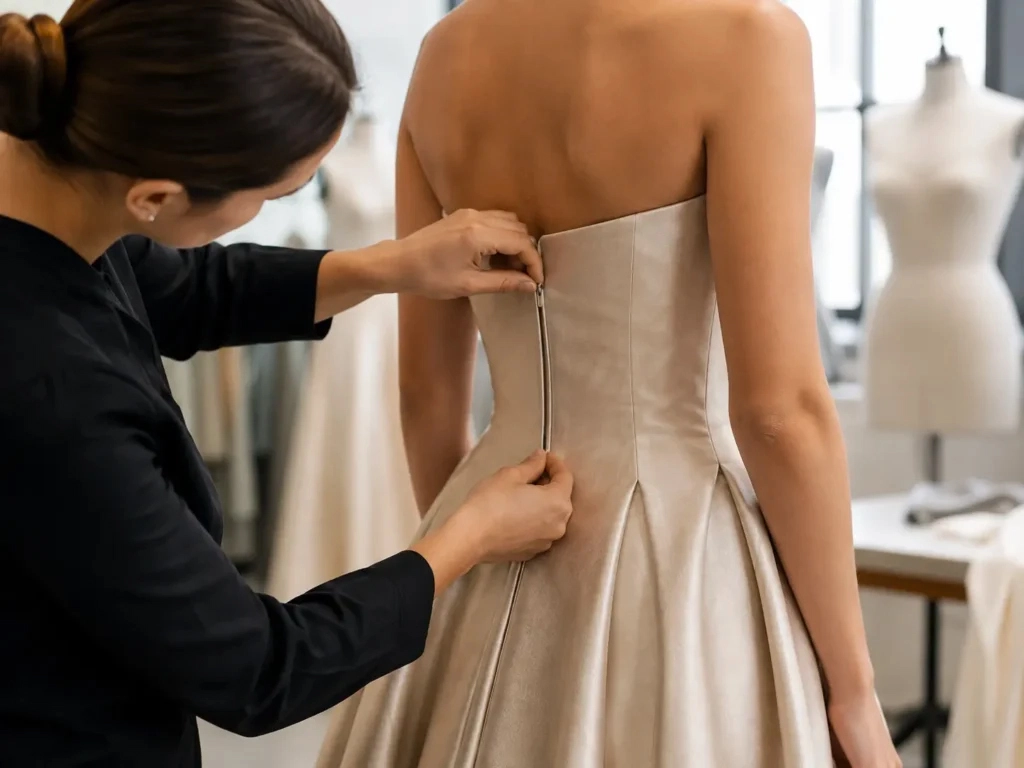
Zipper Length and Specification: What Should Buyers Confirm?
Zipper length is one of the details that can cause avoidable problems during sampling.
If the opening is too short, the wearer may struggle to put on the dress. If it is too long, the zipper may interfere with the waist seam, neckline or other finishing details.
When preparing your tech pack, include as much of the following information as possible:
- Zipper type and construction
- Finished zipper length
- Opening position
- Zipper tape color
- Tooth material and finish
- Slider and puller details
- Supplier reference, if available
- Construction drawing or reference photo
If you do not have a confirmed zipper supplier, the manufacturer can help with sourcing. However, the expected appearance and performance should still be clear.
One thing we check during sampling is the actual opening length after the zipper has been installed. The measurement on a drawing is useful, but the finished garment needs to provide enough room for dressing without disturbing the fit.
Once approved, record the zipper specification alongside the sample details so it can be followed during bulk production.
What Happens When a Zipper Is Changed After Sampling?
A replacement zipper may have the same length but still produce a different result.
The tape width, tooth size, slider shape, stiffness and thickness can all affect the finished garment. These differences are particularly noticeable on lightweight fabrics and dresses with exposed zippers.
For example, a stiffer zipper tape may not sit as smoothly on a soft satin fabric. A different slider or puller can also change the appearance of the finished opening.
If your original zipper is unavailable, ask the manufacturer to compare the replacement with the approved sample before bulk sewing begins.
For a minor change in a hidden trim, a material comparison may be sufficient. If the replacement changes the appearance, flexibility or fit of the garment, a new sample or sewing test is a better way to confirm it.
Common Dress Zipper Problems During Production
When a zipper does not look right, the zipper itself is not always responsible. The pattern, sewing operation and fabric handling should be reviewed before changing the specification.
Zipper puckering: Uneven sewing tension, fabric movement or incorrect seam allowance can create puckering along the opening.
Wavy zipper tape: Lightweight fabrics may stretch during attachment. The fabric and zipper tape need to be controlled during sewing.
Fabric pulling: A close-fitting dress may place too much tension around the zipper area. Check the garment ease and pattern balance.
Difficult opening: The zipper may run smoothly but still provide insufficient room for the wearer to put on the garment.
Uneven installation: Differences in the position of the two zipper sides can affect the alignment of the center-back or side seam.
During sample inspection, check the zipper with the dress laid flat and again when worn. Some problems only become visible when the garment is under normal body tension.
How a Clothing Factory Checks Zippers During Sampling
A zipper should be inspected as part of the finished garment, not simply tested before it is sewn in.
During sample development, we check the following:
- Whether the zipper opens and closes smoothly.
- Whether the opening length works for the garment.
- Whether both sides are aligned.
- Whether the surrounding fabric remains flat.
- Whether the color and finish match the design.
- Whether the lining interferes with the slider.
- Whether the zipper affects the garment’s fit when worn.
For satin, chiffon and other delicate fabrics, the zipper area needs another inspection after pressing and finishing. Some surface problems only become visible after these operations.
If you are developing several colorways, the fabric should also be checked across the different colors. Weight, finish and stretch can vary even when the material comes from the same supplier.
The approved sample should remain the reference for the zipper construction and finished appearance before bulk production is released.
What Should Buyers Check Before Bulk Production?
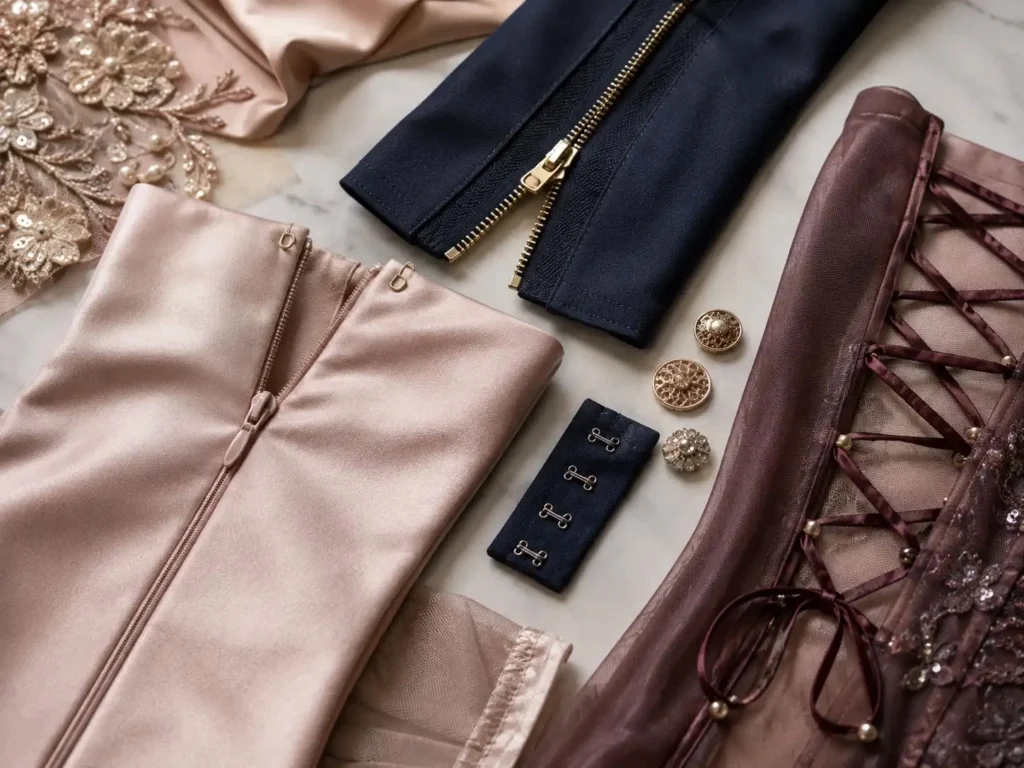
Before approving your production order, make sure the zipper specification is recorded and matches the approved sample.
For private-label and wholesale orders, this is particularly important when you plan to repeat the same style in different colors or future seasons.
Your pre-production checklist should cover:
- Correct zipper type and finished length
- Approved tape color and finish
- Matching slider and puller details
- Correct opening position
- Smooth opening and closing
- No excessive puckering or fabric pulling
- Lining properly secured around the zipper
- Approved zipper reference recorded for production
If the zipper needs to be sourced again for a repeat order, compare it with the original approved reference before releasing it to the sewing line.
This small check helps avoid differences between the approved sample and the garments delivered to your customers.
FAQ
Can I request a specific zipper brand for my dress collection?
Yes. You can provide a zipper brand, supplier reference or physical sample when submitting your design. If the specified zipper is unavailable in the required length or color, the factory should confirm an alternative with you before purchasing it. This is especially important for branded or exposed trims.
Who is responsible if the zipper supplied for bulk production does not match the approved sample?
The approved sample and confirmed trim specification should be used as the production reference. If the factory sources the zipper, the incoming material should be checked against that reference. If you nominate a supplier, both parties should confirm the specification and sample approval before production starts.
Can I use different zipper suppliers for the same dress style?
You can, but the replacement should be compared with the original zipper first. Different suppliers may use different tape widths, sliders or tooth constructions. If you are planning repeat orders, keep the original sample and trim reference so the replacement can be checked before bulk production.
What should I do if my order has several styles but the same zipper requirement?
Prepare a shared trim specification showing the zipper type, color, length and finish for each style. This makes sourcing and material checking easier, particularly when several styles use similar fabrics. However, do not assume the same zipper length will work across different patterns.
How early should zipper sourcing be arranged for a new collection?
It is better to confirm zipper requirements during sample development, particularly if you need custom colors, branded pullers or non-standard lengths. These items may require additional sourcing time. Leaving the decision until after sample approval can delay material purchasing and affect your planned bulk production schedule.
Conclusion
For most dresses, a closed-end zipper is suitable for fixed back and side openings, while an open-end zipper is used when the design needs complete separation. The right choice also depends on fabric, pattern, fit and finishing. Confirming these details during sampling helps keep the approved design consistent in bulk production. If you are developing a new collection, Xiuyu Apparel, an experienced dress manufacturer, can work with your design and production requirements.

