

When a buyer sends us a mesh dress for sampling, we usually do not choose the fabric just by looking at the swatch. Once the mesh is cut and sewn, its stretch, recovery, transparency and sewing behavior can change the way the dress fits and looks.
That is why we normally test power mesh and soft mesh on the actual sample before confirming the fabric for bulk production.
Power Mesh vs Soft Mesh: What Is the Difference?
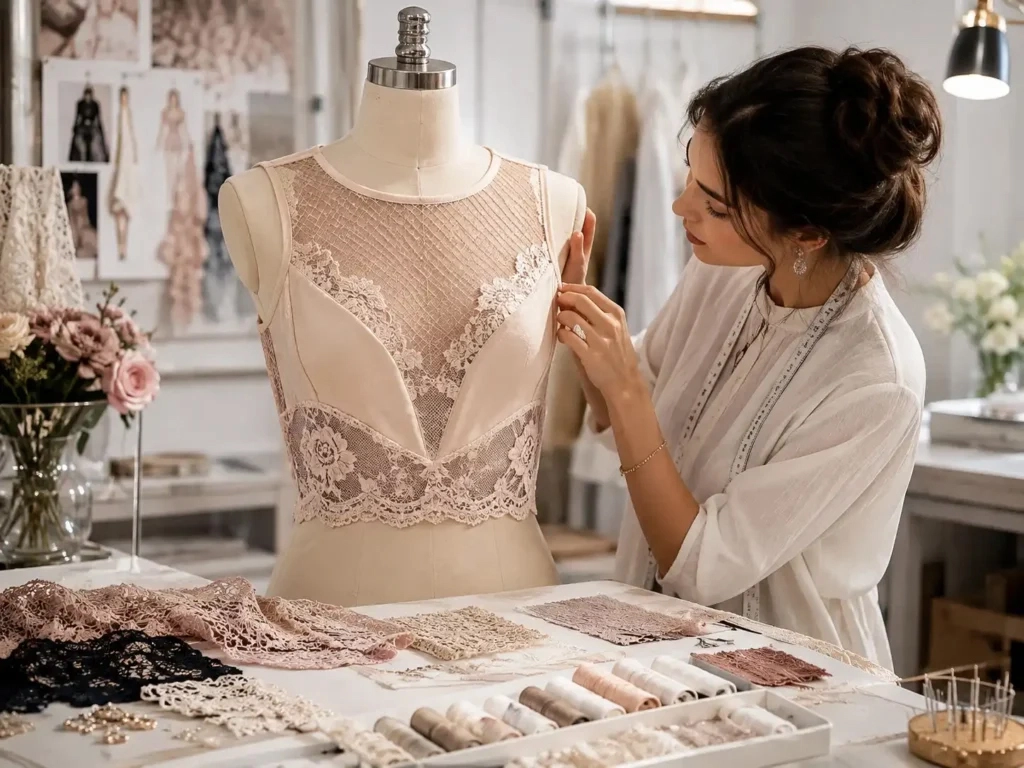
Power mesh and soft mesh can look quite similar on a fabric card. You can usually feel the difference quite quickly when you stretch the two fabrics by hand. We also check them on a dress form and, for fitted styles, on the actual sample panel. A mesh that feels similar on a fabric card can behave quite differently once it is sewn.
Power mesh is usually firmer and has stronger recovery. It is often chosen when the fabric needs to provide some control or help a fitted garment keep its shape.
Soft mesh has a softer hand and tends to fall more easily. It is often used where transparency, movement and a lighter appearance matter more than support.
For a dress collection, we would not approve the mesh from the fabric name alone. The pattern, fit and construction all need to be considered together.
| Fabric Factor | Power Mesh | Soft Mesh |
|---|---|---|
| Hand feel | Firmer | Softer |
| Stretch | More controlled | Easier and softer |
| Recovery | Usually stronger | Usually lower |
| Support | Medium to high | Low to medium |
| Drape | More controlled | Softer and more fluid |
| Transparency | Depends on weight and construction | Often more transparent |
| Typical use | Fitted and supportive areas | Overlays and soft layers |
| Sewing | Requires controlled handling | Can move more easily during sewing |
These are general characteristics rather than fixed rules. Different mills can produce meshes with very different stretch, weight and recovery even when they use similar fabric names.
How Do Stretch and Recovery Affect a Dress?
Stretch is easy to notice when you pull the fabric. Recovery is what we pay more attention to after releasing it, especially for fitted dresses.
For fitted dresses, we pay more attention to recovery than to the maximum stretch figure.
A bodycon dress needs to stretch over the body and return after movement. If recovery is weak, looseness can start to show around the waist, hip or bust.
We have seen samples where the fabric was blamed for a fitting problem, but the real issue was the pattern. The mesh was recovering normally; the pattern was simply asking too much from it.
That is why we test the mesh on the sample instead of judging it from one stretch test.
Which Mesh Is Better for Different Dress Styles?
The right choice depends heavily on how the mesh is being used.
Bodycon Dresses
For a fitted bodycon dress, we would normally test power mesh first if the design needs stronger recovery or some body control.
You should check how the fabric behaves around the waist, hip and bust rather than looking only at its overall stretch. The amount of negative ease in your pattern also affects the final fit.
A strong fabric cannot fix an incorrectly balanced pattern.
For bodycon styles, we also check whether the fabric is being stretched too much at one particular area. Excessive tension around the hip or bust can make an otherwise suitable mesh look unsuitable.
Ruched Dresses
Ruching creates another problem because the mesh is being gathered, stretched and sewn at the same time.
Power mesh can give you a cleaner and more controlled appearance when the ruching is part of the shaping. Soft mesh can be a better choice when you want loose, irregular folds with more movement.
You should also look closely at the spaces between the gathers. Lightweight mesh can bunch unevenly if the sewing tension is not consistent.
For a production sample, it is worth checking the full ruched panel rather than judging the fabric from a flat swatch.
Sheer Dresses
For sheer dresses and overlay construction, soft mesh is often easier to work with.
Here, transparency and drape normally matter more than strong support. You want the mesh to sit naturally over the lining or base garment without making the outer layer look stiff.
A firmer mesh can still be used, but it may change the character of the design. This can be especially noticeable at the neckline, sleeve and skirt hem.
If your design relies on a very light, floating appearance, fabric weight becomes just as important as transparency.
Corset-Inspired Dresses
Corset-inspired dresses need more control around the structured sections.
Power mesh can be useful for panels where you need additional recovery, but it should not be treated as the main structural component. Boning, lining, seam placement and the outer fabric all affect how the finished dress holds its shape.
For this type of design, we normally look at the complete construction during sampling. A mesh that looks suitable by itself may not work once it is combined with boning or a heavier outer fabric.
Mesh Sleeves and Panels
Sleeves and decorative mesh panels usually have different requirements from the main body of the dress.
For a sheer sleeve, softness and drape may be more important. For a fitted mesh panel, recovery and seam stability may matter more.
A single dress does not always need the same mesh throughout. A sleeve may need a soft, lightweight mesh, while a fitted body panel may need stronger recovery.
What Should You Check Before Using Mesh for Dress Production?
Before approving a mesh, composition and color are only the starting point.
Stretch Direction
Before cutting, check which direction the mesh is designed to stretch.
Some meshes have most of their stretch across the width, while others stretch in both directions. This affects pattern placement and how the finished dress fits.
If the stretch direction is turned during cutting, the same pattern can produce a different fit.
For fitted dresses, we prefer to confirm the direction on the actual production roll rather than rely only on the original swatch.
Fabric Recovery
We normally check recovery several times rather than stretching the fabric once.
Stretch the material, release it and repeat the test. What matters is whether it returns consistently after repeated movement.
This is especially important for close-fitting dresses and areas that receive a lot of movement.
GSM and Fabric Weight
GSM gives you a useful reference for fabric weight, but it does not tell you everything about how a mesh will behave.
Two meshes with similar GSM can have noticeably different hand feel, transparency and recovery. When we compare two suppliers, we prefer to put the actual samples side by side. GSM is useful for checking the specification, but it is not enough to approve the fabric.
For sheer dresses, a small difference in weight can also change how much of the lining or body underneath can be seen.
Fabric Width
Fabric width is easy to overlook during development.
A mesh with the right stretch and appearance may still create a cutting problem if the usable width is too narrow for your pattern pieces.
This becomes more important with larger sizes, wide skirt panels or designs with long sleeves. Before confirming the fabric for bulk production, check the usable width rather than only the nominal width supplied by the mill.
Transparency
Transparency should be checked on the finished construction, not just against a white background.
Place the mesh over the actual lining or base fabric and look at it under normal lighting. The result can be quite different once the two fabrics are layered.
For black, nude and light-colored mesh, this check is especially useful because small changes in lining color can affect the appearance of the dress.
Seam Behavior
Mesh can behave very differently from a stable woven fabric during sewing.
If it is too soft, the fabric may move under the presser foot. A firmer mesh can sew more cleanly, but the seam may become more noticeable.
For the sample, we check the armhole, waist seam and other curved areas for puckering, stretching and uneven seams.
Machine settings also matter, so we prefer to judge the fabric after it has actually been sewn rather than from the raw material alone.
How Does Mesh Choice Affect Pattern Making?
Fabric selection and pattern making should not be treated as two separate steps.
If you are using a highly elastic mesh, the pattern may need different ease from a softer, less resilient material. The amount of stretch available in the fabric and the intended body fit both need to be considered.
For example, if you develop the first sample using one mesh and later replace it with a softer fabric, keeping exactly the same pattern does not guarantee the same fit.
As a dress manufacturer, we usually prefer to confirm the fabric before finalizing the production pattern. It avoids a common situation where the sample fits correctly, the fabric is changed later for cost or availability reasons, and the bulk garment no longer behaves in the same way.
This is particularly important for private label collections where the same basic block may be used across several styles.
What Happens When a Mesh Dress Goes Into Bulk Production?
A mesh can work well on the first sample and still cause problems in bulk production.
Before cutting, we check the bulk fabric against the approved sample for:
- Fabric width
- Stretch direction
- Recovery
- GSM
- Transparency
- Hand feel
- Color
- Surface appearance
Fabric lots can vary. The difference may be small on a swatch but become more obvious when the fabric is spread across a production table and cut in volume.
The approved sample is kept with the production reference so the team can compare the bulk fabric before cutting starts. As a clothing manufacturer, we keep the approved sample with the production reference so the team can compare the bulk fabric before cutting starts.
Fabric substitution also needs attention. If the original mesh is unavailable, a replacement should not be approved simply because the color and composition look similar. The substitute needs to be sampled and checked for fit, drape and sewing behavior before bulk cutting.
How Should You Choose Between Power Mesh and Soft Mesh?
There is no single mesh that works best for every dress. We normally start with the construction and fit, then choose the fabric that suits that part of the garment.
| Your Dress Requirement | Better Starting Point |
|---|---|
| Stronger body control | Power mesh |
| Fitted bodycon construction | Power mesh |
| Softer drape | Soft mesh |
| Sheer overlay | Soft mesh |
| Lightweight sleeves | Soft mesh |
| Structured mesh panels | Power mesh |
| Loose gathered effect | Soft mesh |
| Repeated body stretch | Power mesh with suitable recovery |
Actual fabric performance can vary, so the sample still needs to be checked before production.
If your dress combines several constructions, you may need different mesh fabrics in different sections. The final decision should come from the sample, because the interaction between fabric, pattern and sewing can be difficult to predict from specifications alone.
What Should You Confirm Before Approving the Mesh?
Before moving from development into bulk production, check these points with your dress manufacturer:
- What is the usable fabric width?
- Where is the main stretch direction?
- How does the fabric recover after repeated stretching?
- Does the bulk fabric match the approved sample?
- Will the same mesh be available for repeat orders?
- Can the fabric be supplied in the required color and quantity?
- Does the mesh need a different sewing method from the base fabric?
- Does the lining change the appearance of the mesh?
- Has the final construction been tested in the intended size range?
- If the fabric needs to be replaced, will a new sample be approved first?
For B2B production, these questions are often more useful than simply asking whether a mesh is “good quality.”
FAQ
1. Can I use the same mesh for all sizes of a dress?
Yes, in many cases. But we still recommend checking the larger sizes, especially for fitted styles. As the pattern gets larger, the mesh can be under more tension around the bust, waist and hip, so the fit should be confirmed before bulk production.
2. Should mesh fabric be ordered together with the first production order?
Not always. It depends on the fabric, color and production schedule. For special colors or less common mesh constructions, we recommend confirming availability early. If the style is expected to be reordered, it is also worth discussing future fabric availability with the supplier.
3. What happens if the approved mesh is unavailable later?
We would not replace it based only on color or fiber composition. The replacement should be compared with the approved mesh for stretch, recovery, transparency and hand feel. If the difference affects the fit or drape, a new sample should be approved before production.
4. How should you handle leftover mesh after bulk production?
If the mesh is suitable for another style or a repeat order, keep the remaining rolls properly labelled. Record the fabric specification, color, lot and remaining quantity. Unlabelled leftover rolls can be difficult to use later because the original fabric information may be unclear.
5. Can mesh dresses be reordered months later with exactly the same fabric?
It depends on the fabric mill and whether the same construction and color are still available. For repeat orders, we recommend keeping the approved fabric reference and production details with the style. If the original mesh has been discontinued, test the replacement before confirming the repeat order.
Conclusion
For a close-fitting dress, we would usually test power mesh first because recovery and body control matter more. For sheer overlays or soft sleeves, we are more likely to choose a lighter mesh with better drape.
The important part is what happens after the mesh is cut and sewn. Check the fabric with the actual pattern, lining and construction before approving it for bulk production. That small step can prevent a much bigger fitting or sewing problem later.
Explore More Dress Manufacturing Services
If you are developing a new dress and need support with fabric selection, internal construction, sampling, and bulk production, an experienced clothing manufacturer can help you deal with these decisions before they become production problems.
At Xiuyu Apparel, we work with fashion brands, startups, designers, and private label companies from sample development through bulk production.
Get a Clothing Manufacturing Quote Based on Your Design
If you already have a garment design, send us the product photo, tech pack, or reference sample together with your target quantity.
As a dress manufacturer, we can review the fabric, lining, construction, trims, workmanship, and finishing requirements before preparing a quotation based on the actual garment rather than a general price range.

