

When you compare dress manufacturers, the quotation is often the easiest part to compare. The harder questions come later: Can the factory understand your construction details? Will the bulk fabric match the approved sample? Who corrects the pattern after fitting? What happens when a problem appears during production? From a clothing manufacturer’s side, these are the details we pay attention to before an order reaches bulk production.
Start With How the Factory Handles Your Design
A manufacturer may tell you they can make almost any dress. That answer is not enough to evaluate whether the factory is suitable for your project.
Give the manufacturer the information you already have and see what happens next.
You might have a complete tech pack. Or you may only have a sketch, reference photos, an existing garment, or a sample bought from another brand. The questions coming back from the factory can tell you quite a lot about how the team is looking at the garment.
The conversation should normally touch on details such as:
- Fabric composition and weight
- Garment measurements
- Lining
- Seam construction
- Closures
- Pleats or gathers
- Draping
- Embellishment
- Print placement
- Fit requirements
- Special finishing
If the discussion stays focused mainly on quantity and price, you still have little evidence of how the manufacturer will handle the garment itself.
We often see a small detail in a reference garment create a much bigger issue later. A neckline that looks simple in a photo, for example, can require a completely different pattern or sewing method once the garment is actually developed.
That is much easier to find out during development than after bulk production has been scheduled.
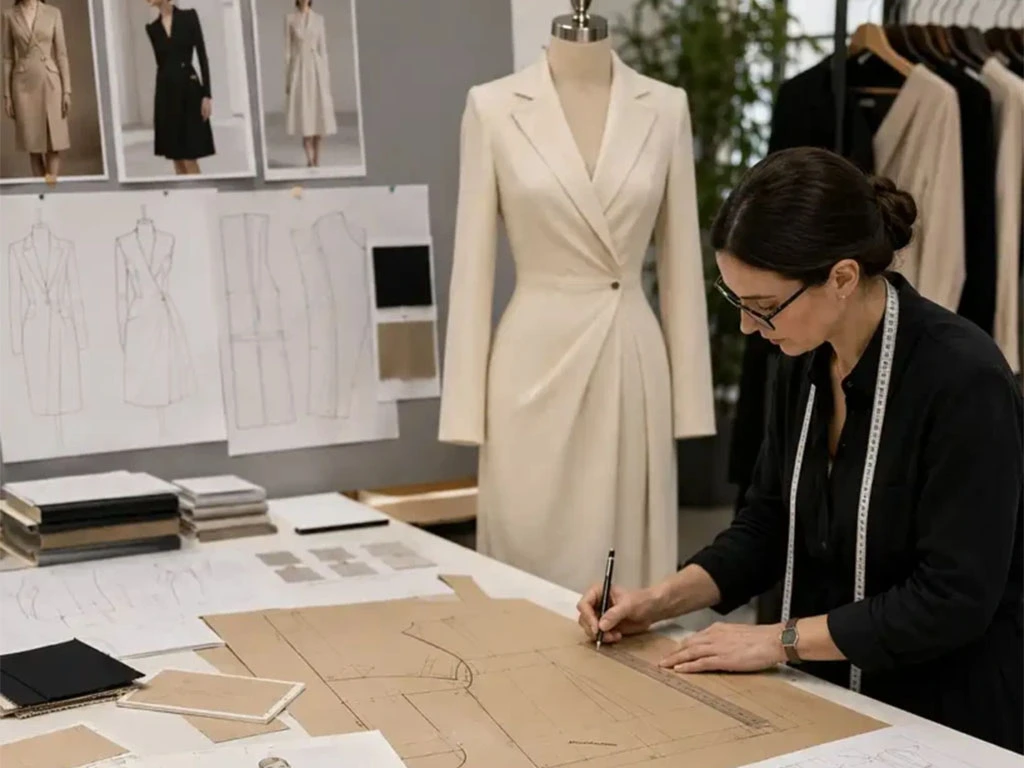
Look at the Pattern-Making Side, Not Only the Sewing Floor
For dresses, pattern making can have as much impact on the result as sewing.
Find out who develops the pattern and who makes adjustments after fitting. This becomes particularly important when the design is fitted, asymmetrical, draped, or built with several panels.
Ask what happens when you send comments such as:
- Bust is too tight
- Waist needs to move up
- Armhole is too low
- Skirt volume needs adjustment
- Shoulder width needs changing
- Hem is not falling evenly
A good sample revision is not simply a matter of sewing the same garment again.
The pattern may need to be changed first.
When you send fit comments, ask what happens to the pattern afterward. If the bust is too tight, the waist needs to move, or the armhole is too low, someone needs to translate those comments into actual pattern changes before the next sample is made.
For a fashion brand developing several styles at once, poorly managed revisions can quickly turn into extra sample costs and lost development time.
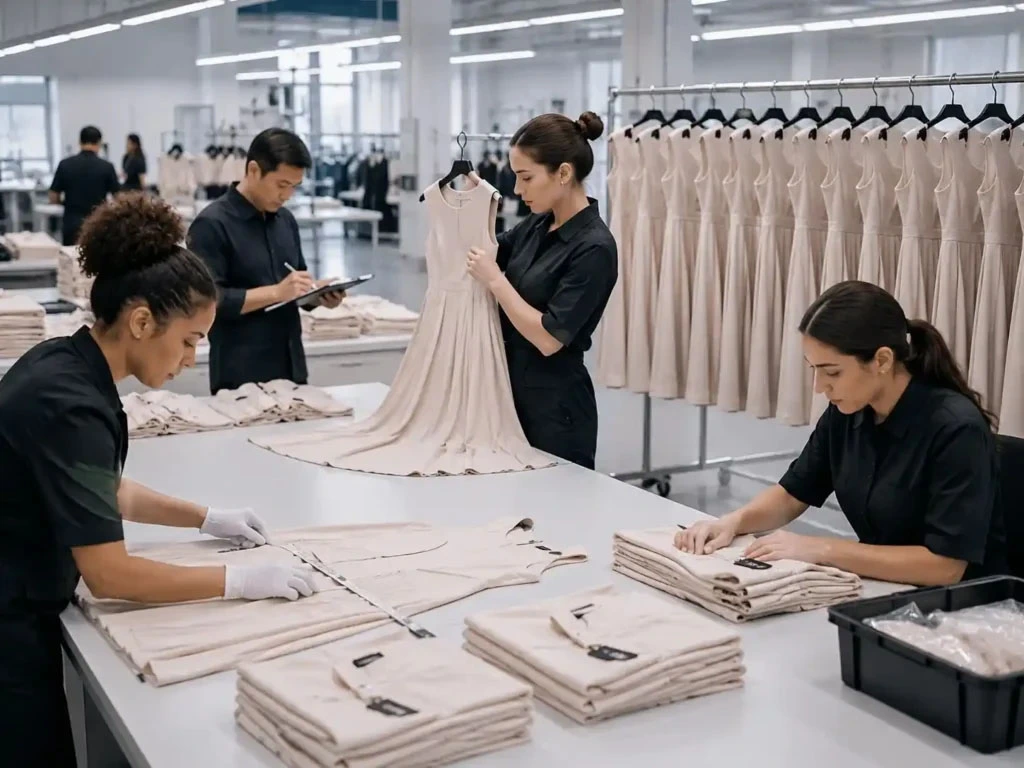
Ask What Happens to the Fabric Before Cutting
A dress can meet the construction requirements and still look different from the approved sample if the fabric has not been properly checked.
Check whether the manufacturer works from your nominated fabric, a fabric swatch, a composition requirement, or a reference garment. If the factory is sourcing the material, ask how the fabric is checked before production.
Pay attention to:
- Fabric width
- Weight
- Stretch
- Shrinkage
- Color
- Surface defects
- Hand feel
- Drape
Shrinkage is particularly easy to overlook.
If the fabric changes after washing or finishing, measurements can move with it. That can affect everything from the length of a dress to the fit around the waist and bust.
We prefer to deal with these issues before bulk cutting. Once a large quantity of garments has been cut, changing the fabric becomes a much more expensive problem.
The same applies to fabric color and surface defects. If the material is not suitable, changing it after cutting has started becomes much more expensive.
Do Not Judge Sampling by the First Sample Alone
The first sample is only the beginning of the development process.
The more useful question is:
How does the manufacturer respond when the first sample is not right?
You may need to change the fit, fabric, construction, length, trims, or finishing. Watch how the factory handles those comments.
A typical development may move through:
Pattern → First Sample → Fit Comments → Pattern Revision → Revised Sample → PP Sample → Bulk Production
Some styles may need several revisions before the PP sample, while simpler styles may move through development faster.
What matters is whether the manufacturer keeps track of what changed.
For example, if you approve a revised neckline but also change the fabric and sleeve construction, the production team needs a clear record of the final version. Otherwise, different people may be working from different samples.
That becomes particularly important when several weeks pass between the first sample and the bulk order.
Compare Quotes Only After You Understand What They Include
A unit price gives you a starting point, but it does not tell you whether two manufacturers are quoting the same production scope.
Two factories can quote different prices because they are working from different assumptions.
Before comparing the numbers, check whether the quotation includes:
- Main fabric
- Lining
- Trims
- Printing
- Embroidery
- Beading
- Labels
- Hangtags
- Packaging
- Pattern development
- Sampling
- Special finishing
The fabric alone can create a noticeable difference.
A satin-look fabric, silk, chiffon, cotton poplin, and a rayon or viscose fabric will not necessarily have the same sourcing cost or production requirements.
Construction matters too.
A dress with lining, gathering, invisible zipper, boning, hand-applied embellishment, or multiple layers may take considerably more production work than a similar-looking style made with simpler construction.
So when you compare quotes, make sure the manufacturers are pricing the same product.
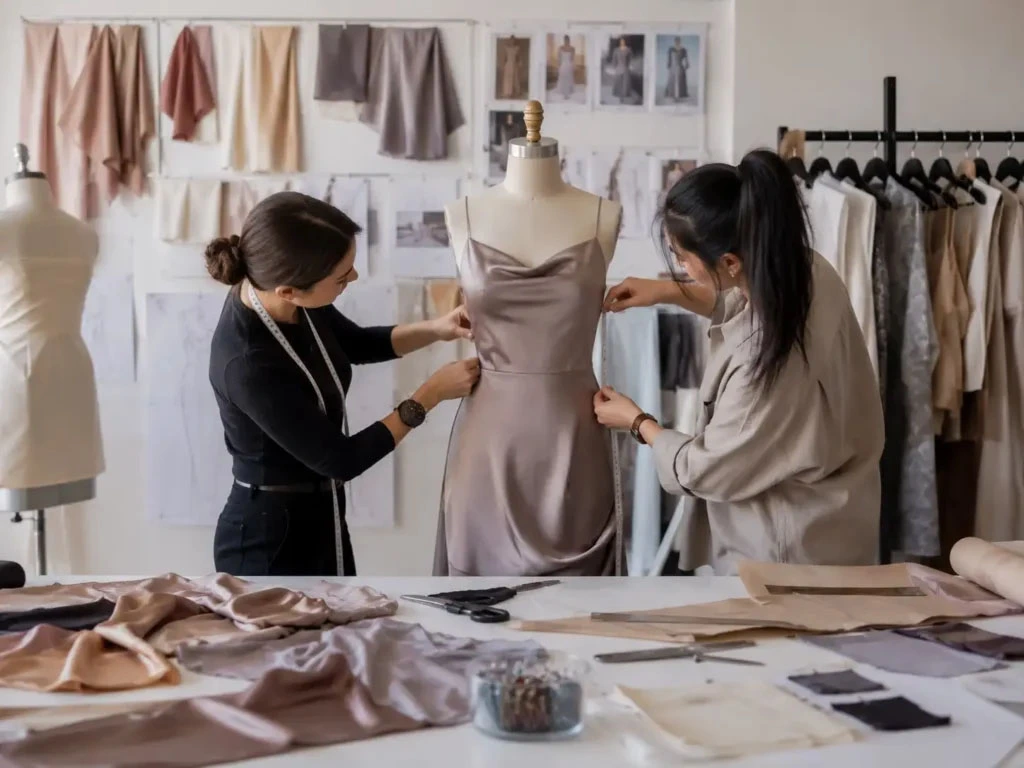
Check MOQ Against the Way You Plan Your Collection
MOQ can become a problem when your collection contains many styles and colors.
Rather than asking for one MOQ number, find out how the factory applies the minimum quantity.
For example, find out whether the minimum applies per:
- Style
- Color
- Fabric
- Order
- Size
A new brand might plan ten dress styles but only need a relatively small quantity of each. In that situation, a factory with a high minimum per style may not fit the collection plan, even if its production capabilities look suitable.
You should also ask whether different colors can be combined under one style or whether each color is treated separately.
This is a practical question, but it can make a significant difference to your first production budget.
Look at Capacity in Relation to Your Order
A factory’s worker count or building size does not tell you everything about its capacity.
You need to understand whether the manufacturer has the production resources needed for your type of order.
Ask about:
- Sewing equipment
- Cutting facilities
- Pattern makers
- Sample sewers
- QC staff
- Production lines
- Current production schedule
- Experience with similar garments
A factory may have plenty of machines but limited availability during a busy season.
A more useful question is:
How many pieces can you produce per month?
Ask:
Can you schedule my order within the required production window?
For repeat orders, another question matters:
Can you reproduce the approved sample consistently when the quantity increases?
That is where production capacity becomes relevant to your business rather than simply being a factory statistic.
Find Out How Quality Is Checked During the Order
Ask how quality is controlled before the finished garments reach packing.
A dress order may pass through several points:
Fabric Inspection → Cutting → Sewing → Inline QC → Finishing → Final Inspection → Packing
A printed dress may require attention to print position and color consistency. A fitted dress may need closer measurement checks. A beaded style may require inspection of attachment and finishing. A lightweight garment may need more attention during sewing because marks or puckering can be more visible.
This is why asking:
“Do you have QC?”
does not tell you very much.
A better question is:
“What will you check on this dress during production?”
The answer gives you a much clearer picture of how the factory approaches your actual product.
Pay Attention to How Problems Are Communicated
Before an order starts, we often find that the difficult questions tell you more than the easy ones.
Tell the factory about a tight deadline. Ask about a difficult fabric. Point out a complicated construction detail. Ask whether a requested change will affect the price or lead time.
Then pay attention to the response.
You need to know what can be done, what needs to change, and what still needs confirmation.
We sometimes tell a customer that a requested detail needs to be adjusted before sampling. That conversation may be less convenient at the beginning, but it is much easier than making the sample, starting bulk production, and then discovering that the original construction cannot achieve the expected result.
A manufacturer should not simply say yes to every request.
The useful part is knowing why something can or cannot be done.
Make Sure Changes Are Controlled Before Bulk Production
Changes become more expensive once production has moved forward.
Before you approve the order, make sure there is a clear final version of the specifications.
That can include:
- Approved sample
- Final measurements
- Fabric
- Color
- Construction
- Trims
- Labels
- Packaging
- Grading
- Finishing requirements
If your team has exchanged several sample versions, do not assume everyone is referring to the same one.
Identify the approved sample clearly and keep the final comments together with the production specifications.
This matters when the designer, buyer, and manufacturer are discussing the same order separately. One person may be talking about the first sample while another is referring to the revised version.
Understand When the Production Lead Time Starts
A quoted lead time needs context.
If a factory tells you that bulk production takes 25 days, ask what has to be completed before those 25 days begin.
For example:
PP Sample Approval + Fabric Confirmation → Bulk Cutting → Sewing → Finishing → Final Inspection → Packing
If fabric still needs to be sourced, the actual project timeline will be longer than the sewing period alone.
Also clarify whether the production lead time starts after:
- Deposit payment
- Fabric approval
- PP sample approval
- Final specifications
- All trims and labels being available
For a brand working toward a launch date, these details matter.
A factory may be able to produce the garments within the quoted production period, but the order can still arrive late if approvals or materials are not ready beforehand.
Check Private Label and Packaging Requirements Early
For a private label collection, garment production is only one part of the preparation.
Your order may also include:
- Woven labels
- Printed labels
- Size labels
- Care labels
- Hangtags
- Barcodes
- Polybags
- Cartons
- Custom packaging
Before production starts, make sure the manufacturer knows what you need and where each item should be placed.
Also clarify who supplies the materials.
For example, your company may provide the finished labels while the factory handles sewing them into the garments. Or the factory may source the labels according to your artwork and specifications.
It is easier to settle this during production preparation than after the garments are already being packed.
Use a Simple Manufacturer Evaluation Checklist
Once you have spoken with several factories, put the answers side by side rather than relying on memory.
Use the same basic questions for each manufacturer.
| Area | What to Check |
|---|---|
| Design | Does the factory understand your construction details? |
| Pattern | Who develops and revises the pattern? |
| Fabric | How is the fabric selected and checked? |
| Sampling | How are fit comments handled? |
| Quote | What is included in the price? |
| MOQ | How is the minimum quantity calculated? |
| Capacity | Can the factory schedule your order? |
| QC | What is checked during production? |
| Changes | How are specification changes controlled? |
| Lead time | When does bulk production actually start? |
| Labels | Can your labeling requirements be followed? |
| Packaging | Who supplies and checks packaging? |
| Approval | Which sample becomes the production reference? |
| Communication | Does the factory raise production issues early? |
The manufacturers do not need to follow identical processes. What matters is that you understand what each quotation and production setup actually covers.
A lower quotation may come with a different MOQ, fabric basis, sampling process, or packaging scope. Another manufacturer may include more of the work in the quoted price.
Once the specifications are aligned, the comparison becomes much more meaningful.
What Matters Most Before You Place the Order?
Before you commit to a manufacturer, you need clear answers about how your particular dress will be developed and produced.
Factory size, price, MOQ, and capacity only show part of the production picture.
Before committing, make sure you understand:
- How your design will be interpreted
- Who handles pattern revisions
- How fabric is checked
- How samples are developed
- What the quotation covers
- How production is scheduled
- How quality is monitored
- How changes are controlled
- What becomes the final production reference
These answers give you a more practical basis for comparing dress suppliers than a factory introduction page alone.
FAQ
1. What should you do if a manufacturer refuses to share production details?
You do not need every internal factory procedure, but basic questions about sampling, production timing, quality checks, and order preparation should have clear answers. If important information remains vague, ask for the specific part that affects your order rather than requesting a general factory overview.
2. Can you work with a manufacturer if your first order is very small?
That depends on the manufacturer’s production setup and the styles you want to make. Some factories are set up for larger production runs, while others may accept smaller development or production orders. Ask about the minimum practical order for your specific styles rather than relying on a general MOQ.
3. What if your target price is lower than the manufacturer’s quotation?
Ask which part of the specification is creating the difference before asking the factory to reduce the price. Fabric, construction, quantity, trims, packaging, and finishing can all affect cost. Sometimes changing one requirement can bring the project closer to your target without changing the parts of the garment that matter most.
4. Should you send the same information to every manufacturer you are comparing?
Yes. Using the same tech pack, reference sample, fabric requirements, quantity, color, and packaging information makes the quotations much easier to compare. If every factory receives different information, the price differences may come from different assumptions rather than genuine differences between manufacturers.
5. What information should you keep after choosing a manufacturer?
Keep the approved sample, final measurements, fabric information, artwork, label specifications, packaging details, quotation, and agreed production timeline together. This gives your team a clear reference for repeat orders and makes it easier to identify what changed if a later production run does not match the previous one.
Conclusion
Before placing an order, look past the factory introduction and the unit price.
The useful questions are more specific: Who develops the pattern? How are fit changes handled? How is the fabric checked before cutting? What does the quotation include? When does bulk production actually start? What happens when a production issue is found?
Give each manufacturer the same product information and ask the same core questions. That gives you a clearer view of what is actually included in the price, how the order will be handled, and where the production differences are.
For a dress order, the important part is not simply finding a factory that can make the style. You also need to know how the factory will handle the details from sampling through bulk production.
If you are looking for a factory to develop and produce your dress collection, Xiuyu Apparel can review your design, fabric, construction, sampling requirements, and production specifications before bulk production begins.
Related Dress Manufacturing Services
If your project involves a specific dress fabric or construction, you can also review our related manufacturing pages:
- Maxi Dress Manufacturer
- Velvet Dress Manufacturer
- Slip Dress Manufacturer
- Ruffle Dress Manufacturer
- Midi Dress Manufacturer
Get a Quote for an Existing Dress Style
If you are transferring an existing dress style to a new manufacturer, send us the latest approved sample, tech pack, product photos, or measurement chart together with your target quantity.
As a dress manufacturer, we can review the construction, fabric, trims, measurements, and current production status with you before confirming the sampling requirements.

