

When we quote a dress for production, lining can make a bigger difference to your final cost than you might expect. As a clothing manufacturer, we look beyond the lining fabric price and check consumption, fabric width, pattern layout, sewing operations, and finishing. If you are comparing factory quotations or working with a target cost, understanding these factors helps you see where the price difference comes from and avoid unexpected costs during bulk production.
Which Parts of a Dress Cost Does Lining Affect?
When we calculate the production cost of a lined dress, we normally look at several areas together:
- Lining fabric cost
- Lining fabric consumption
- Pattern and cutting work
- Additional sewing operations
- Pressing and finishing
- Sample development
- Quality inspection
- Production time
- Material waste
Lining costs vary significantly between a lined bodice, a full-length maxi dress, and a fitted stretch style. Lightweight silk and stretch fabrics also require different lining specifications.
1. Lining Fabric Cost
The lining fabric itself is the most obvious additional cost.
For most commercial dress production, polyester and viscose are common choices. Silk or cupro becomes more relevant when the outer fabric is lightweight or positioned as a premium product.
For a price-sensitive collection, polyester lining may be a practical option. For a premium silk or luxury dress, you may prefer a softer lining with a similar level of drape and hand feel to the shell fabric.
Price per meter should not be the only consideration.
A cheaper lining can still cause problems if it is too stiff, too heavy, or difficult to sew. We normally find this during sampling, especially with lightweight silk or stretch fabrics.
For example, a lightweight silk shell can lose some of its natural drape when paired with a relatively heavy lining. On a fitted stretch dress, a non-stretch lining may restrict movement even when the outer fabric has enough stretch.
In practice, we may reject a cheaper lining if it creates problems during sewing or changes the way the finished dress hangs.
2. Lining Fabric Consumption
Lining consumption can have a bigger effect on your final cost than the lining price itself.
A full lining does not simply mean cutting the same shape as the outside of the dress. The lining follows its own pattern construction, seam allowances, grain direction, and finishing requirements.
The actual lining consumption depends on several details in the pattern and garment construction:
- Dress length
- Skirt volume
- Number of panels
- Sleeve construction
- Fabric width
- Grain direction
- Seam allowance
- Pattern layout
- Size range
- Lining coverage
A long dress naturally uses more lining than a short dress. A wide skirt can require even more because the pattern pieces become larger.
Fabric width is another detail that is easy to overlook when comparing quotations.
Two lining fabrics may have a similar price per meter but produce different costs if one has a narrower usable width. The factory has to check whether the pattern pieces can be placed efficiently on the available width.
Before confirming the material requirement, we check the pattern against the usable fabric width rather than estimating lining from the finished garment length alone.
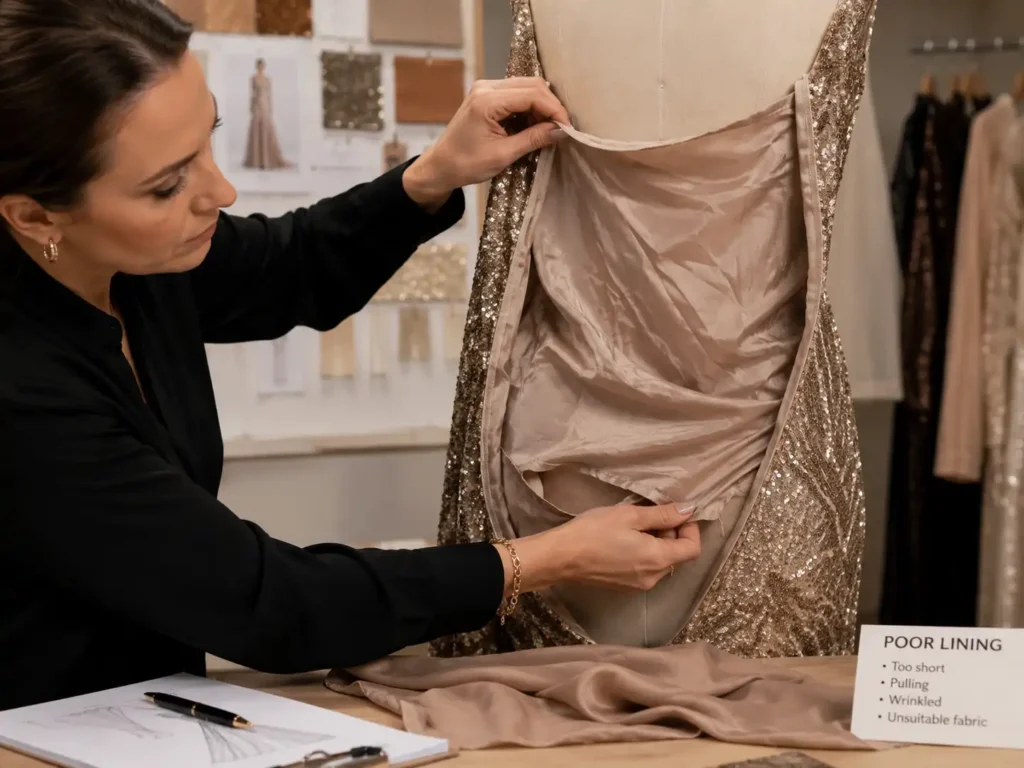
How Does Lining Fabric Choice Change the Cost?
Different lining materials affect both the material budget and the way the garment is produced.
| Lining Fabric | General Cost Level | Common Consideration |
|---|---|---|
| Polyester | Lower | Cost control and general dress production |
| Viscose | Medium | Softer hand feel and drape |
| Acetate | Medium–High | Smooth feel and premium applications |
| Cupro | Higher | Soft hand feel and fluid garments |
| Silk | Higher | Luxury and silk dress applications |
| Stretch Lining | Varies | Needs to match the stretch of the shell fabric |
You should choose the lining according to the shell fabric and garment construction, not only according to the lining price.
We also check shrinkage before approving the lining. If the shell and lining shrink differently, the finished dress can pull, twist, or develop an uneven hem after washing or pressing. It is much easier to catch this during fabric testing or sampling than after bulk production starts.
Does Full Lining Cost More Than Partial Lining?
In most dress production, full lining costs more because it requires more fabric and additional sewing operations.
A fully lined dress uses more material and requires more construction work than a dress where lining is added only where it is needed.
In some dress styles, lining is only added to areas such as:
- Bodice
- Bust area
- Skirt section
- Front panel
- Sheer sections
For a lightweight chiffon dress, lining may mainly be required to improve opacity. There may be no practical reason to line every section.
A structured evening dress is different. The lining may also form part of the internal construction and help control the finished appearance and comfort.
A cheaper lining only helps if it still works with the garment. Otherwise, you may save a few cents on fabric and lose that saving through extra sewing or fitting adjustments.
How Does Lining Affect Cutting Cost?
Adding lining means adding another set of pattern pieces that need to be prepared, checked, and cut.
Multi-panel dresses, curved seams, and complicated internal construction usually require more work on the lining pattern.
During cutting, the team checks the usable width, grain direction, pattern placement, and how much fabric is left between the pieces.
Lightweight or slippery lining fabrics can require additional care during cutting. If the fabric shifts, the resulting pieces may not match the pattern accurately enough for clean assembly.
Cutting problems are much easier to correct before the pieces reach the sewing line. Once the garment is assembled, fixing inaccurate or mismatched lining pieces takes much more time.
Pattern development can also change material efficiency, especially on larger orders. A production pattern needs to achieve the required fit while allowing the fabric to be used efficiently. A small improvement in pattern layout can become meaningful when the order contains hundreds or thousands of pieces.
How Does Lining Increase Sewing Labor?
Lining adds sewing operations that do not exist on an unlined garment.
The extra sewing work can include:
- Prepare the lining pieces
- Join lining panels
- Attach the lining to the shell
- Finish the neckline or armholes
- Secure the lining around closures
- Control the lining length
- Check that the lining does not pull or twist
- Press the completed construction
A simple dress may only require a few additional operations.
A fitted dress with several curved seams can take considerably longer because the lining has to follow the shape of the garment correctly. Zipper areas, armholes, necklines, and hems also need to be checked carefully.
This is one reason why comparing factories only by their basic sewing price can give you the wrong picture.
When you compare two quotations, the construction specification needs to be the same.
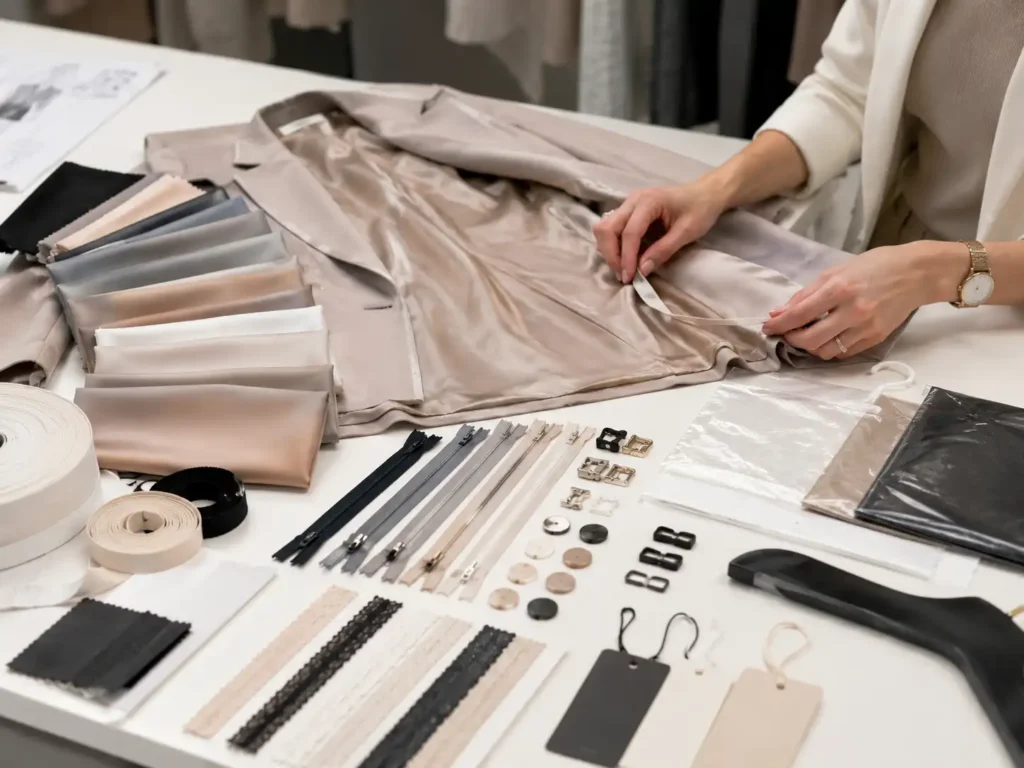
How Does Lining Affect Different Types of Dresses?
Silk Slip Dress
With a silk slip dress, we pay close attention to lining weight and drape. A lining that feels fine on the cutting table can make lightweight silk fall differently once the dress is assembled. This is especially noticeable on bias-cut styles, where the shell and lining can settle at different rates after hanging. We therefore confirm the lining length from the finished sample rather than fixing it from the paper pattern alone.
For this type of garment, lining should be reviewed together with the silk weight, construction, target price, and finished drape.
Satin Dress
Satin can show differences in drape and surface appearance quite clearly.
Under satin, too much lining can add unnecessary bulk and change the way the dress falls. Neckline, seam, and zipper construction also need to be checked during sampling.
Satin fabrics can behave quite differently from one supplier to another. Before confirming the lining, we check the actual shell fabric rather than assuming one lining will work for every satin.
Bodycon Dress
For a bodycon dress, the lining needs to stretch with the shell fabric.
If the outer fabric stretches but the lining does not, the finished garment may feel restrictive or pull in certain areas.
The lining needs to match the shell fabric’s stretch and recovery. Price alone is not enough for a bodycon dress.
Chiffon Dress
With chiffon, opacity is often the main reason for adding lining.
In some chiffon styles, lining is only needed through the body or other sheer areas rather than across the entire dress. Lining color can also change how the finished chiffon appears, especially with light or transparent shades.
Reducing the lining coverage can lower material consumption, but the result should be checked on the actual sample.
Evening Dress
Evening dresses can involve multiple layers, structured sections, boning, embellishment, or more complicated finishing.
In these garments, the lining often does more than provide coverage. It can support the internal construction and help keep the finished garment clean and comfortable.
This can increase both sewing time and finishing requirements, especially when the inside of the garment needs to look clean and remain comfortable during wear.
A Simple Example of Lining Cost
Suppose you are developing a dress that uses:
- 1.2 meters of lining per piece
- Lining fabric at $3 per meter
- Additional lining-related sewing and finishing of $1.50 per piece
The basic lining-related cost would be:
1.2 × $3 + $1.50 = $5.10 per dress
For a 1,000-piece order:
$5.10 × 1,000 = $5,100
This is a simple costing example. Actual consumption and labor will vary with the fabric width, pattern layout, lining coverage, and construction.
In a factory quotation, lining cost is not simply the lining fabric price. Consumption, cutting, sewing, and finishing all contribute to the final number.
If your lining consumption or workmanship changes by even a small amount per piece, the difference becomes much more noticeable across a larger order.
How Can You Reduce Lining Cost Without Lowering Quality?
If you are working to a target factory price, review the lining with your clothing manufacturer during development. Waiting until the production specification is finalized leaves fewer options for reducing cost.
Start With the Shell Fabric
You do not always need the most expensive lining.
We normally choose the lining by looking at the shell fabric, the construction, the quality level you need, and the target cost together.
Ask Whether Full Lining Is Necessary
If full coverage is not necessary, partial lining can reduce material consumption and sewing work.
This works well for some chiffon, sheer, and lightweight dress styles.
Check the Usable Fabric Width
Do not compare lining fabrics only by price per meter.
Usable width can change the actual consumption after the pattern is laid out.
Look at the Actual Pattern Layout
Once the production pattern is ready, we can check whether the lining pieces are using the fabric efficiently before confirming consumption.
The saving per piece may look small on a single garment, but it becomes more meaningful when you are producing hundreds or thousands of pieces.
Test Shell and Lining Together
We normally put the lining into the sample before making the final cost decision. This lets us see whether the two fabrics actually work together, rather than judging them separately from the swatches.
Lock the Construction Before Bulk Cutting
Once the bulk fabric has been cut, changing the lining is no longer a simple material substitution. It can affect the pattern, consumption, and sewing process.
If you already have a target cost, discuss the lining, shell fabric, and construction together before the production version is approved.
What Should You Check When Comparing Factory Quotations?
When two dress manufacturers quote different prices for the same dress, first check whether they are quoting the same specifications.
Compare:
- Shell fabric composition
- Fabric weight
- Lining fabric
- Lining coverage
- Lining width
- Fabric consumption
- Order quantity
- Zippers and trims
- Labels
- Packaging
- Quality requirements
- Special finishing
A lower quotation may be based on a different lining, lower material consumption, lighter fabric, fewer sewing operations, or different finishing requirements.
For example, a $10 quotation and a $13 quotation may look far apart until you check what is included in each one. One may include full lining, while the other uses partial lining or a different fabric specification.
The same problem occurs when one factory includes extra finishing or inspection and the other does not.
When you request a quotation, giving the factory the lining specification or clearly stating the required quality level can make the comparison much more useful.
How Should You Confirm Lining Before Bulk Production?
On some styles, the lining length is not finalized from the paper pattern alone. We check the finished sample after it has been hanging, particularly on bias-cut or lightweight dresses.
The sample is where we confirm whether the lining works with the actual garment.
You should check:
- Lining weight
- Hand feel
- Opacity
- Drape
- Finished length
- Seam appearance
- Neckline and armhole construction
- Stretch and recovery where applicable
- Movement between shell and lining
- Shrinkage after washing or the required care test
Pay particular attention to the hem.
If the lining hangs below the shell, pulls the outer fabric upward, or creates an uneven appearance after pressing, the lining length or construction may need to be corrected.
We prefer to correct these issues before bulk cutting. After cutting, even a small lining change can affect material consumption and production.
This is why we treat sample approval as a production checkpoint, not just a design approval. A sample is not only for checking whether the dress looks right. It is also an opportunity to confirm that the construction can be reproduced consistently in bulk.
How We Normally Calculate Lining Requirements
At Xiuyu Apparel, we don’t cost the lining in isolation. We review it together with the shell fabric, pattern, construction, and finishing.
Our basic costing flow is:
Design Review → Pattern → Fabric Width → Consumption → Sample → Construction Check → Bulk Calculation
We first review the garment structure and determine where lining is actually required.
Then we check the pattern against the usable fabric width to estimate realistic consumption.
Once the sample is made, we can review the actual construction again. If the pattern, lining, fabric, or finishing method changes, the material consumption and production cost may also need to be recalculated.
This gives us a more realistic bulk cost than simply multiplying an estimated lining price by the order quantity.
FAQ
1. Can I use a cheaper lining to hit my target cost?
Often, yes. We can compare lower-cost lining options, but we still check consumption, drape, opacity, and sewing performance before making the change.
2. Why does my small order have a higher lining cost per dress?
With a small order, fabric purchasing and production setup are spread across fewer pieces. Some lining suppliers also have minimum quantities or different prices for small orders. This can push the lining cost per dress higher.
3. Should I choose the lining before sending my tech pack?
If you already know the exact lining you want, you can specify it in your tech pack. If you are unsure, you can provide the required hand feel, opacity, stretch, quality level, and target cost instead. This gives us enough information to recommend a few lining options during sampling.
4. Why does the same lining fabric work well for one dress but not another?
The same lining does not behave the same way on every shell fabric. Stretch, weight, drape, and construction all make a difference. For example, a lining that works well under a stable woven dress may feel restrictive under a stretch bodycon style or add too much weight to lightweight silk.
5. What happens if I change the lining after the sample is approved?
A lining change after sample approval can affect fit, drape, garment weight, and sewing operations. We normally review the pattern and construction again before making the change, especially if bulk cutting has already been planned.
6. Why is one factory quoting $2 more for the same dress?
The lining may be one reason. In our factory, we check the lining fabric, width, consumption, coverage, and sewing method before comparing costs. Two dresses can look identical in a photo but use different lining specifications, and the difference can contribute significantly to the final quote.
Conclusion
When we cost a lined dress, we do not separate the lining from the rest of the garment. The fabric, pattern, lining coverage, sewing method, and finishing all need to work together. If you are working to a target cost, it is better to review these details during sampling than after bulk cutting starts. That is usually where the biggest avoidable cost differences can be found.
Explore Our Clothing Manufacturing Solutions
- Dress Manufacturer
- OEM Dress Manufacturer
- Private Label Clothing Manufacturer
- Halter Dress Manufacturer
- Cocktail Dress Manufacturer
- Evening Dress Manufacturer
Get a Clothing Manufacturing Quote Based on Your Design
If you already have a garment design, send us the product photo, tech pack, or reference sample together with your target quantity.
We can review the fabric, lining, construction, trims, workmanship, and finishing requirements and prepare a quotation based on the actual garment rather than a general price range.