

When we sample a white, ivory or pastel dress, the fabric swatch is only the starting point. A fabric can look perfectly acceptable on the table and turn out much sheerer after cutting, stretching and fitting.
This comes up quite often with lightweight fabrics. So before we approve a dress sample, we check the actual color together with fabric weight, construction, stretch and lining. This is also part of how we approach sampling as a dress manufacturer. If there is a coverage problem, we would rather find it during sampling than after the bulk fabric has been ordered.
Why Does Fabric Color Affect Dress Transparency?
Fabric color matters, but it is not the only thing we look at when checking transparency. The weave, fabric weight and construction may stay the same, but a white or pale shade can make what is underneath much easier to notice.
We see this quite often when the same fabric is offered in several colors. A black chiffon may look fine during fabric approval, while the white version needs lining or a different fabric weight to achieve the coverage the buyer wants.
For a multi-color collection, approving one shade does not automatically approve the others. White, ivory and pastel colors can reveal coverage issues that are much less obvious in darker shades.
Why Are White and Light-Colored Dresses More See-Through?
White and pale-colored dresses usually need a little more attention during transparency checks than darker styles.
The fabric underneath becomes easier to see
With a light-colored outer fabric, the contrast between the fabric and the body underneath can make transparency more noticeable.
It is often more noticeable around fitted areas, especially across the bust and waist.
Lightweight fabric makes the difference more obvious
Lightweight fabrics usually let more light through, so any coverage problem is easier to notice.
If you choose a very light chiffon, georgette or silk for a white dress, you may need to consider the fabric weight and lining before the first sample is approved.
Increasing the fabric weight is one possible solution. Adding or changing the lining is another. We normally choose between the two based on the silhouette and hand feel we need to keep.
Stretch can increase visible transparency
If your dress is fitted, you should not judge transparency from a flat piece of fabric.
Once the fabric stretches across the body, the spaces within the fabric structure can become more visible. A white bodycon dress can therefore be much harder to manage for coverage than a loose dress made from the same fabric. The difference usually becomes obvious once the fabric is pulled across the bust, waist or hips.
For stretch dresses, we prefer to look at the fabric in roughly the same tension it will have in the finished garment.
Does Fabric Color Affect Every Dress Fabric in the Same Way?
No. It depends a lot on the fabric itself.
Lightweight chiffon usually shows the difference more clearly. With a denser fabric, the change between light and dark colors may be much less noticeable.
Silk and Silk Satin
For a light-colored silk dress, the color name alone is not enough to judge the fabric.
With silk, we normally look beyond the color name. Momme weight is one of the first things we check, but it is not the only factor. The weave, finish and lining can change the way the finished dress looks.
For example, two ivory silk satins can look similar on the color card but behave quite differently once we make the sample. One may need only a light lining, while another may need more coverage to achieve the same result.
One thing we have learned from comparing silk suppliers is that the same color name does not guarantee the same fabric performance. Two suppliers may both call a fabric “ivory”, but the weight, surface and opacity can still be quite different.
Chiffon and Georgette
Both fabrics can work well for flowing dresses, but some lightweight qualities can be very sheer.
For pale-colored chiffon or georgette, we prefer to judge the fabric itself rather than rely too heavily on the supplier’s description. Terms such as “lightweight,” “soft” or “semi-opaque” are useful when comparing fabrics, but they do not tell us exactly how the material will look after cutting and fitting.
The lining also matters. A lining can improve coverage, but it adds weight and can change how the outer fabric moves. For a soft, flowing design, too much lining can make the dress feel heavier than you intended.
Lace
Lace needs a slightly different approach because some transparency may be intentional.
When we sample lace dresses, we look at the lace and lining as one combination. Black lace over black lining gives a very different result from black lace over nude lining. The same applies to white lace and its lining color.
If coverage is important, the lining color should be approved with the lace rather than selected later.
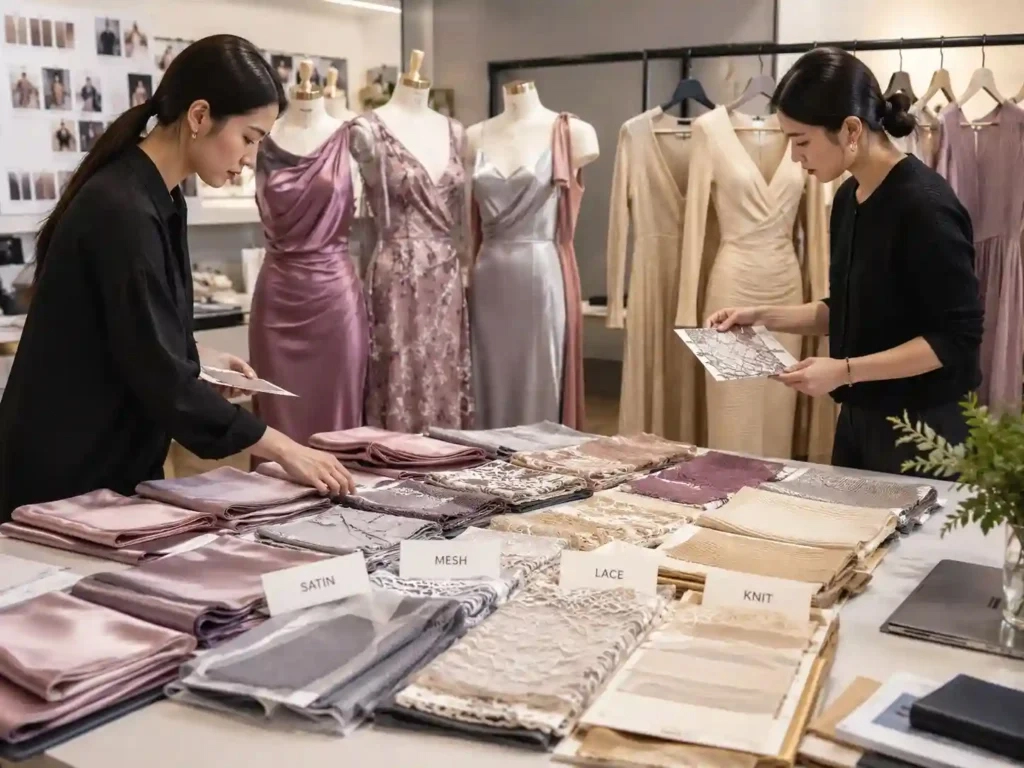
What Other Factors Affect Dress Transparency?
Color is only one part of the decision.
When we are choosing fabric for a new dress, these are the main things we check.
Fabric Weight
Fabric weight is a useful starting point, but we do not approve a dress based on GSM alone.
A heavier fabric will often give better coverage, but two fabrics with similar GSM can still look very different. Their construction and density may not be the same.
In our work as a clothing manufacturer, we prefer to compare the actual fabric swatches and finished sample rather than rely on the GSM figure by itself.
Fabric Construction
The way the fabric is woven or knitted affects how light passes through it.
Two fabrics can have similar fiber content and weight but different structures. One may look compact and covered, while the other allows more light through.
For a dress order, fiber content alone does not tell us enough. Two “100% silk” fabrics can behave very differently once they are cut, sewn and fitted.
Stretch and Recovery
For a fitted dress, we also check what happens when the fabric is stretched.
For us, the more useful question is not simply whether the fabric stretches. We want to know how much it stretches in the finished garment and whether it recovers properly afterward.
A fabric that looks fine when relaxed can become noticeably more transparent around the bust, waist or hips once it is under tension.
Lining
Lining can solve a transparency problem, but it can also create a new one. A heavier lining may improve coverage, but it can also change the weight, drape and movement of the dress. We have to look at both results before deciding which lining works better. A lining that is too stiff can make a soft outer fabric behave differently from the approved sample.
When lining is part of the design, we prefer to test the two layers together. That gives a much more reliable idea of the finished garment.

How Do We Check Dress Fabric Transparency During Sampling?
For a new style, the fabric swatch is only the first step.
During sampling, our team normally looks at the material in the following order.
1. Start with the actual production color
If the final order is white, ivory or another pale shade, we check that exact production color.
Do not use a black or darker swatch to approve the transparency of the final fabric.
The approved color reference should also be kept for repeat production. A replacement fabric that looks similar on a screen can still behave differently once it is made into the garment.
2. Look at it outside showroom lighting
Strong showroom lighting can make a fabric look more covered than it does in a normal room. For pale dresses, we prefer to check the sample under ordinary indoor light as well as daylight.
We also check the sample under lighting that is reasonably close to the conditions where the dress will be worn.
This is especially useful for white dresses, sheer sleeves and lightweight skirts.
3. Pay attention to areas under tension
For fitted dresses, we look closely at the areas where the fabric will be stretched.
The bust, waist and hip areas usually deserve more attention than a loose sleeve or full skirt.
Coverage problems that are not visible on the fabric card often become obvious at these fitted areas.
4. Judge the fabric on the actual pattern
A fabric swatch does not tell us everything about the finished garment.
Large pattern pieces, seams, gathers and the direction of stretch can all change the way the fabric looks.
So we prefer to check the fabric on the actual pattern instead of making the decision from a small fabric card.
5. Make the final call on the finished sample
The finished sample gives us the clearest answer.
On the finished sample, we check the coverage, transparency under normal lighting, fitted areas, lining visibility and how the dress moves. We also compare lined and unlined sections where both are used.
If the coverage is not right, it is much easier to adjust the fabric, lining or construction before bulk cutting begins.
How Should You Choose Fabric for a White or Light-Colored Dress?
For a light-colored dress, start with the finished silhouette rather than choosing the fabric color in isolation.
A loose maxi dress may allow you to use a lighter and more fluid fabric. A fitted bodycon dress gives you less room because the material will be under more tension.
Then compare the fabric options according to:
| What you should check | Why it matters |
|---|---|
| Fabric weight | Affects coverage and garment weight |
| Fabric construction | Changes how much light passes through |
| Stretch | Can increase transparency when fitted |
| Recovery | Helps control the final fit |
| Lining | Improves coverage but can change drape |
| Fabric color | Changes the visual appearance of transparency |
| Fabric width | Can affect layering and fabric consumption |
| Finished sample | Shows how the material actually performs |
You do not necessarily need the heaviest fabric or the thickest lining. The goal is to get enough coverage without losing the silhouette, movement or hand feel of the dress.

Common Transparency Problems When Developing Light-Colored Dresses
Most transparency problems are not obvious from the fabric card. They usually become easier to see once the first sample is made.
The swatch looks opaque but the dress looks sheer
This usually happens when the fabric is stretched, layered differently or viewed against the body.
Changing the color is not always the answer. We normally compare the fabric weight, construction and lining first and see which change gives the required coverage without affecting the dress too much.
The lining solves coverage but changes the silhouette
Adding a heavy lining to a lightweight dress can change the way the garment moves.
For flowing styles, we normally compare different lining weights rather than automatically choosing the thickest option.
The approved fabric is changed after sampling
This is risky for a light-colored dress.
Even when the replacement fabric has the same composition and similar GSM, its density, finish, hand feel and transparency can differ.
When the fabric needs to be changed after the first sample, we prefer to make a comparison sample before bulk production. It gives us a chance to check the new fabric before it reaches the cutting stage.
Different colors of the same style do not look identical
When one dress is ordered in several colors, we do not assume that every shade will give exactly the same result.
White, ivory and pastel shades usually deserve more attention during sample approval, especially when the fabric is lightweight.
What Should You Give the Factory When Developing a Light-Colored Dress?
When a new dress project comes to a clothing manufacturer, the fabric name alone is rarely enough.
A reference sample or tech pack is much more useful when working with an OEM dress manufacturer, especially when it includes the fabric composition, target weight, color reference, lining requirement, finished measurements and size range.
If you already have a physical fabric swatch, we also prefer to receive that rather than work only from a screen image or color name.
It also helps to explain what you want the finished dress to look and feel like. A white dress that needs full coverage requires a different fabric decision from one with intentionally sheer sleeves or an unlined skirt.
That gives the sampling team something specific to work against instead of simply asking whether the fabric is “opaque enough.”
FAQ
Can the same fabric need different lining for different dress colors?
Yes, it can. We have seen cases where the same lining worked well with a dark color but gave insufficient coverage under white or ivory. The fabric may be the same, but the lighter shade exposes the body or lining more clearly. For multi-color orders, we prefer to approve the fabric and lining combination by color.
Should I approve fabric color before choosing the lining?
You can approve the color first, but the final fabric and lining should be tested together. A lining can slightly change the appearance of the outer color, especially with pale shades. For a new collection, checking the combination before bulk production can prevent an unexpected color or coverage difference.
Can a light-colored dress be made without lining?
Sometimes, but it depends on the fabric, silhouette and coverage required. A heavier or densely constructed fabric may work without full lining, while a lightweight white chiffon or silk may not. You can also line only selected areas if the design intentionally keeps some sections sheer.
Why can two suppliers’ fabrics in the same color look different?
The color reference does not describe the whole fabric. Two suppliers can produce a similar ivory or white shade while using different yarns, construction, finishing or fabric weights. When you are comparing suppliers, you should assess the physical fabric and finished sample rather than relying on the color name alone.
How should a buyer handle transparency problems found just before bulk production?
First find out what is causing the problem. It may be the fabric itself, the amount of stretch, the lining or the way the garment is constructed. We normally change one main variable at a time and make another sample. That makes it much easier to see whether the change actually solved the problem before bulk cutting.
Conclusion
For white, ivory and pastel dresses, we would not approve the fabric from the color swatch alone. Fabric weight, construction, stretch and lining all affect the final result, so the finished sample is still the final check.
For B2B production, finding a transparency problem during sampling is much easier than dealing with it after bulk fabric has been ordered or cut.
If you are developing a light-colored dress, you can send us the fabric reference, target color and dress specifications. We can review the fabric together with the construction and lining before bulk production.
Explore More Dress Manufacturing Services
If you are developing a new dress and need support with fabric selection, internal construction, sampling, and bulk production, working with an experienced clothing manufacturer can help reduce unnecessary development changes.
At Xiuyu Apparel, we work with fashion brands, startups, designers, and private label companies from sample development through bulk production.
Get a Clothing Manufacturing Quote Based on Your Design
If you already have a garment design, send us the product photo, tech pack, or reference sample together with your target quantity.
As a dress manufacturer, we can review the fabric, lining, construction, trims, workmanship, and finishing requirements and prepare a quotation based on the actual garment rather than a general price range.

