

When you send a dress design to a factory, you may expect the first reply to be a price. Instead, the factory often asks, “How many pieces do you need?” That question is not only about whether your order meets the MOQ. Your target quantity affects fabric purchasing, cutting, sewing efficiency, trims, production planning, and sometimes even whether a particular material can be sourced for the order. Your target quantity affects fabric purchasing, cutting, sewing efficiency, trims, production planning, and sometimes even whether a particular material can be sourced for the order. If you understand what the factory is calculating, you can give better information and get a more useful quotation.
Why Does a Factory Ask for Quantity Before Giving You a Price?
The quantity is one of the first things we look at because production costs can change quite a bit between a 100-piece run and a 1,000-piece run.
Take a simple example.
You are developing a satin dress and expect to order around 100 pieces. If those 100 pieces are split between four colors, the factory needs to consider four separate fabric requirements. If each color also has its own size breakdown, the cutting plan becomes more complicated.
Now compare that with 500 pieces in one color.
The pattern may stay the same, but the way we buy the fabric and schedule production can be quite different.
The factory also needs to consider whether the required fabric is available in the quantity you need, whether the supplier has a minimum order quantity, and how the production can be arranged on the sewing floor.
Your first quantity does not need to be exact. It just needs to be realistic enough for the factory to work with.
If you are still estimating, say that it is an estimate.
What Does Your Target Quantity Change?
Your order quantity changes more than the unit price.
Fabric purchasing
Fabric is usually one of the first things we check.
A small dress order does not always mean the fabric supplier will sell us a small quantity. Some fabrics have their own minimums, especially custom colors, prints, or developed fabrics.
If the fabric requirement is below that minimum, the fabric cost has to be considered differently.
Custom colors and special fabrics can make this more noticeable.
Cutting
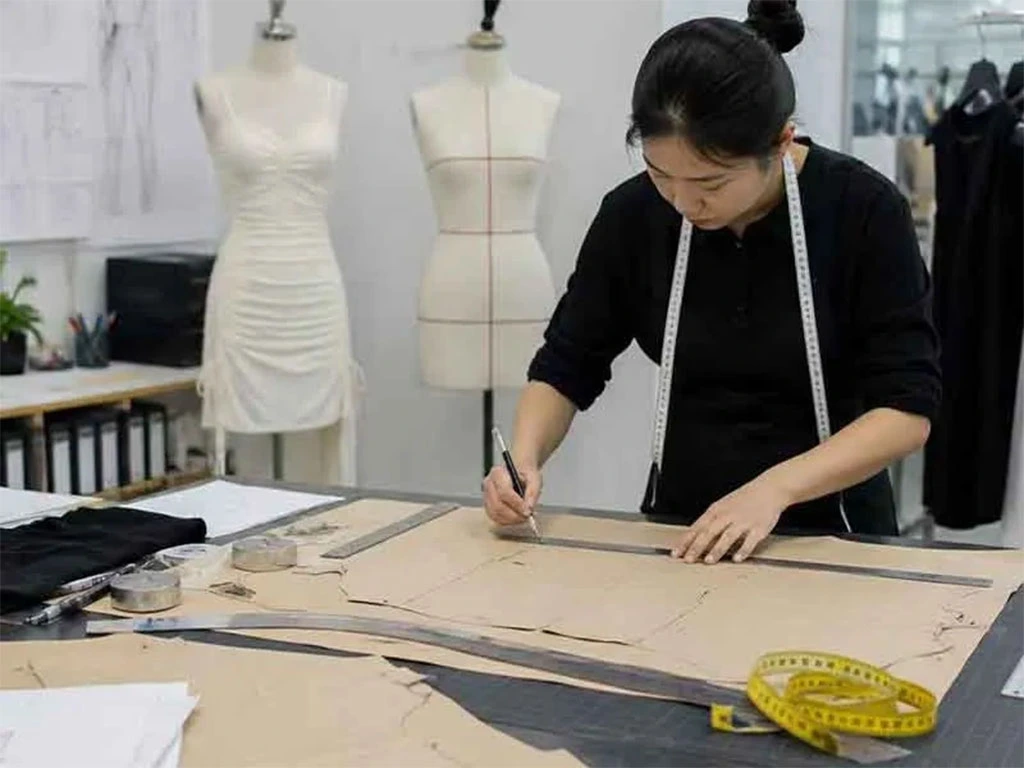
The cutting plan also changes with the order. With a small run, we may be cutting only a few layers or separating several color groups. With a larger run, the cutting team can often plan more pieces together. Fabric width, size ratio, color breakdown, and pattern layout all affect the cutting plan.
The difference is not simply “more pieces = lower cost.” The fabric width, size ratio, color breakdown, and pattern layout all matter.
Sewing
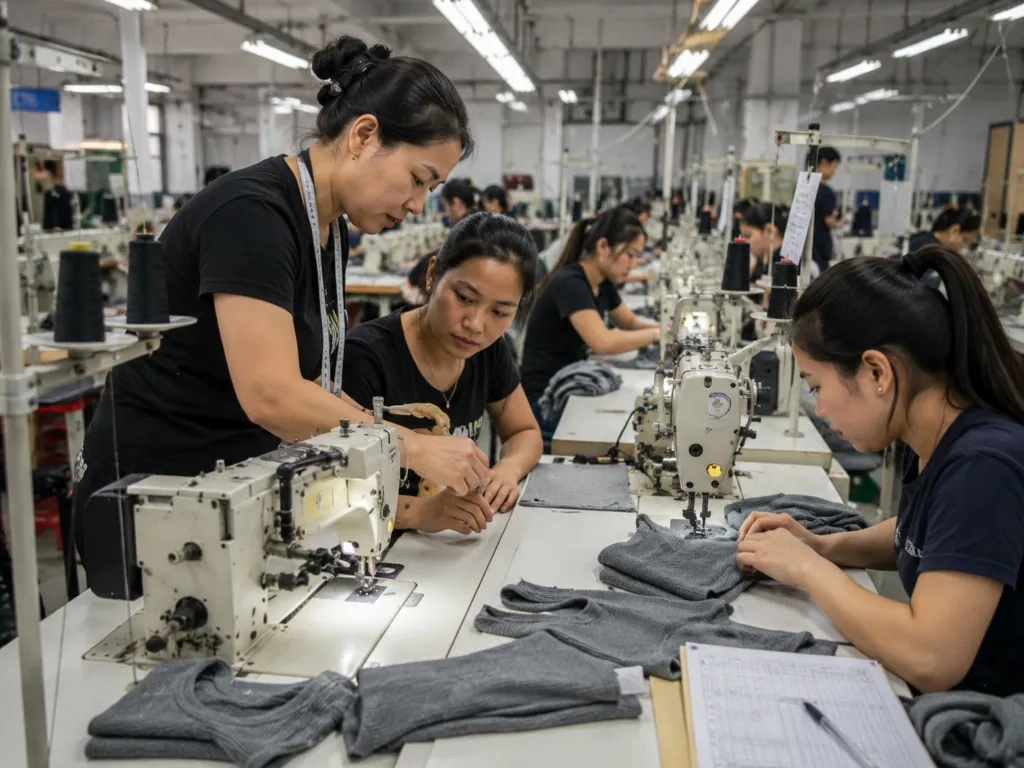
The sewing floor also looks different for a 100-piece run and a 500-piece run.
On a larger run, operators can stay on the same operations for longer. On a small run, the line may need to change more often between styles, colors, or operations.
Trims and components
Zippers, buttons, elastic, lining, labels, and other components can have their own purchasing conditions.
If you need 100 dresses but a special zipper is supplied in packs or minimum quantities that exceed your actual requirement, the component cost per garment can be higher.
Looking only at the final unit price can hide these differences.
Does a Larger Quantity Always Mean a Lower Price?
No.
It is easy to assume that a larger order will automatically get a lower unit price.
A larger order can improve production efficiency, but your final price still depends on what you are ordering.
Suppose you increase your order from 100 to 500 pieces, but at the same time:
- Add three more colors
- Change to a more expensive fabric
- Add lining
- Add embroidery
- Expand the size range
- Require custom packaging
The factory is no longer calculating the same production setup, even though the total number of dresses is higher.
We often see buyers focus on the quantity first and overlook the specification behind it.
When comparing two quotations, keep the main assumptions the same:
same style + same fabric + same construction + same quantity + same packaging
Only then does the difference between two quotations tell you much.
100 Pieces vs. 500 Pieces: Why the Factory May Quote Differently
Imagine you are launching one new dress.
Your first estimate is:
100 pieces
Later, you decide to order:
500 pieces
At first glance, you might expect the unit price for 500 pieces to be much lower than the price for 100 pieces. But the calculation is not that simple.
Manufacturing does not work that way.
With 100 pieces, the factory may be dealing with:
- Small material quantities
- More limited fabric purchasing
- Lower cutting volume
- Shorter sewing runs
- Higher setup cost per piece
At 500 pieces, some of those costs can be spread across more garments.
Color breakdown matters too.
If your 500 pieces are:
- 100 black
- 100 ivory
- 100 pink
- 100 blue
- 100 green
the factory is not producing one 500-piece run. Material purchasing and cutting have to be considered by color.
If your order is 500 pieces in one color, the production plan can be quite different.
When you ask for a quotation, give the quantity by style and color instead of only giving the total for the collection.

Target Quantity vs. MOQ: What Is the Difference?
These two numbers are often confused when a new brand starts contacting manufacturers.
MOQ is the minimum quantity a factory is willing to accept under its production conditions.
Target quantity is the quantity you expect or hope to order.
Target quantity: 200 pcs per style
Factory MOQ: 100 pcs per style/color
You can tell a factory that your target is 200 pcs per style even if its minimum is 100 pcs per style/color.
You are telling the factory what you plan to buy. The factory is telling you the minimum order it can accept.
The two numbers do not have to match. A factory may accept 100 dresses while the fabric supplier requires a larger minimum, especially for:
- Custom-dyed fabric
- Special prints
- Developed fabrics
- Certain colors
- Low-volume materials
So when you receive an MOQ, ask what it actually applies to.
Is it:
- Per style?
- Per color?
- Per fabric?
- Per size?
- Per order?
What Quantity Should You Give If You Are a New Brand?
If you are launching your first collection, you may not know your exact order quantity yet.
That is normal.
You can give the factory a range instead of pretending the number is confirmed.
For example:
We are estimating 100–150 pcs per style for the first production run.
That is enough for an initial production discussion.
If you have several styles, list the estimated quantity for each one.
| Style | Estimated Quantity |
|---|---|
| Style A | 150 pcs |
| Style B | 100 pcs |
| Style C | 100 pcs |
| Style D | 150 pcs |
| Style E | 100 pcs |
| Style F | 100 pcs |
If you already know the color plan, add that as well.
This gives the factory a much better idea of the size of the project.
For a startup, I would rather see a realistic first-order estimate than an inflated quantity given only to obtain a lower unit price.
If you increase the order later, we can recalculate the quotation based on the new quantity.
What Information Does a Factory Need Besides Quantity?
Quantity alone is not enough for a custom dress quotation.
Send the details you have already confirmed, and mark anything that is still open.
Design
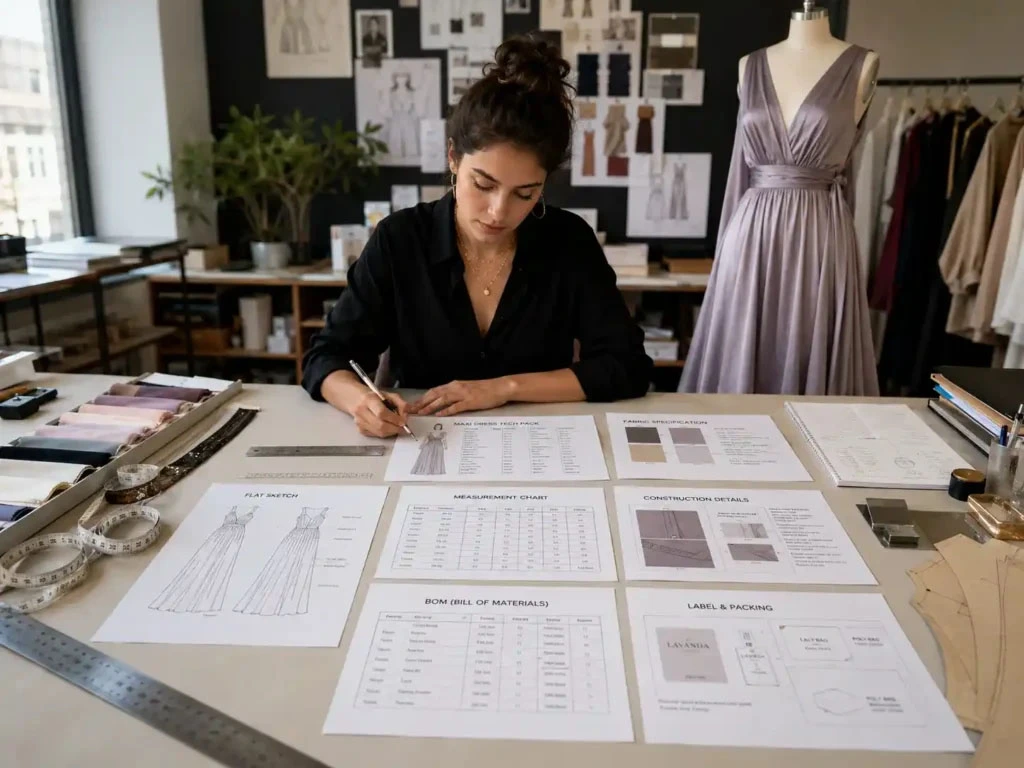
A tech pack is helpful, but it is not the only way to start.
You can send:
- Technical drawings
- Sketches
- Reference photos
- Existing garments
- Measurement information
If the design is still being developed, tell the factory which parts are not final.
Fabric
If you already have a fabric specification, include it.
If you have them, include:
- Fiber composition
- Fabric weight
- Width
- Stretch
- Finish
- Color
- Fabric swatch
If you do not have a fabric yet, tell the factory what kind of hand feel, weight, drape, or appearance you are looking for.
“Satin” by itself does not tell the factory enough about the fabric.
Size range
Tell the factory whether you need:
- XS–XL
- XXS–XXL
- Plus sizes
- Custom measurements
If you have a size ratio, include it.
Color
Do not only say:
300 pieces.
If the order is 300 pieces across three colors, say so.
For example:
Black – 150 pcs
Ivory – 100 pcs
Burgundy – 50 pcs
That is much more useful for material planning.
Construction
Mention anything that can significantly change production work:
- Lining
- Boning
- Pleats
- Ruffles
- Embroidery
- Beading
- Appliqué
- Special closures
- Multiple layers
Packaging and labels
If you need private-label packaging, tell the factory before the final quotation.
Woven labels, care labels, hangtags, barcodes, custom polybags, and carton requirements can all affect the final cost.
Why You Should Not Compare Factory Prices Without Checking the Quantity
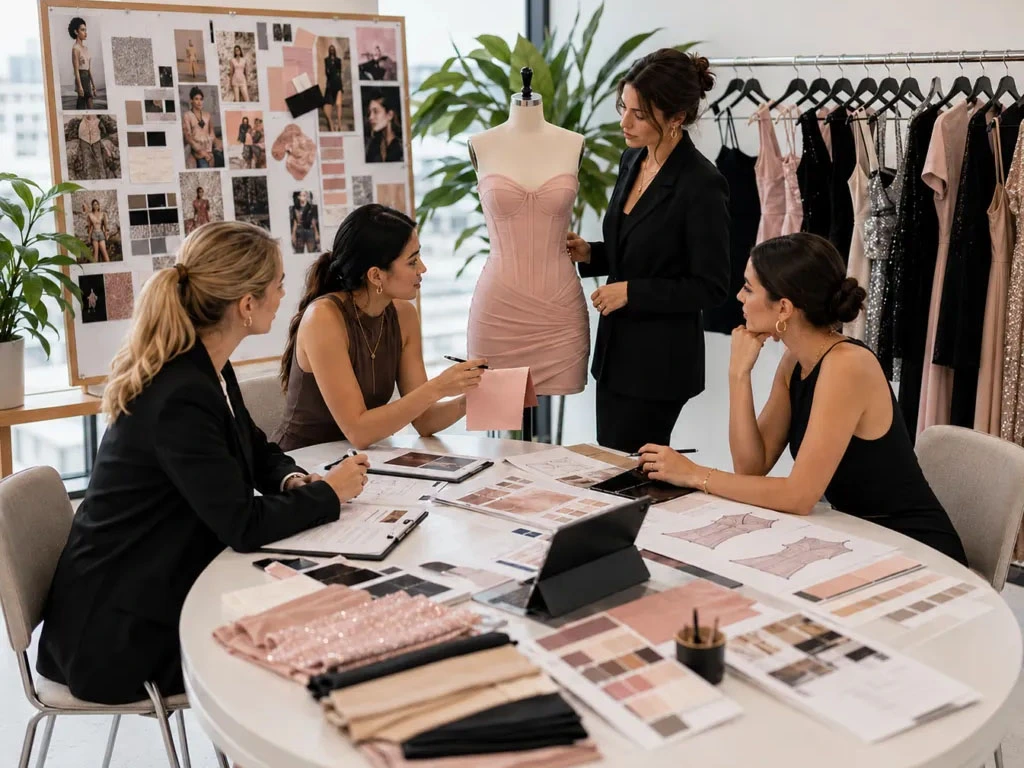
Suppose Factory A quotes $12 and Factory B quotes $14.
It is tempting to choose Factory A immediately.
But before doing that, check:
What quantity did each factory use for the quotation?
You may discover that:
- Factory A calculated 1,000 pieces
- Factory B calculated 200 pieces
Or:
- Factory A included basic packaging
- Factory B included custom packaging
Or:
- Factory A quoted without lining
- Factory B included lining
The same problem happens with fabric.
One factory may quote using a standard polyester satin, while another is calculating a heavier satin with a different finish.
The numbers are not directly comparable.
When you collect quotations, record the main assumptions beside each price.
| Quotation Item | Factory A | Factory B |
|---|---|---|
| Quantity | ||
| Fabric | ||
| Lining | ||
| Colors | ||
| Size range | ||
| Trims | ||
| Labels | ||
| Packaging | ||
| Delivery |
This takes a few extra minutes and can save a lot of confusion later.
Can a Factory Give You a Price Without a Final Quantity?
A factory can usually give you a preliminary estimate.
A final bulk quotation is a different matter.
If you only have a sketch and an approximate quantity, the factory may be able to give you an estimated range based on similar materials and construction.
Once you confirm the:
- Fabric
- Measurements
- Size range
- Colors
- Quantity
- Trims
- Packaging
the quotation can be reviewed again.
If you are not ready to confirm the order quantity, simply tell the factory:
“We are looking for a preliminary quotation. The first order quantity is still under discussion.”
It is better to give the factory an estimated range than a quantity you already know is unlikely.
The factory can then tell you which parts of the quotation are still provisional.
What Should You Ask When a Factory Sends a Quotation?
If you receive a quotation and something looks too high or too low, do not start with:
“Can you give me a better price?”
First find out what is driving the number.
You can ask:
- What quantity is this price based on?
- Is the MOQ per style or per color?
- What fabric specification is included?
- Is lining included?
- Are trims included?
- Are labels included?
- What packaging is included?
- Is the price for sampling or bulk production?
- How would the price change at a higher quantity?
- Is there a separate fabric MOQ?
Once you know the answer, you have something specific to discuss.
If the price is above your target, you may be able to adjust the fabric, construction, trims, or packaging rather than simply asking the factory to cut its margin.
You can then discuss the part of the specification that is pushing the price up.
What Should You Send in Your First Dress Manufacturing Inquiry?
You do not need to wait until every detail is perfect.
If you are a fashion startup, designer, boutique, retailer, wholesaler, or private-label company, prepare the information you already have.
A useful first inquiry can include:
- Dress design or reference
- Estimated quantity
- Color options
- Size range
- Fabric direction
- Key construction details
- Label requirements
- Packaging requirements
- Target delivery date
You can also separate confirmed information from information that is still being discussed.
For example:
Quantity: 100–150 pcs per style
Colors: 2 colors under consideration
Size: XS–XL
Fabric: Looking for a medium-weight satin with good drape
Labels: Private label required
Delivery: Targeting a spring launch
That is enough for the factory to start reviewing the style and preparing an initial quotation.
You do not need a perfect tech pack to start the conversation. But if the quantity, fabric direction, colors, size range, and key construction details are already clear, the quotation process will usually move faster.
FAQ
1. Can I negotiate MOQ with a dress factory?
Sometimes. First ask what is creating the MOQ. It may come from the fabric, a special trim, or the production setup rather than the factory simply setting a higher minimum.
2. Should my sample quantity be included in the bulk quantity?
Keep them separate. Tell the factory how many samples you need and then state the expected bulk quantity separately. If you need several samples, specify whether they are for different colors, sizes, or fit corrections.
3. What if I need different quantities for different sizes?
Give the factory your expected size ratio if you have one. For example, an order of 200 pieces could be divided according to your expected sales mix rather than evenly across all sizes. This helps the factory understand the actual production breakdown before bulk cutting.
4. Can I change the quantity after approving the sample?
You can ask, but the quotation and production plan may need to be reviewed. Changing the quantity before fabric is ordered is much easier than changing it after materials have already been purchased. If your quantity is uncertain, tell the factory before bulk production starts rather than waiting until the cutting stage.
5. Why can the same dress have different prices at different times?
Fabric cost, trims, exchange rates, material availability, production schedules, and order quantities can all change. The original quote was based on the fabric, trims, quantity, and production conditions available at that time. If you are comparing an old quotation with a new one, check whether the underlying materials and quantities are still the same.
Conclusion
A factory needs your target quantity to understand what kind of production run you are planning. The number affects more than MOQ. It can change how fabric is purchased, how colors are cut, how the sewing line is arranged, and how trims and packaging are calculated.
You do not need to know the final quantity when you first contact a factory. An estimated range is fine. Just make it realistic, and show the quantity by style and color when you can. A realistic quantity and a clear style/color breakdown make it much easier to compare quotations before you commit to bulk production.
Related Dress Manufacturing Services
If your project involves a specific dress fabric or construction, you can also review our related manufacturing pages:
- Midi Dress Manufacturer
- Off Shoulder Dress Manufacturer
- Sequin Dress Manufacturer
- Evening Dress Manufacturer
- Velvet Dress Manufacturer
Get a Quote for an Existing Dress Style
If you are transferring an existing dress style to a new manufacturer, send us the latest approved sample, tech pack, product photos, or measurement chart together with your target quantity.
As a dress manufacturer, we can review the construction, fabric, trims, measurements, and current production status with you before confirming the sampling requirements.

