

When buyers compare dress factories in China and the USA, the first question is often the price.
That makes sense. But once we start quoting an actual dress, the price is rarely determined by sewing alone. Fabric, sampling, MOQ, construction, production planning and shipping can all change the final number.
This is where the China-versus-USA comparison becomes more complicated than it looks on paper.
China vs USA Dress Manufacturing: What Actually Changes?
In practice, the collection usually tells us more than the country does. The styles, fabrics, quantities and delivery requirements will usually tell you more about the type of factory you need.
There is a big difference between producing 100 pieces of one simple dress and managing 5,000 pieces across 15 styles. The fabric, number of patterns, sampling work and production schedule can all change the way a factory handles the order.
Before we quote a new collection, we normally want to know the fabric, number of styles, expected quantity, sampling requirements, target cost and delivery date. If you are comparing a factory for a full collection rather than dresses alone, you may also want to look at our clothing manufacturer page to see how we handle fabric sourcing, sampling and bulk production.
For a startup or smaller brand, these details can matter more than whether the quotation comes from China or the USA.
A Practical Comparison
| Factor | China | USA |
|---|---|---|
| Garment production cost | Often more competitive | Generally higher |
| Fabric and trim sourcing | Broad supplier network | Depends more on local suppliers |
| Dress development | Strong OEM/ODM ecosystem | Convenient for domestic development |
| MOQ flexibility | Varies by factory and material | Varies by factory |
| Large-scale production | Strong infrastructure | More dependent on individual factory |
| Domestic US delivery | International shipping required | Clear logistics advantage |
| Made-in-USA positioning | Not applicable | Strong advantage |
| Multi-style collections | Well suited to established supply chains | Depends on production setup |
| Repeat production | Strong when specifications are retained | Depends on factory capacity |
The table is only a starting point. In practice, the useful comparison starts when the factories are quoting the same specifications and quantity.
China vs USA Dress Manufacturing Cost
The factory price on the first quotation is only part of what you will eventually pay.
For a dress, your actual cost can include:
- Main fabric
- Lining
- Trims
- Zippers and buttons
- Labels
- Cutting
- Sewing
- Finishing
- Pressing
- Packaging
- Sampling
- Pattern adjustments
- Freight
- Import costs
- Possible rework
Two factories can therefore quote very different prices for what appears to be the same dress.
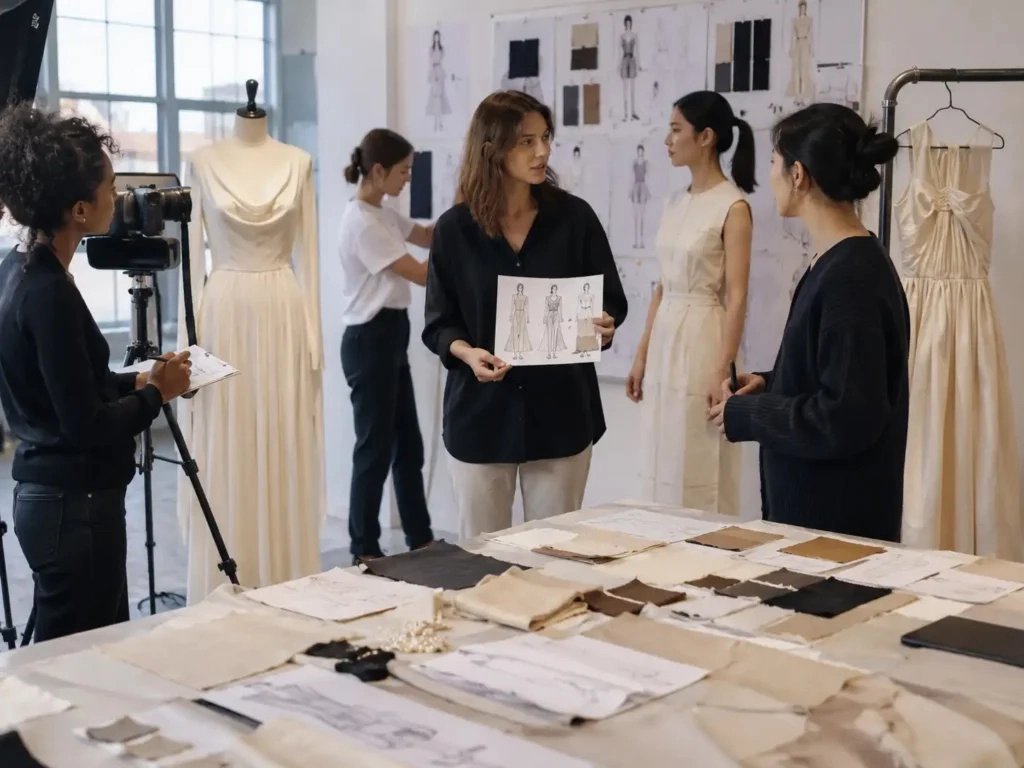
Fabric Can Move the Price Quickly
When you are working with silk satin, velvet, chiffon, lace, stretch fabric, or embellished materials, the fabric itself can represent a substantial part of the garment cost.
For an accurate quotation, “silk satin” by itself is usually not enough. We may need the composition, weight, width, finish, color and lining specification, as well as the hand feel you expect.
The same applies to polyester satin or stretch fabrics. Two fabrics can have similar names but behave very differently during cutting and sewing.
If your quotation is based on a different fabric from the one you approved, the price comparison is not useful.
Look at the Landed Cost
If you are buying from overseas, calculate beyond the factory price.
Your comparison should look more like:
Garment Cost + Packaging + Freight + Import Costs + Other Logistics Costs = Landed Cost
For a US-based brand, domestic production may reduce transportation time and simplify logistics. From our experience, China becomes more attractive once the order involves several styles or more complicated sourcing. That does not mean the US is always more expensive in every situation. It depends heavily on the factory and the product.
We usually tell buyers not to stop at the factory price. What matters in the end is the cost of getting the finished dresses into your warehouse.
“Which factory has the cheaper unit price?”
It is:
“Which option gives me the right product at the right landed cost?”
China vs USA for Dress Fabric Sourcing
Fabric sourcing is one of the areas where you should look beyond the sewing factory itself.
Your dress may require a specific satin, silk, chiffon, lace, lining, velvet, or stretch fabric. You may also need matching buttons, zippers, labels, elastic, thread, or decorative trims.
A factory with access to established fabric and trim suppliers can usually coordinate these components more efficiently than a production setup where each material needs to be sourced separately.
Why This Matters During Development
You may approve a fabric during sampling and then discover that the supplier cannot provide enough quantity for bulk.
Or the bulk fabric may have a different shade from the sample.
Or the fabric width may change the cutting efficiency.
Or the fabric may shrink differently after production preparation.
This is where some orders start to run into trouble—when the approved sample moves into bulk production.
When you compare dress manufacturers, also ask where the main materials will come from and how the factory will secure the same quality for bulk production.
China vs USA Dress Sampling and Product Development
Sampling is usually where you can tell how much production experience a factory really has. If sampling and fit development are important for your collection, choosing the right dress manufacturer can make the development process much easier. Making the first sample is one thing; finding and correcting fit or construction problems is another.
Your development process may look like this:
Tech Pack → Fabric Confirmation → Pattern → First Sample → Fit Comments → Revision → PP Sample → Bulk Production
The first sample can reveal problems that were not obvious on paper.
You may find:
- The waist sits too high
- The bust is too tight
- The skirt does not fall correctly
- The sleeve has too much volume
- The neckline needs support
- The fabric stretches differently than expected
- The lining pulls against the outer fabric
- The zipper changes the way the garment hangs
The first sample is also a good way to see how the factory team handles problems. If the fit, construction or fabric behavior is not right, pay attention to whether they can explain the cause, adjust the pattern or construction, and make a usable revision.
Give Your Factory Useful Fit Comments
Instead of saying:
“The dress does not fit correctly.”
Give measurable comments where possible.
For example:
“Reduce the waist by 1 cm and move the waist seam down 1.5 cm.”
That gives the pattern team something they can work with.
Photos with marked areas can also help, especially when the problem involves drape, balance, or the position of a seam.
For sample revisions, one clear comment sheet is usually easier for the pattern and sample teams to follow than a long series of separate messages.
China vs USA Dress Manufacturing Quality
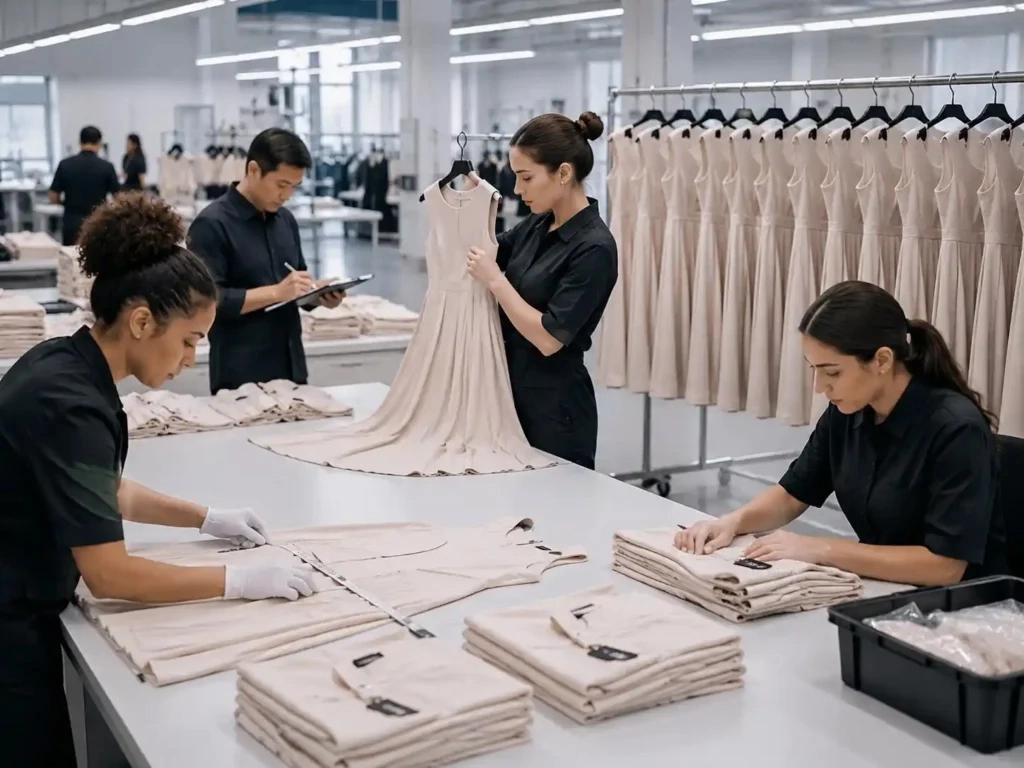
We would not judge a dress factory by country alone. What matters more is how the factory controls fabric, cutting, sewing, measurements and finishing.
Fabric Inspection
Before cutting, the fabric should be checked for visible defects, shade problems, width variation, stains, and other issues relevant to the material.
If a problem is found after cutting, the cost is much higher.
Pattern and Cutting
Pattern accuracy becomes particularly important with fitted dresses and designs with multiple panels, especially when developing more detailed designer dresses where construction and fit need to stay consistent from sample to bulk production.
For example, if your front and back panels do not balance correctly, the problem may only become obvious after sewing.
The cutting team also needs to follow the correct fabric direction.
This matters with materials such as velvet and certain patterned fabrics, and it becomes especially important for bias-cut dresses.
Sewing and Finishing
For your finished dress, look beyond loose threads.
Check:
- Seam consistency
- Stitch quality
- Zipper installation
- Hem finishing
- Lining attachment
- Neckline construction
- Sleeve balance
- Pressing
- Final measurements
A garment can pass a basic visual inspection and still have problems with fit or construction.
Quality Checks During Production
You should also ask whether quality is checked during production rather than only at the end.
If a measurement problem is discovered while the first few pieces are being sewn, it can be corrected before the entire order is completed.
A dress can look fine during a basic visual check and still have a fit or construction problem. That is why in-line checks matter.
China vs USA Dress Manufacturing MOQ
MOQ needs more clarification than the number printed on a factory website.
If someone tells you:
“Our MOQ is 100 pieces.”
Ask:
100 pieces per what?
It could mean:
- Per style
- Per color
- Per fabric
- Per order
- Per production run
For a startup brand, this distinction is important.
Imagine you have eight styles and three colors per style. A seemingly low MOQ can still create a large total inventory commitment.
Ask About Material MOQ Separately
Your garment MOQ may be low while your custom fabric MOQ is much higher.
This can happen when you need:
- Custom colors
- Special fabric composition
- Custom printing
- Special finishes
- Custom lace
- Exclusive trims
If you are testing a new collection, ask the factory to explain both the garment MOQ and material MOQ before you approve the project.
This tells you how much inventory and working capital the collection may actually require.
China vs USA Dress Manufacturing Lead Time
Production lead time is not the same thing as sewing time.
Your calendar may actually look like:
Fabric Sourcing → Sampling → Revision → Approval → Material Preparation → Cutting → Sewing → Finishing → QC → Packing → Shipping
For a seasonal collection, a delay at any one of these stages can push back the final delivery date.
Sampling Can Become the Bottleneck
A factory may be able to complete bulk production quickly, but that does not help if your sample takes too long to develop or requires several rounds of corrections.
When requesting a quotation, we recommend asking for two separate timelines:
Development timeline
and
Bulk production timeline
Another point worth confirming is when the factory considers production to have started.
For many projects, bulk production cannot realistically start until the PP sample, fabric, measurements, labels, and other key details have been approved.
Think About Your Warehouse Date
If you need stock in your US warehouse by a specific date, work backward.
Do not simply add “30 days production” to your launch date.
You need to account for:
- Sample approval
- Material preparation
- Production
- QC
- Packing
- Freight
- Customs
- Final delivery
Working backward from the warehouse date gives you a more realistic deadline for factory approval and production.
China vs USA Dress Manufacturing for Scaling
Your first order and your fifth order may look very different.
You might begin with 100–300 pieces to test a new style. If the style performs well, you may need several thousand pieces for the next season.
At that point, production capacity becomes important.
You should ask about:
- Monthly capacity
- Number of sewing lines
- Cutting capacity
- Fabric sourcing
- QC resources
- Production scheduling
- Packaging
- Repeat-order management
What to Check Before Increasing Production
If you have 10 dress styles in one collection, the factory needs to manage different patterns, fabrics, trims, measurements, and production requirements at the same time.
A factory experienced in multi-style production can organize these details before they reach the sewing floor.
Repeat Orders Are Easier When Production Records Are Clear
Once you have an approved style, the factory should retain the important production information.
That can include:
- Final measurements
- Approved pattern
- Fabric specification
- Color reference
- Construction details
- Label information
- Packaging requirements
When the same style is reordered, you should not have to explain the entire garment from the beginning.
Which Is Better for Your Fashion Brand?
For many B2B dress buyers, China is worth considering when the project involves multiple styles, broader fabric sourcing, OEM/ODM development, competitive production costs or repeat seasonal orders.
US production can be attractive when domestic logistics, local communication, factory visits or Made-in-USA positioning are more important than the lowest manufacturing cost.
Your first test order may also lead you to a different choice than a larger seasonal program.
The factory that works well for a 100-piece test order is not necessarily the same factory you want for a 5,000-piece seasonal program.
How to Compare China and USA Dress Factories Properly
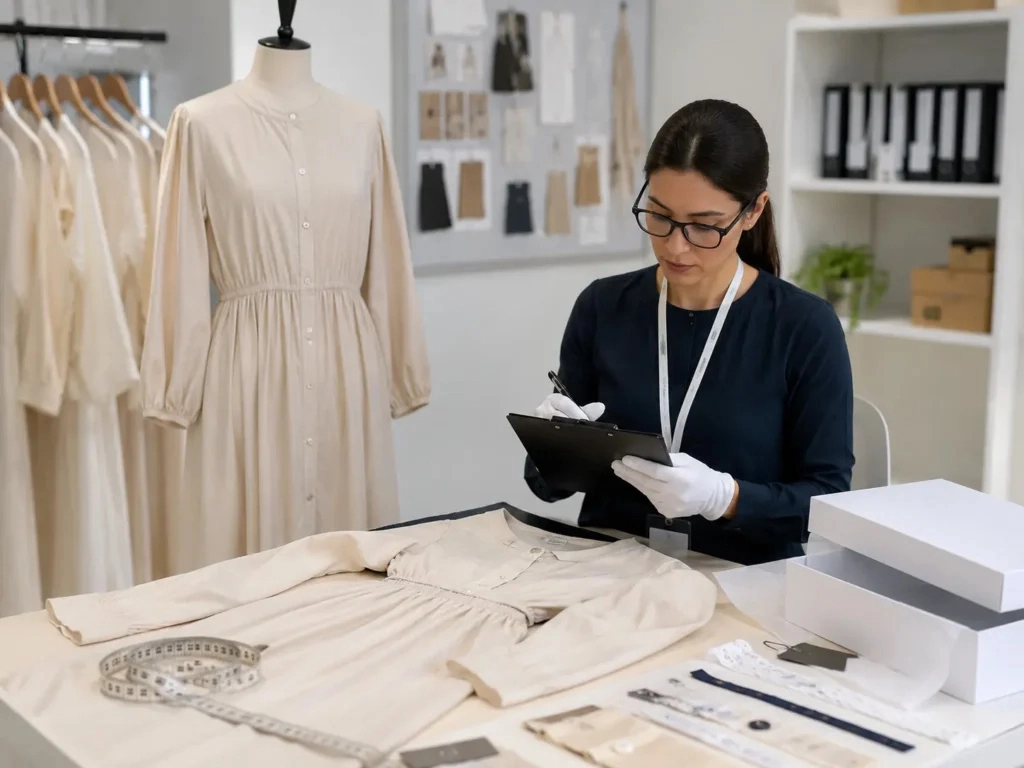
Before asking several factories for prices, send each one the same RFQ. This becomes even more important when you are sourcing for a private label clothing collection with custom labels, packaging and multiple styles.
Include:
- Technical drawings or tech pack
- Fabric composition and specification
- Estimated quantity
- Colorways
- Size range
- Label requirements
- Packaging requirements
- Target delivery date
- Delivery destination
Then send the same information to each factory.
Compare More Than Price
Put the quotations side by side and check:
1. Check the fabric specification
A price based on a cheaper substitute is not a real comparison.
2. What development work is included?
Check whether pattern development and sample revisions are included or charged separately.
3. What is the actual MOQ?
Separate garment MOQ from fabric and trim MOQ.
4. When does production start?
Make sure you understand whether lead time begins after deposit, material arrival, PP approval, or another milestone.
5. What happens if the sample needs changes?
You want to understand the revision process before production starts.
6. How is quality checked?
Ask about in-line inspection, measurement checking, final inspection, and how defects are handled.
7. Can the factory support repeat orders?
This becomes increasingly important once you have a style that sells.
A Practical Decision Guide for B2B Dress Buyers
A startup usually looks at MOQ and sampling first because cash is tied up quickly when a new collection is still being tested.
For a designer working on complicated dresses, pattern development, fabric behavior and construction may matter more than a small difference in unit price.
Once the order becomes larger, the questions change again. Capacity, consistency and repeat production become much more important.
Frequently Asked Questions
1. Should you visit a factory before placing your first dress order?
For a large or long-term program, a factory visit can be useful. You can see the production floor, sample room, cutting area and QC setup for yourself.
2. How can you tell whether a dress factory really understands your design?
Do not stop at “Can you make this dress?” Ask about the fabric, lining, difficult construction areas, measurements and finishing. An experienced factory will often point out possible production problems before making the sample. That kind of discussion is usually more useful than a simple yes.
3. What should you prepare before asking a factory for a dress quotation?
Prepare as much technical information as you can: sketches or a tech pack, fabric composition, size chart, quantity, colors, labels, packaging, and target delivery date. If some details are still missing, that is fine. Just tell the factory what is confirmed and what is still open. It gives the quoting team a clearer starting point.
4. How do you avoid quality problems when working with an overseas factory?
Your approved sample, measurement chart, fabric specification and construction details should be the production reference. Also tell the factory which points are critical, such as fit, fabric appearance or measurements, so QC knows what to pay particular attention to.
5. When should you start looking for a dress manufacturer?
Start earlier than your planned launch date. You need time for factory selection, quotation, material sourcing, sampling, fitting, revisions, approval, bulk production, inspection, and shipping. If your collection is seasonal, working backward from the date you need inventory in your warehouse gives you a much more realistic starting point.
Conclusion
There is no single answer to whether China or the USA is better for dress manufacturing.
For a small test order, MOQ, sampling and delivery may matter most. For a larger seasonal collection, fabric sourcing, production capacity, consistency and landed cost become more important.
From our experience as a clothing manufacturer, the most useful comparison is not simply China versus the USA. It is factory versus factory, based on the same dress, the same fabric, the same quantity and the same delivery requirement.
Once those details are clear, the quotation is much easier to judge.
Explore More Dress Manufacturing Services
If you are developing a new dress and need support with fabric selection, internal construction, sampling, and bulk production, an experienced clothing manufacturer can help you deal with these decisions before they become production problems.
At Xiuyu Apparel, we work with fashion brands, startups, designers, and private label companies from sample development through bulk production.
- Bodycon Dress Manufacturer
- Slip Dress Manufacturer
- Chiffon Dress Manufacturer
- Mermaid Dress Manufacturer
Get a Clothing Manufacturing Quote Based on Your Design
If you already have a garment design, send us the product photo, tech pack, or reference sample together with your target quantity.
As a dress manufacturer, we can review the fabric, lining, construction, trims, workmanship, and finishing requirements before preparing a quotation based on the actual garment rather than a general price range.

