

When a brand sends us the same dress specification for comparison with another country, the unit price is usually the first number we discuss. It is also the easiest number to compare—and sometimes the least useful one.
Once we start checking the fabric, sample requirements, order quantity and production schedule, the difference between factories becomes much clearer.
China and Portugal can both work for dress manufacturing. If you are comparing a Chinese dress manufacturer with a Portuguese factory, the difference usually becomes clearer once we look at the actual collection, order quantity and production plan.
China vs Portugal Dress Manufacturing at a Glance
Before choosing between the two, put your actual collection requirements on paper. The table below gives you a quick comparison, but fabric, quantity, sampling and delivery still need to be checked in the quotation.
For dress production, fabric, quantity, sampling and delivery can change the final cost quite a bit.
| Factor | China | Portugal |
|---|---|---|
| Manufacturing Cost | Generally more competitive | Generally higher |
| Fabric Selection | Very broad | Strong European sourcing options |
| MOQ | Depends on factory and materials | Depends on factory and materials |
| Sampling | Strong OEM/ODM capability | Strong development capability |
| Production Scale | Well suited to larger programs | More dependent on factory capacity |
| Multi-Style Collections | Strong fit | Suitable for selected programs |
| EU Logistics | Longer international shipping | Shorter regional logistics |
| Private Label | Widely available | Widely available |
| Best Fit | Variety, cost control and production scale | European proximity and local production |
If you are producing a small premium collection for a European market, Portugal may fit your operation well. If you need several dress styles, broader fabric choices, flexible sourcing and room to increase production later, China may make more sense.
China vs Portugal Dress Manufacturing Cost
A quotation gives you a starting point, but it does not always tell you what is included.
When we cost a dress, we look at the fabric, consumption, lining, trims, sewing operations, finishing and order quantity. Two dresses that look almost identical in a photo can take very different amounts of work to produce.
When you ask a factory for a dress price, the quotation may be affected by:
- Main fabric and fabric consumption
- Lining
- Trims and hardware
- Cutting
- Sewing
- Finishing and pressing
- Packaging
- Order quantity
- Special construction or custom development
A dress that looks simple in a photo can still be time-consuming to make, especially when there are several panels, a lining or detailed finishing involved.
For example, a fitted style with lining, an invisible zipper and several panels needs more control during cutting, sewing and pressing than a loose unlined dress made from a stable fabric.
Compare Like With Like
If you are comparing a Chinese factory with a Portuguese factory, send both factories the same specification.
Check:
- Fabric composition
- Fabric weight
- Fabric width
- Lining
- Color
- Quantity
- Size range
- Trims
- Label requirements
- Packaging
- Quality requirements
This is easy to overlook when you are collecting quotations. We sometimes see two prices that look close on paper, only to find that the fabric, lining or packaging specifications are different.
Before deciding which quotation is cheaper, make sure both factories are costing the same dress.
One factory may quote using a standard polyester lining while another is costing a higher-grade lining. One may include packaging and inspection while another quotes only the garment production.
A $12 quotation and a $14 quotation may not be $2 apart in real cost if the specifications are different.
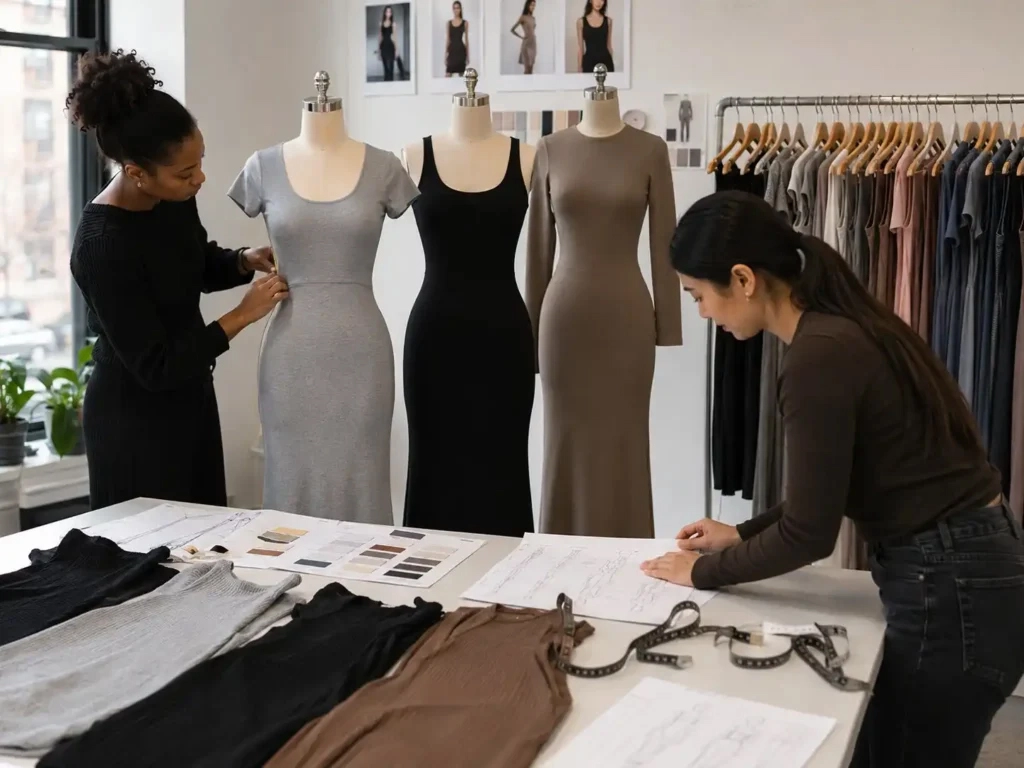
Look at Your Landed Cost, Not Just the Factory Price
If you are buying overseas, the factory price is only part of what you eventually pay.
Your calculation may look more like:
Factory Cost + Packaging + Freight + Duties + Import Costs = Landed Cost
Portugal can have a clear logistics advantage if your warehouse, distribution center and customers are mainly in Europe.
China involves longer international transportation, but you may gain advantages earlier in the supply chain through fabric sourcing, trims, production options and manufacturing scale.
A lower factory price can lose its advantage once freight, rework, material issues or delays are added.
We would rather compare the expected landed cost than make a decision from the sewing price alone.
Fabric Sourcing: China vs Portugal
Fabric is one of the first areas where you can see a practical difference between manufacturing locations.
For silk dresses, satin, chiffon, lace, velvet, mesh or stretch dresses, you also need to know how the material will be sourced and whether enough of it will be available for bulk production.
The fabric name alone does not tell you enough. Ask the supplier about:
- Composition
- Weight and width
- Stretch and shrinkage
- Color availability
- Finish and hand feel
- Bulk availability
- Minimum fabric quantity
You may approve a fabric sample without realizing that the supplier has a much larger MOQ for the color you want.
This becomes a practical problem when you are testing a new style at 100 or 200 pieces. The factory may be comfortable with the garment quantity, while the fabric mill may not want to produce such a small custom-dyed order.
Fabric MOQ Can Change Your Production Plan
Your garment factory MOQ and fabric supplier MOQ are not always the same.
For example, you may want:
100 dresses × 1 custom color
The garment factory may accept the quantity, but the fabric supplier may require a larger quantity for custom dyeing.
You then have several choices:
- Use a stock color
- Increase the order
- Choose another fabric
- Combine the same fabric across several styles
- Accept leftover fabric
For a growing brand, this kind of decision can have a bigger impact on cash flow than a small difference in sewing cost.
One practical advantage we see in China is the number of fabric, lining and trim suppliers that can be checked during development. If the first fabric does not work, it is usually possible to look for another option without changing the whole production setup.
Portugal can be attractive when keeping sourcing and production close to your European market is important.
MOQ and Order Flexibility
When you compare MOQs, check what the number actually refers to.
A factory may quote an MOQ per style, while the fabric supplier has a separate minimum per color. For private-label collections, those two numbers can affect the order much more than the garment MOQ shown on the factory website.
It may be:
- Per style
- Per color
- Per fabric
- Per size
- Per order
- Per production run
This matters even more when you are ordering several styles instead of one dress.
For example, you might have:
6 styles × 3 colors × 100 pieces
That is already 1,800 garments.
A factory offering a low MOQ per style may still require you to manage substantial material quantities.
Small Orders Need a Different Cost Calculation
When you produce a small quantity, pattern development, cutting preparation, fabric purchasing and production setup are spread over fewer garments.
A 100-piece order does not simply cost one-fifth of a 500-piece order. Pattern work, cutting preparation, material handling and production setup still have to be done for the smaller order.
For this reason, we look at the whole order before suggesting that a buyer increase quantity just to lower the unit price.
For a startup or a brand testing a new collection, a lower unit price is not always worth a larger order.
The extra stock still has to be stored, financed and sold.
You also need to consider:
- Expected sales
- Available cash flow
- Storage
- Unsold inventory
- Number of styles
- Number of colors
A lower unit cost is not useful if you are left holding thousands of dresses that take months to sell.
Sampling and Fit: Where Factory Capability Becomes Visible
The first sample is often where you find out how well a factory handles development.
A dress can look right in the tech pack and still need changes once the pattern is made. We often see adjustments around the bust, waist, neckline, sleeve shape or lining after the first fitting.
That is common with fitted dresses and styles with more complicated construction.
Your process may start with:
Tech Pack → Pattern → First Sample → Fit Comments → Revision → PP Sample → Bulk Production
The first sample is rarely the end of the development process for a fitted or complicated dress.
You may find that:
- The bust is too tight
- The waist is too high
- The skirt does not fall correctly
- The sleeve needs more volume
- The neckline needs additional support
- The lining pulls against the outer fabric
- The zipper affects the fit
These are production issues, not just design issues.
Your Fit Comments Matter
You will usually get better results when your comments are specific.
Instead of saying:
“The waist is too loose.”
Give the factory something measurable:
“Reduce the waist by 1 cm and keep the hip measurement unchanged.”
Photos with marked areas can help too.
From the factory side, a clear revision list is much easier to follow than several messages sent at different times.
This is also why you should leave enough time for sampling before your planned launch date.
Production Lead Time and Capacity
A fast sample does not automatically mean fast bulk production.
Before confirming an order, we normally look at the full production sequence:
Fabric Booking → Material Arrival → Cutting → Sewing → Finishing → Inspection → Packing
Your delivery date depends on the whole sequence, not just sewing.
If the bulk fabric is late, the sewing line may have nothing to run.
If trims arrive late, finished garments may sit waiting for the final operation.
If a sample is approved but the bulk fabric is a different shade, you may need to stop and resolve the issue before continuing.
Why Production Scale Matters
The first order is not always the most important one.
If a style sells well, you may need the same fabric, measurements and construction again a few months later. That is when factory capacity and material repeatability start to matter.
A factory that handles 100 pieces well is not necessarily the right factory for 2,000 pieces across several styles.
Ask yourself:
- Can the factory repeat the same quality?
- Can it handle several styles at once?
- Can it source the same fabric again?
- Can it increase capacity during peak seasons?
- Can it maintain the approved measurements?
- Can it support repeat orders?
For an established fashion brand, repeatability can be more important than the lowest first-order price.
Quality Control in China vs Portugal
The country of production does not tell you enough about garment quality.
The factory’s inspection process and the specification you approve before production matter just as much.
Before production, make sure your approved sample establishes:
- Measurements
- Fabric
- Color
- Construction
- Stitching
- Lining
- Trims
- Labels
- Finishing
A useful process can include:
Material Inspection → In-Line QC → Measurement Checks → Final Inspection
The purpose of checking during production is simple: find a problem while there is still time to correct it.
If a measurement issue is found after the entire order has been packed, the options are much more limited.
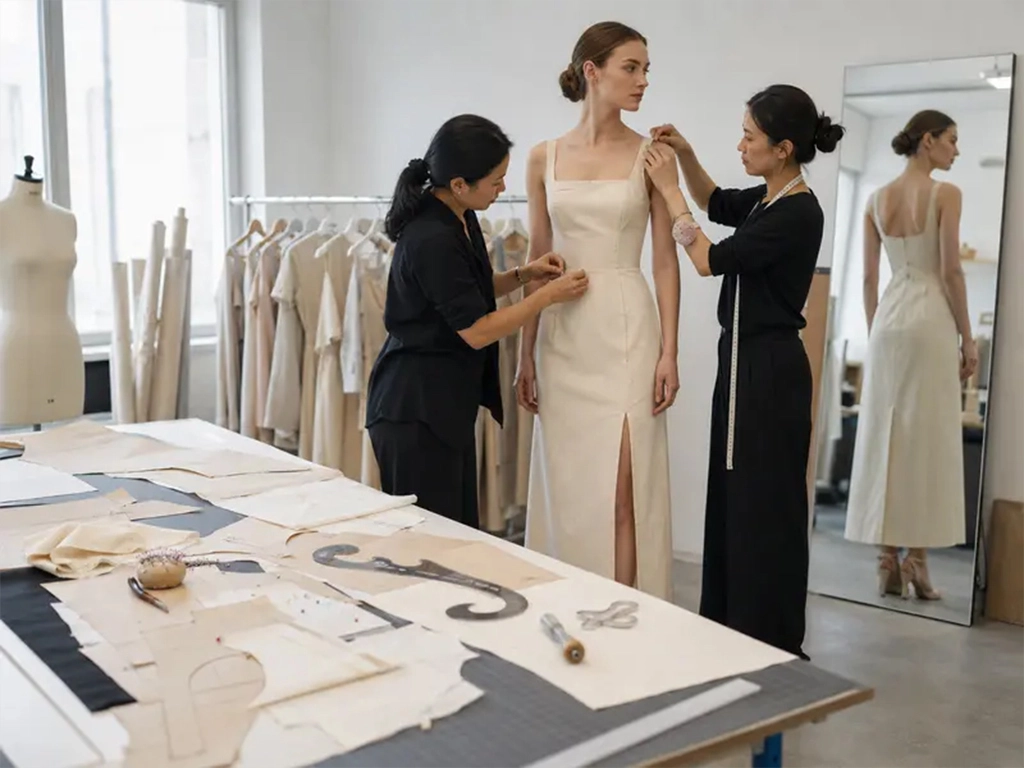
The Approved Sample Should Be Your Reference
Photos are useful during development, but they are not a substitute for an approved sample.
For bulk production, the factory needs a clear reference for measurements, fabric, construction and finishing. Otherwise, small differences can easily become larger across a full production run.
Keep a final approved sample or a clearly documented reference.
If the bulk garment differs from the sample, you need to be able to identify exactly what changed.
This becomes particularly important with:
- Fitted dresses
- Stretch fabrics
- Bias-cut dresses
- Lace
- Pleated styles
- Structured bodices
- Dresses with lining
Private Label and Custom Dress Production
For a private-label order, the dress itself is only part of the production work.
You may also need custom labels, care labels, hangtags, packaging, branded hardware or individual packing. These details should be discussed before bulk production because some of them have their own MOQ and lead time.
For example, a custom zipper or branded hardware may have its own minimum order quantity. A custom-dyed fabric may also require more material than your first production run needs.
If you are comparing China and Portugal, compare the full private-label setup rather than only the basic garment price.
Shipping: China vs Portugal
Your destination should be part of the manufacturing decision from the beginning.
If you sell mainly in Europe, Portugal gives you a geographic advantage. Shorter regional transportation can make planning easier, particularly when delivery speed matters.
If your customers are spread across the US, Europe, Australia and other markets, China can still be practical, especially when your production volume and product range justify international shipping.
The practical questions are usually:
- Shipping method
- Transit time
- Freight cost
- Customs clearance
- Warehouse location
- Delivery schedule
- Order frequency
If you place smaller repeat orders frequently, logistics can affect your total cost differently from one large seasonal shipment.
Which Is Better for Different Fashion Brands?
Where China May Make More Sense
China can be a practical option if your collection includes several styles, different fabrics or a production plan that may grow over time.
It also works well for brands that need OEM or ODM clothing manufacturing, private-label production or several material options.
Development can also be more flexible. If the first fabric, lining or trim does not work, you can usually check other suppliers without rebuilding the entire production setup.
Where Portugal May Make More Sense
Portugal can be attractive when your business is mainly European and keeping production geographically close to your market is important.
For some brands, shorter regional logistics and easier access to the factory may be worth paying more for.
China vs Portugal: What Should You Choose?
The answer usually becomes clearer once you put your actual order beside the two manufacturing options.
Compare the same dress specification, quantity, fabric requirements and delivery schedule. Then look at what each factory can realistically support if the order grows.
For a European-focused premium collection, Portugal may be a strong option.
For a collection with several styles, broader fabric requirements, private-label details or larger future orders, China may give you more flexibility.
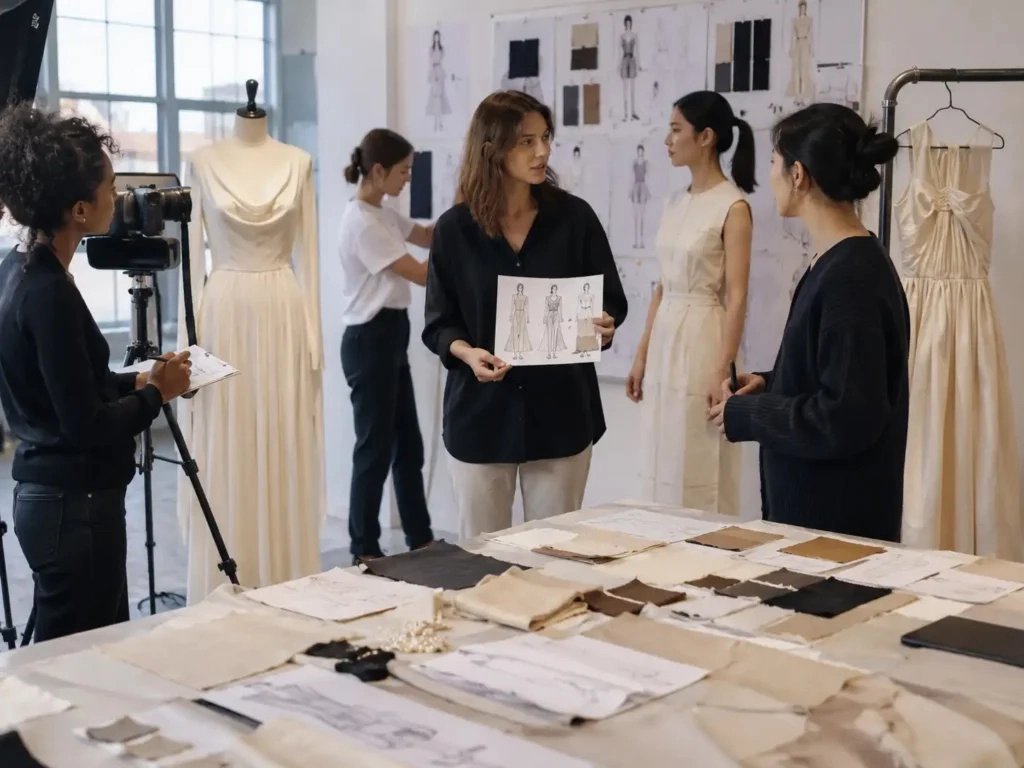
How to Compare Two Dress Manufacturers Before Placing an Order
Once you have quotations from China and Portugal, compare the two clothing manufacturers on the same specification rather than making the decision from the spreadsheet alone.
Put the two quotations side by side and check what is actually included. If one factory is using stock fabric and the other is costing custom-dyed fabric, the unit prices are not really comparable.
The same applies to sampling, labels, packaging, inspection and freight.
Ask both factories the same practical questions:
- What fabric is included in the quotation?
- What is the MOQ per style and color?
- What happens if the first sample needs revisions?
- How long does fabric sourcing take?
- What is the bulk lead time after sample approval?
- What QC process is used?
- Can the same fabric be reordered later?
- Can the factory increase the quantity if the style sells well?
- Are labels and packaging included?
- Which costs are excluded from the quotation?
What Should You Send a Dress Manufacturer?
You do not need a perfect tech pack before starting a conversation.
If you have one, send:
- Tech pack
- Size chart
- Fabric specification
- Color requirements
- Construction details
- Label requirements
- Packaging requirements
- Target quantity
- Target delivery date
A clear product photo, sketch or reference garment can be enough for an initial discussion. Once the style is shortlisted, the factory can help identify the measurements, fabric details and construction information needed for sampling.
A clear starting specification also makes the initial costing more accurate because the factory has fewer details to estimate.
Frequently Asked Questions
Can you use the same fabric supplier when producing in China and Portugal?
Not always. If you already have a preferred fabric, send the fabric details or supplier information to both factories before sampling. They can check whether the same material is available, what the supplier MOQ is and how quickly it can be delivered.
What happens if the factory cannot meet the original delivery date?
First find out where the delay happened. Fabric arrival, trim delivery, sample approval and production capacity can all affect the schedule, and each one needs a different solution. Ask the factory which stage is delayed and whether part of the lost time can be recovered before changing your launch date.
Should you place one large order or several smaller orders?
If the style is new, a smaller first order can make sense because you are still testing demand. For an established style, a larger run may improve production efficiency. We would compare the unit-cost saving with the extra inventory before recommending a larger quantity.
How should you handle different size ranges between suppliers?
Give every factory the same size chart and grading information. Otherwise, you may end up comparing samples that were made to different measurements. For a fitted dress, an approved reference sample is also useful because it gives the factory something physical to check against.
What should you do if the first sample looks right but the fabric feels different?
Hold the bulk approval until the fabric has been checked. Compare the composition, weight, width, finish and hand feel with the approved sample. Even when two fabrics have the same composition, differences in weight or finishing can change how the dress hangs and fits.
Conclusion
China and Portugal can both work for dress manufacturing. The better fit depends on the actual order behind the quotation.
If you are developing several styles, need broader material sourcing or expect production to grow, China may give you more flexibility.
If your business is mainly European and keeping production close to your market is a priority, Portugal may be worth considering.
Before placing the order, put the two quotations side by side and check the same dress specification, fabric, MOQ, sampling process, bulk lead time, QC requirements and landed cost.
Explore More Dress Manufacturing Services
If you are developing a new dress and need support with fabric selection, internal construction, sampling, and bulk production, an experienced clothing manufacturer can help you deal with these decisions before they become production problems.
At Xiuyu Apparel, we work with fashion brands, startups, designers, and private label companies from sample development through bulk production.
- Chiffon Dress Manufacturer
- Evening Dress Manufacturer
- Satin Dress Manufacturer
- Halter Dress Manufacturer
- Maxi Dress Manufacturer
Planning Your Next Dress Collection?
If you already have a dress style, tech pack or reference sample, send us the details. Our team can review the fabric, construction, quantity and production requirements and let you know what information is needed for sampling and bulk production.

